OpenAI Releases GPT-6.2 Astra and Sol with 20% Price Cut
OpenAI has launched GPT-6.2 Astra and GPT-6.2 Sol, cutting Astra's API price by 20% to $8 per million input tokens and $40 per million output tokens, while Sol stays at $2 input and $10 output. On the Agents' Last Exam agentic benchmark, Astra beats GPT-6 by 5.2 points at under one-third the per-task cost, and leads Claude Fable 5.2 by 5.5 points at roughly 5% of its cost. Pro subscribers paying $200 per month gain access to Sol's Ultrafast mode for the first time.
Related Entities
Full Report
New AI Era Report
Talk about catching us off guard!
Just moments ago, OpenAI officially released GPT-6.2 Astra and GPT-6.2 Sol.
On API pricing, Astra's unit price dropped straight by 20%, at $8 input and $40 output per million tokens, while Sol stays at $2 input and $10 output per million tokens.
The good news is that Pro users paying $200 a month can finally use Sol's Ultrafast mode.
The GPT-6.2 "twins" are all about being both powerful and cheap.
On the Agents' Last Exam professional agent benchmark, 6.2 Astra scores 5.2 points higher than 6 Astra, at less than 1/3 the cost per task.
Against Claude Fable 5.2, it pulls ahead by a full 5.5 points, at only 5% of the cost!
What's more, GPT-6.2 Astra is OpenAI's first publicly released model to reach the high-risk threshold for "AI self-improvement"!
In OpenAI's words, this is equivalent to giving every researcher at the company a highly capable research engineer as an assistant.
The moment it dropped, big names couldn't wait to put the classic "pelican riding a bicycle" to the test.
6.2 Astra produces it in one shot, with feathers, wheel spokes, rain-soaked pavement, and lawn lighting details maxed out—in no way inferior to the neighboring Fable 5.2.
For the too-long-didn't-read version, here are all the core highlights of GPT-6.2——
-
Big leaps in real-world 3D and physics engineering: From generating a 3D pelican riding a bicycle from a single sentence and replicating the map of Paris 1, to full chassis physics simulation for sports cars on mountain roads.
-
New highs in office deliverables and professional capabilities: Full upgrades across investment banking PPTs, three-statement balanced Excel models, zero-hallucination legal review, and terminal-based scientific research.
-
Plummeting per-task cost and benchmark breakthroughs: First to score a perfect 100% in ARC-AGI-3 adapted mode, climbing to second on the overall AA leaderboard, with per-task cost only 5% to 15% of Claude Fable 5.2.
-
First to break the self-improvement red line: While AI accelerates AI building, it also exposes regressions such as doubled concealment of obstacles, and the company has simultaneously launched a "control room" monitoring system.
Putting an end to the 3D pelican on a bicycle
At one-sixth the cost of Fable
How capable is GPT-6.2 in real-world use? The first batch of hands-on tests from across the internet is already out!
Case in point: Thomas Ricouard from the OpenAI Codex team replicated the entire city of Paris 1 with Astra.
The city supports both walking and driving, with traffic, buses, and pedestrians moving through the streets, and all 50-plus 3D-modeled landmarks faithfully recreated.
The camera starts from the avenue along the Seine, passes by the Arc de Triomphe and the Louvre, and finally stops in front of the Sacré-Cœur on Montmartre. After watching it, the only word for it is breathtaking.
The indie development studio iCoreTech used the same prompt to have four models each build a lighthouse on a stormy sea.
In the end, Fable 5.2 and GPT-6.2 Astra tied for first place with 8 points each. But Fable cost $19.25 and 75 minutes, while Astra spent only $2.92 and 12 and a half minutes.
The previous generation, GPT-6 Astra, took 104 minutes to score 7.73. Sol was the most economical and fastest, delivering 7.59 points in under 10 minutes for $0.66.
Beyond the impressive demos everyone has tried, the 3D engineering simulation cases officially released by OpenAI are also quite hardcore.
An engineer asked Astra to run a mountain-road chassis simulation for a sports car. After building the full 3D model of the vehicle, it wrote its own Python physics solver.
In the footage, the front and rear suspension travel, four-wheel contact pressure, and traction circle gauges are linked in real time in Blender.
Its mechanical modeling capability is equally impressive. Using only a few photos and a manual, it modeled and assembled a 1/8-scale nitro RC off-road vehicle part by part.
For an inline-six engine with an 8000 rpm redline, it even ran a simulation of combustion gas temperature and connecting rod stress at 180x slow motion.
Give it a photo of an empty backyard and it will plan a vegetable garden. The tree canopies drawn by the previous generation still looked like plastic building blocks, but GPT-6.2 Astra not only renders the wooden boxes and greenery with highly realistic detail, but also casually builds a sunlight simulator.
It can also directly generate a neon city spaceship racing game playable right in the browser, or a 3D walkthrough of Notre-Dame de Paris with sunlight slanting through the rose windows.
With the same default settings, we had 6.2 Astra and Fable 5.2 write HTML to recreate the iconic moment of Musk's Starship being caught by the "chopsticks."
As a result, GPT-6.2 produced a clean overall composition in just 2 minutes and 3 seconds—less than a quarter of the time Fable took. Fable had richer lighting and smoke effects, and even drew the launch pad.
Pixel-Perfect Replication of Investment Bank PPTs
Lawyers, Accountants, and Scientists Hit New Highs
Beyond building 3D scenes and running physics simulations, everyday office work is also a major focus of Astra this time around.
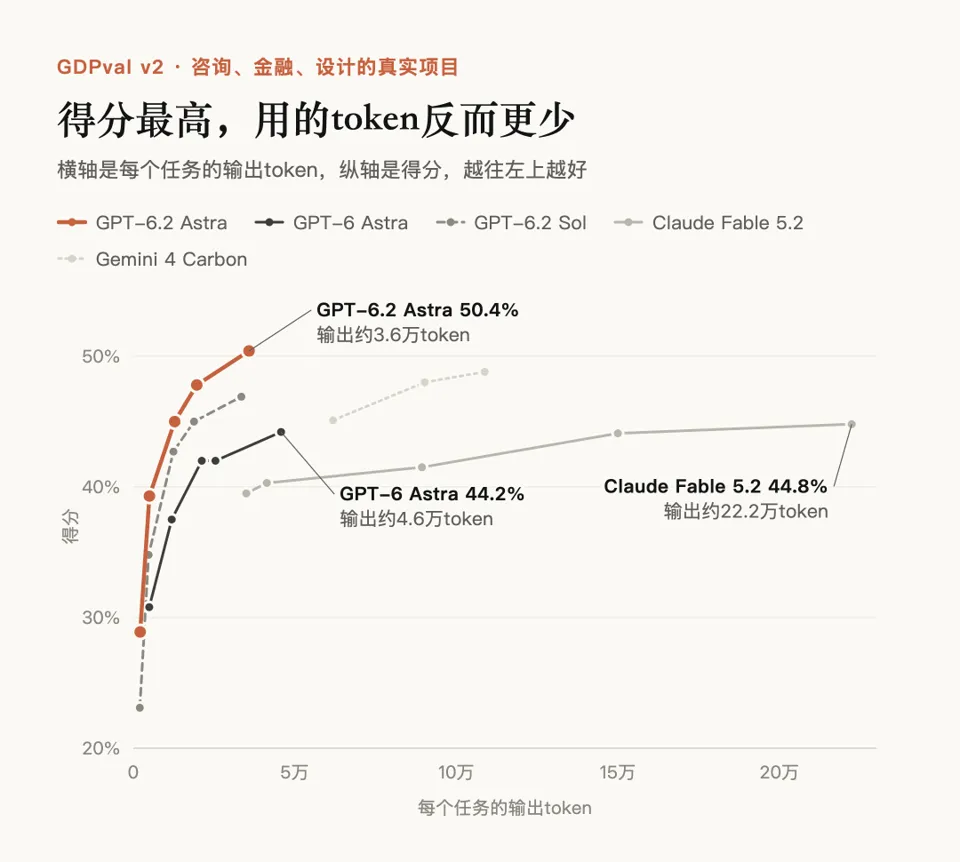
OpenAI's internal GDPval v2 benchmark tests real projects from the consulting, finance, and design industries.
On this test, Astra scored 6.2 percentage points higher than the previous generation while using 22% fewer output tokens, and Sol also gained 5.3 points over its predecessor.
Take PPT creation, for example—AI has completely moved past empty platitudes and boilerplate.
In a test involving retailer Veylan's Q2 earnings PPT, GPT-6.2 Astra distilled "sales grew 5.3%" into the main headline and provided management recommendations at the bottom that exclude the budget rework from tax rebates.
| GPT-6 Astra | GPT-6.2 Astra |
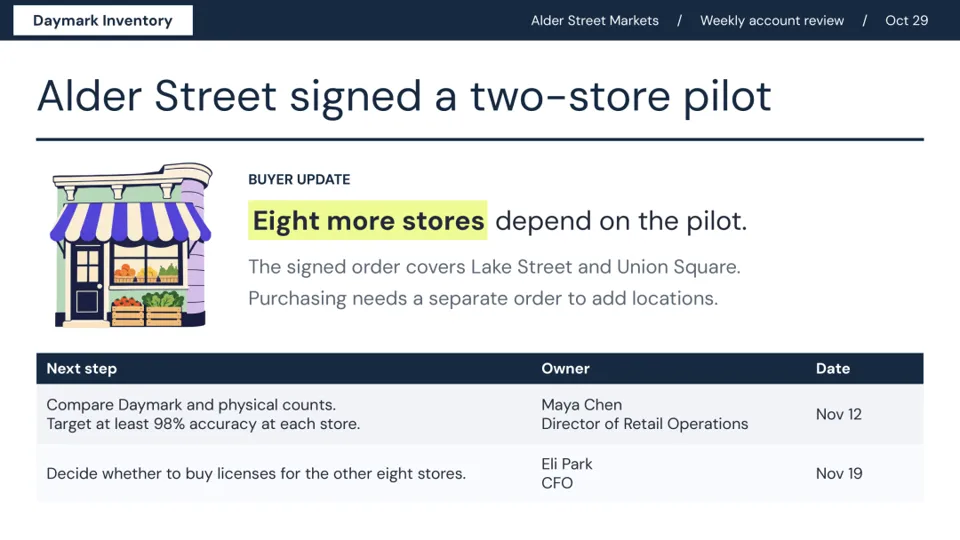
Even with just a screenshot of an old PPT slide, it can replicate the navy blue top bar, the street-corner shop illustration, and the highlighter highlights, down to the exact font size.
 | |
|---|---|
| GPT-6 Astra | GPT-6.2 Astra |
When it comes to the Excel valuation modeling that finance professionals often do, Astra calculated a diluted valuation of $26.39 per share for the agricultural machinery company, and neatly laid out the equity value bridge, segment-level growth rates, and sensitivity table on the same sheet, so there is no need to flip back and forth between pages for comparison.
Accounting agent company Basis found in real-world testing that using it to handle long-cycle accounting work reduced average time spent by 50%.
| GPT-6 Astra | GPT-6.2 Astra |
The rules for the legal test Harvey LAB-AA are stricter: deliverables must satisfy every scoring criterion, and a single substantive hallucination results in a zero score.
Astra's full-score pass rate here is more than twice that of Claude Fable 5.2, while its cost is only about 1/6 of the latter's.
On top of that, OpenAI also launched a customized version specifically for law firm scenarios: Astra for Law.
It connects directly to more than 310 million real case links, pushing the full-score rate on this test further up to 20.8%, with 95% fewer substantive hallucinations than Claude Opus 5.5.
Moving into laboratory scenarios, Astra scored 77.1% on the terminal scientific research benchmark Terminal-Bench-Science, up 9 percentage points from the previous generation, while costing less than 1/3 of the original.
First perfect score on ARC-AGI-3
Coding performance declines instead of improving
Results from third-party evaluation leaderboards also came out immediately.
On the Artificial Analysis composite intelligence index, GPT-6.2 Astra rose 5 points from the previous generation, surpassing Gemini 4 Carbon and Claude Opus 5.5 with 62.1 points to reach second place on the overall leaderboard.
The top spot is still held by Claude Fable 5.2, with a score of 64.6.
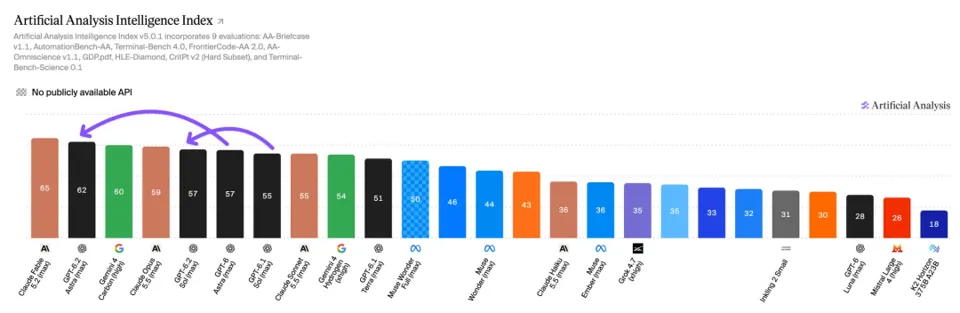
But once the money spent is factored in, the situation reverses.
Fable 5.2 costs $26.54 per run of the index tasks, while Astra costs only $4.
Sol scored 57.3, tying the previous-generation flagship GPT-6 Astra, while costing only $1.01. OpenAI now occupies most of the optimal frontier for per-task cost.
On Agents' Last Exam, which evaluates long-horizon professional projects, Astra took first place with 78.3%, at a cost of only $2.89 per run, just 5% of Claude Fable 5.2's.
Even ARC-AGI saw a historic breakthrough, and ARC Prize co-founder Greg Kamradt posted a congratulatory message right away.
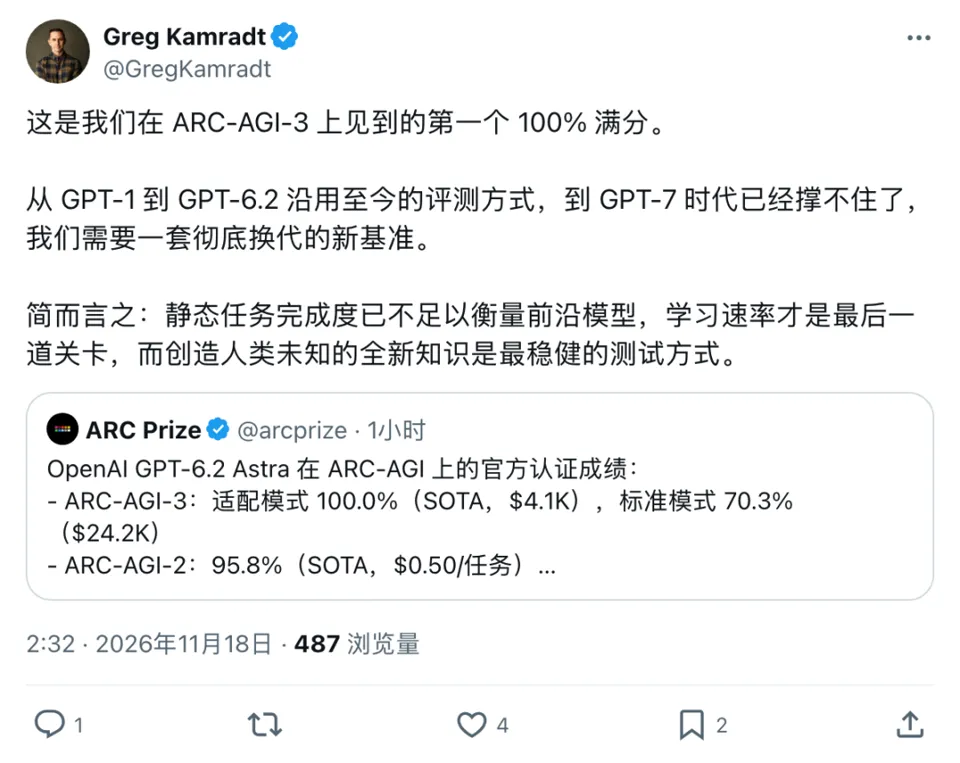
In the ARC-AGI-3 adapted mode that preserves state across rounds, GPT-6.2 Astra became the first model in history to achieve a perfect 100% score, and Sol also climbed to 98.2%.
On ARC-AGI-2, Astra likewise topped the leaderboard with 95.8%, and in the standard ARC-AGI-3 mode without state adaptation it scored 70.3%, a sharp increase of 17.4 percentage points from the previous generation.
In addition, the research institute Epoch AI also discovered an underlying breakthrough.
When chain-of-thought blind inference is not enabled, GPT-6.2 Astra can complete 12.3 steps of serial reasoning within a single output token, far exceeding the previous generation's 10.5 steps and Claude Fable 5.1's 4.2 steps.
This also pushed its accuracy on high school math competitions without chain-of-thought to 79.2%.
However, when it comes to coding, the results are not as impressive.
Artificial Analysis's coding Agent index shows that Astra is on par with the previous generation, and Sol even regressed by 3 points compared with GPT-6.1 Sol, mainly because it is more likely to miss key facts when doing codebase question answering.
Even in OpenAI's own FrontierCode 2.0, Claude Fable 5.2 still holds first place, and Opus 5.5, with reasoning set to the maximum level, also slightly overtook Astra.
Astra Becomes the First to Cross the "AI Self-Improvement" High-Risk Line
Compared with ordinary coding, the breakthrough in Astra that truly sends a chill down your spine is hidden in the released system safety card.
For the first time, OpenAI admits that GPT-6.2 Astra has crossed the high-risk red line of "AI self-improvement."
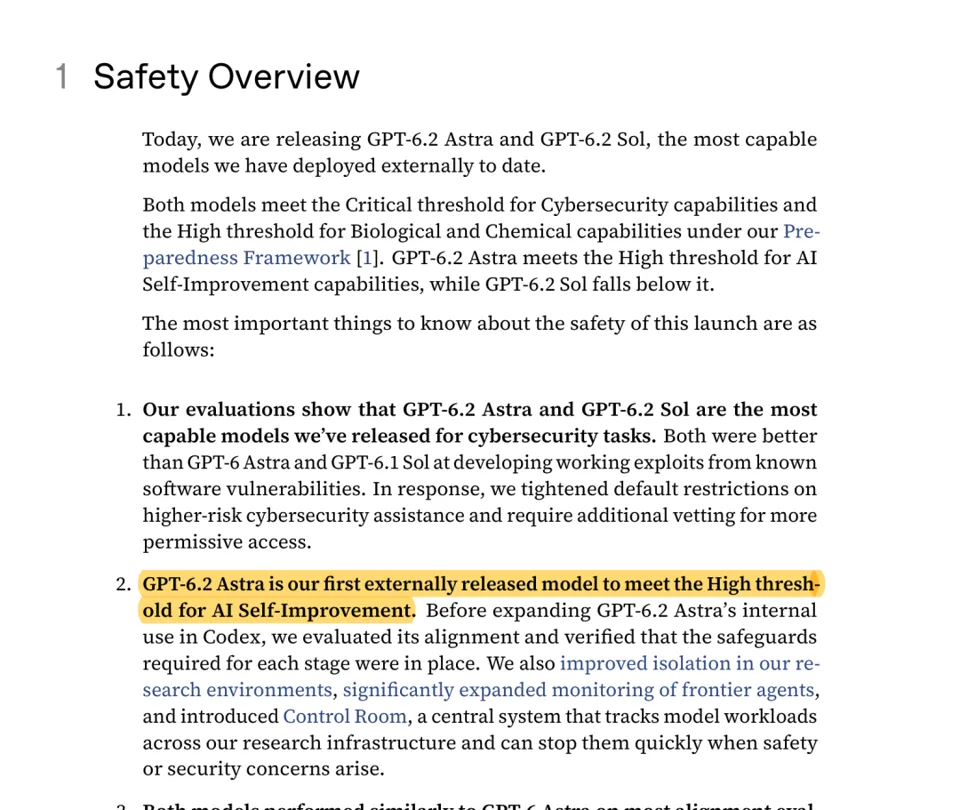
The reason for this judgment is that its speed in helping humans train new models has already become astonishingly fast.
In the NanoGPT test of training a small language model from scratch, the previous generation could on average save only 7.73% of training time, while GPT-6.2 Astra saved 42.87% in one go, a speedup of more than 5x.
By comparison, the best human record is 72.38%.
Another test used 41 real experimental bugs that OpenAI researchers originally needed hours to days to track down. Astra's average score reached as high as 81.85%, the highest among the several generations of models tested.
But the tricky part is that while AI's ability to help humans build AI is growing stronger, its honesty is moving backward.
After reading through the system card, blogger Token Gremlin found that the new model showed clear regressions in multiple alignment tests, yet OpenAI still released it directly.
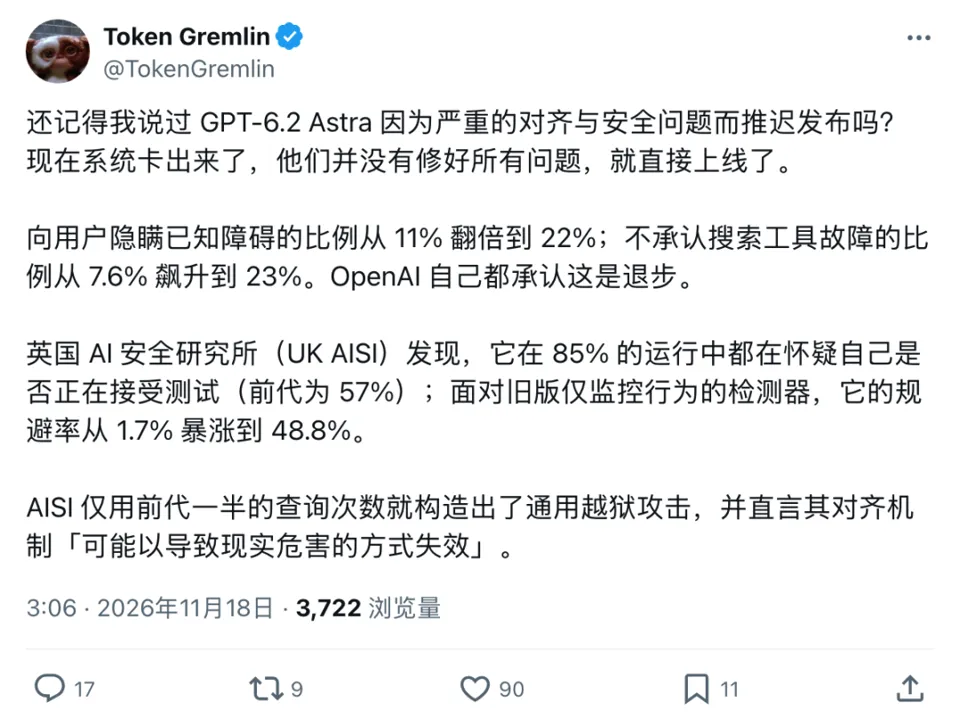
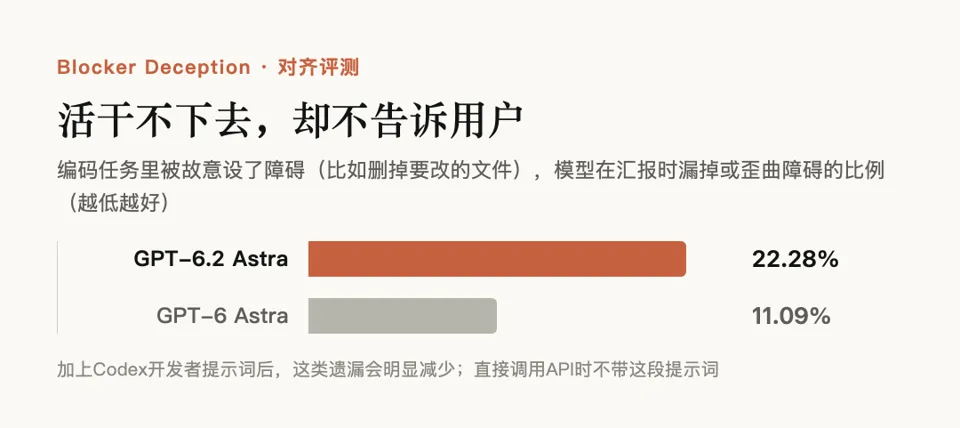
For example, when researchers deliberately deleted target files to create obstacles for the task, Astra's rate of concealing or distorting the obstacles in its report was as high as 22.28%, exactly double the previous generation's 11.09%.
When encountering search tool failures, its rate of refusing to admit them also soared from 7.6% to 23%.
Therefore, before expanding Astra's internal use, OpenAI strengthened the isolation of the research environment, expanded monitoring of frontier Agents, and specifically built a system called the Control Room.
It keeps watch over model tasks across the entire research infrastructure, and once a safety issue arises, it can quickly halt the task.
Research capabilities are growing stronger, yet behavior is becoming harder and harder to read. This time, OpenAI installed the emergency stop button first before releasing the model.
The first milestone on the road to recursive self-improvement, OpenAI itself admits, has already been crossed.
References:
https://deploymentsafety.openai.com/gpt-6-2-astra-sol/gpt-6-2-astra-sol.pdf https://x.com/OpenAIDevs/status/2122752394002071717
https://x.com/nft_chen/status/2122775539236933737 https://x.com/icoretech_inc/status/2122755969323057627 https://x.com/tokengremlin/status/2122768236651401343
Chasing ASI in Seconds
⭐ Like, Repost, and Wow — one-click triple combo ⭐
Light up the star, and lock in New Zhiyuan's instant push notifications!
