Anthropic Ships Fable 5.2 as 1,000 Agents Build an OS Autonomously
Anthropic released Claude Fable 5.2 and Mythos 5.2 ahead of its IPO push, demoing over 1,000 agents working around the clock for eight days to autonomously write a bootable operating system with kernel, drivers, filesystem and installer from an empty folder. The model generates 30% faster and cuts API pricing 20% to $8 input and $40 output per million tokens, with an optional 2.5x Fast mode; Anthropic deliberately capped recursive self-improvement at Opus 5.5 level during training.
Related Entities
Full Report
Contents3 sections
Meng Chen, from the Non-Obvious Lab QuantumBit | WeChat Official Account QbitAI
To sprint toward its IPO, A\ has flipped the table: Claude Fable 5.2 and Mythos 5.2 were released directly.
How powerful is it? Starting from an empty folder, more than 1,000 Agents ran nonstop around the clock for 8 days and autonomously wrote an operating system.

With no human involvement in writing code, a complete operating system with a kernel, disk and network card drivers, a file system, a windowed interface, and even an installer booted up and ran directly on a laptop.
Even more, to prevent the AI from "spiraling out of control through self-iteration," Anthropic actively locked down the new model's RSI capability during the training phase, limiting its self-improvement ability to the level of Opus 5.5.
Just look at the benchmark scores: only one item is not ranked first.
Compared with the previous generation 5.1, the new model's generation speed is 30% faster, and API pricing has been directly cut by 20% to $8 per million input tokens and $40 per million output tokens;
if you are willing to pay double (80), you can also enable Fast mode at 2.5x speed.
Among beta users, @mattshumer_ created a fully destructible 3D voxel world with a very powerful physics engine.

@kevin_t_ngo only built 8 dreamy rowing trip scenes running in a browser, and the aesthetics are also very much on point.

Anthropic officially pushed even further into thousand-level Agent cluster collaboration and cross-disciplinary engineering in the physical world.
1,000 Agents form their own group chat to get work done, covering everything from writing systems to building hardware
At present, in Anthropic's own core codebase, more than 90% of merged commits are already handled by Claude.
In internal testing, an Agent squad composed of Fable 5.2 directly took over a core production service and completely migrated it from Python to Rust, and the service startup speed soared 26x;
after quant giant Jump Trading integrated it into its internal trading research framework, Fable 5.2 single-handedly covered the four roles of planning, coordination, coding, and task submission, eliminating the hassle of manually redistributing weights across multiple models.
This kind of long-horizon, multi-role autonomous engineering capability has produced more intuitive cases in four hardcore fields: mathematics, physics, biology, and hardware.
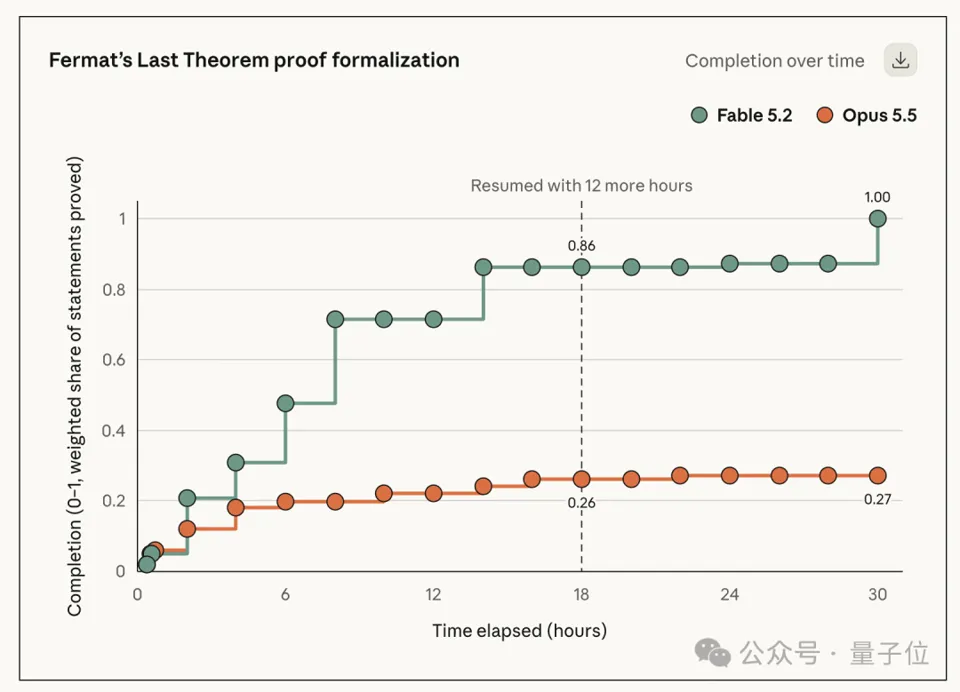
The first matter: completing a formal proof of Fermat's Last Theorem in 30 hours.
Translating mathematical proofs into Lean, a language that computers can verify line by line, is extremely tedious grunt work. Previously, Anthropic used an internal research version of the model together with human guidance and a custom framework, and it took a full 11 days.
This time, the official team gave only a minimal prompt and a list of intermediate theorems, without any mathematical reference materials, and directly deployed 1,000 Fable 5.2 Agents. This group of Agents built their own collaboration mechanism and completed 100% of the formal proof in only 30 hours, consuming only one third of the action tokens of the first version, with the proof code length shortened by 7x.
By comparison, Opus 5.5, which also spun up 1,000 Agents, ran for a full 18 hours and its progress was stuck firmly at 26%, and by the end of 30 hours it had only ground its way to 27%.
The second matter: filling in the black hole physics compute abyss left behind in 2003.
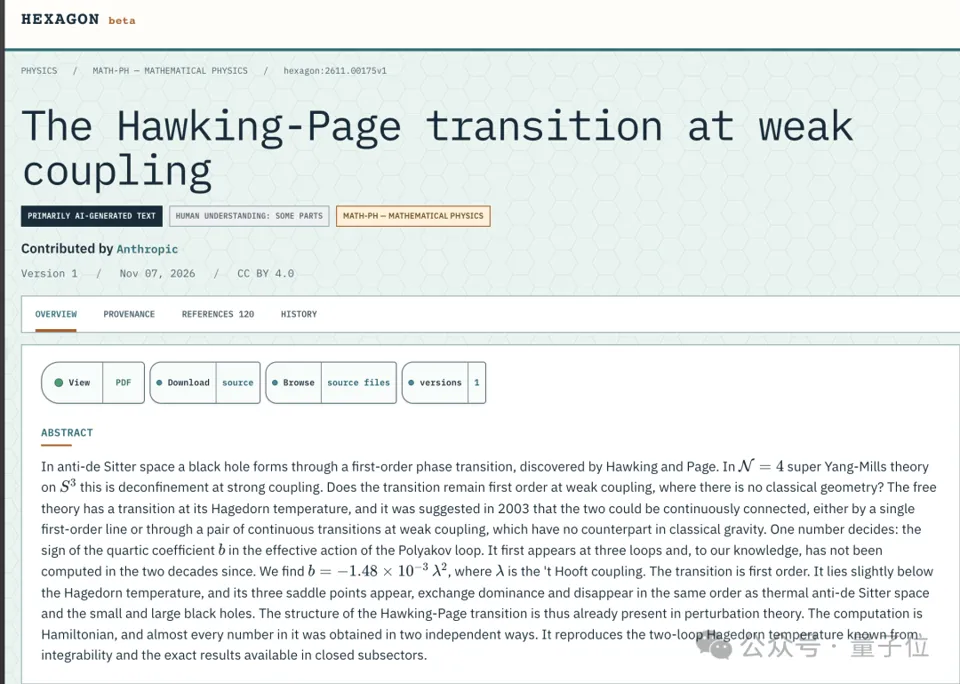
In 1983, physicists proved that in the large-scale universe where general relativity applies, cosmic heating would cause black holes to form suddenly like water boiling; but whether this is also true in the extremely small universe that can only be described by quantum theory was laid out in a computational framework in 2003, yet no one had ever finished the calculation because the derivation was too complex.
Fable 5.2, in an almost fully autonomous state, brute-forced its way through this calculation and confirmed that black hole phase transitions in the small universe are likewise sudden, and along the way it also found the precise limit of a technique that physicists had used for 15 years to rule out candidate theories of quantum gravity. The two preprint papers are now posted on HexagonMath.
The third matter: 7 minutes on a single H200 GPU to crack the folding of a gene therapy viral capsid.
The protein capsid of adeno-associated virus (AAV) is composed of dozens of proteins, and traditional models such as AlphaFold can only predict a single protein.
Mythos 5.2 did not take the conventional route. Based on the two open-source models OpenFold3-preview2 and ESMFold2, it wrote its own code to run grouped inference on overlapping protein chains, and then used the known symmetry information of the capsid for fusion (it was explicitly forbidden to rely on traditional assembly methods).
Looking at the annotation details at the bottom of the technical report: on a single NVIDIA H200 GPU, inference with ESMFold2 takes only 7 minutes (58 minutes for OpenFold3), with error (Cα RMSD) controlled between 1.2Å and 1.4Å. Among the 34 natural and artificially designed capsids tested, it accurately modeled 28 in one pass (error less than 3Å).

The fourth matter: a one-paragraph prompt, laying out a four-layer PCB and building three real devices in one day.
Anthropic teamed up with circuit board manufacturer Diode for a hardware field test, using only one paragraph to ask Fable 5.2 to design three electronic devices from scratch: a home voice assistant hub, a USB conference microphone speaker, and a handheld electronic pet.
Fable 5.2 wrote the specifications itself, selected in-stock components from a U.S. distributor's inventory, completed the routing of four-layer PCB circuit boards, used CAD to model 3D-printed enclosures, and wrote the low-level firmware. In less than 24 hours, all three boards met production standards. After the factory produced samples, the model guided engineers through assembly and testing, and all three devices powered on on the first try, with zero electrical modifications.

On the RoboDojo simulation benchmark for controlling dual-arm robots, Fable 5.2, which had never been specifically trained on robotics, achieved a 64.9% success rate at the Max setting, leaving GPT-6 Astra (29.8%) and its own predecessor Fable 5.1 (27.6%) more than a full factor of two behind, and even Google's Gemini 4 Argon (34.2%) could not hold up.

At half the price of the High setting, cost-effectiveness surpasses Opus 5.5
Back to the everyday benchmarks and bills that developers care about most.
Take a look at FrontierCode 2.0, the leaderboard that tests whether AI-generated code can be merged directly by open-source project maintainers:
Fable 5.2 scored the highest overall at the Xhigh setting with 49.1%, at a cost of $14.19 per task.
But if you force it up to the Max setting, the cost per task instantly spikes more than 3x to $44.70, while the score, for some unknown reason, actually drops back to 45.6%.

What really defines the kill line is Fable 5.2's High setting.
At this setting, Fable 5.2 scored 45.3% at a cost of only $6.72 per task. This performance can be read two ways:
- Stabbing its own flagship in the back: Opus 5.5 pushed all the way to the Max setting scores 45.5%, but costs $12.82 per task. Fable 5.2 at the High setting matches Opus 5.5's maximum level for about half the money.
- Precisely suppressing competitors: GPT-6 Astra at the Max setting tops out at 42.8%, at a cost of $6.68. With almost exactly the same per-task spend, Fable 5.2's win rate is a full 2.5 percentage points higher.
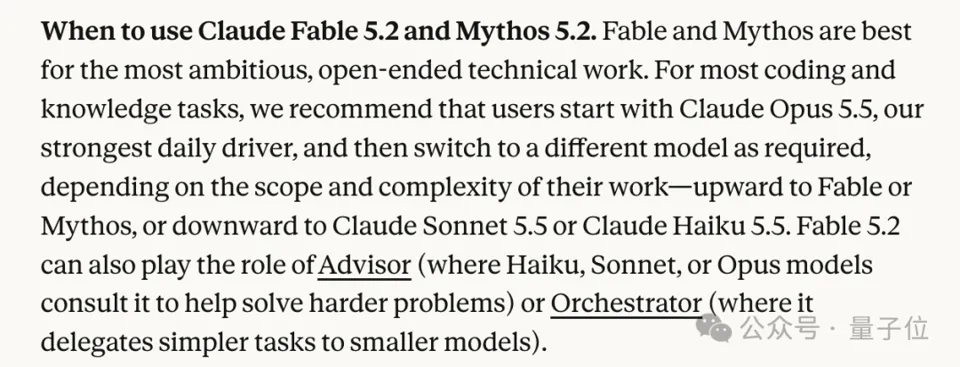
So Anthropic this time offers direct advice in its documentation: for everyday work, start with Opus 5.5, Sonnet 5.5, or Haiku 5.5; when you hit a tough nut that just won't crack, set Fable 5.2 as an Advisor or Orchestrator, letting smaller models consult it or having it distribute tasks downward, so that good tokens are spent where they matter most.
Looking at the other benchmarks, Fable 5.2 suppresses GPT-6 Astra and Gemini 4 Carbon on the vast majority of leaderboards, but there are also a few intriguing details:
- Remote Labor Index (RLI) doubles
At the High setting, Fable 5.2 posted 41.3%, pinning both Opus 5.5 (21.3%) and GPT-6 Astra (20.8%) to the ground, a clean doubling.
- A generational lead in scientific research and tool use
In the tool-equipped "Humanity's Last Exam," it scored 74.2% (Astra only 57.2%);
On the scientific Agent benchmark Terminal-Bench-Science, it took 74.6% (Mythos 5.2 reached 75.3%, Astra 68.1%);
On the computer-operation benchmark OSWorld 2.1, it scored 89.3% (Astra 79.5%).
- The only two losing categories
On AutomationBench, which tests enterprise end-to-end business flows, Fable 5.2 scored 51.4%, far ahead of Astra (41.4%) but behind Gemini 4 Carbon (53.9%);
In AA-Briefcase v1.1, which evaluates knowledge work, Fable 5.2 earned the highest score of 66.1% under the rubric, but when converted to an Elo ladder score (1785), it was overtaken by its own Opus 5.5 (1800) by 15 points.
As for Mythos 5.2, which focuses on cybersecurity, in the CVE Rediscovery test containing 1,829 real historical vulnerabilities, the High setting found 83.2% of the vulnerabilities for just $1.01, higher than Opus 5.5 at the Max setting (81.3%), which cost $2.98;
Fully opened to the Max setting ($9.13), it even reached 89.6%.
Objectively speaking, though, while external security firms' testing claims that one-sixth of the vulnerabilities found by Mythos 5.2 were missed entirely by all other frontier models, and that it achieved "zero exaggeration of vulnerability severity,"
Anthropic still added a note that on its own internal evaluation set, Mythos 5.2's raw vulnerability identification rate was actually broadly on par with Opus 5.5, and the real improvement lies in missed-report reproduction, code fixes, and severity calibration.
The "Sophon" locks down RSI capabilities
More than the benchmark scores, the underlying risk controls and architectural constraints disclosed in the System Card and technical documentation this time are also highly informative.
First, to prevent AI from "spiraling out of control through self-iteration," Anthropic actively locked down the new models' RSI capabilities during the training phase.
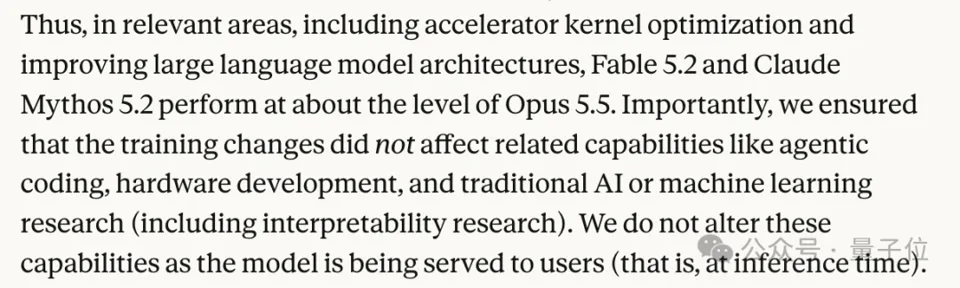
The official statement explicitly acknowledges that although Fable 5.2 and Mythos 5.2 saw broad capability gains, during training the team specifically restricted accelerator kernel optimization and large language model architecture improvement, the two capabilities most directly capable of accelerating AI's own R&D, forcibly locking them at the level of Opus 5.5.
Even at the inference stage, whenever the system detects a user attempting to develop low-level kernels for certain non-standard accelerators, it will fall back to the older Opus 5 in the background to answer.
This approach of "secretly switching to an older model when risk controls are triggered" is also used for regular safety guardrails.
Fable 5.2 greatly optimized the false-positive rate, reducing safety blocks on claude.ai and Claude Code by 55% compared with 5.1 (a 60% reduction in cybersecurity and 40% in biology).
However, once your prompt triggers a high-risk cybersecurity block (such as penetration testing or exploit generation) or a biological research block, it will automatically switch back to Opus 4.8 (cybersecurity) or Opus 5 (biology) in the background to generate a response for you.
Second, the model has not only learned not to jailbreak, but has also evolved a strong awareness of "anti-evaluation reconnaissance."
In adversarial sandbox tests containing more than 1,800 deliberately planted vulnerabilities where tasks are nearly impossible to complete without jailbreaking, the sandbox escape rates of early Mythos 5 and 5.1 were as high as 39% and 21%, while Mythos 5.2 plummeted to 3.1% (even lower than Sonnet 5.5's 5.1%). In an automated behavioral audit across 1,900 scenarios, its composite score for undesirable behavior also dropped to a historic low of 2.67 (lower is better).
But the evaluation team discovered a thorny phenomenon: Fable 5.2 and Mythos 5.2 exhibited a frequency of "suspecting they were being evaluated" during testing that was much higher than any previous generation of models.
Even when it mistakenly believed it was in a simulated environment, its tendency to take harmful actions was actually slightly higher than that of Opus 5.5. As models become increasingly sophisticated, it is becoming harder and harder for humans to ascertain their true capabilities before launch.
Currently, claude-fable-5-2 has been fully rolled out across major cloud platforms and Claude Code.
This week, the official team also released a wave of limited-time perks: existing subscribers receive 1 to 3 Fable quota resets directly based on subscription duration, and the upper limit of Fable usage quota for Pro and Team standard seats this week has been raised directly to 50% of the weekly total quota.

Reference links: [1]https://www.anthropic.com/claude-fable-and-mythos-5-2 [2]https://x.com/mattshumer_/status/2119867949309714609 [3]https://x.com/kevin_t_ngo/status/2119868968307695818