Zhipu AI Releases GLM-5.4 with First Loop Transformer Architecture
Zhipu AI has released GLM-5.4, its first model built on the new Loop Transformer architecture, showing clear gains in code generation and real-time front-end rendering, including end-to-end autonomous MV creation. Overseas developers call it among the best open models available, and Zhipu says weights will be open-sourced after safety hardening.
Related Entities
Full Report
Contents3 sections
Made an MV with pure code!
Jin Lei, from Aofei Temple Quantum位 | WeChat Official Account QbitAI
A brand-new model, a brand-new architecture.
Just moments ago, Zhipu unveiled its first model built on the Loop Transformer architecture — GLM-5.4 — and it made a dazzling debut!

Let's jump straight into the recently viral code-made video and see what GLM-5.4 can produce:

Video link: https://mp.weixin.qq.com/s/ln8fIodXFxbow3kanPhcxA
This MV, titled "Hello World", was created by creator Mike Luan using GLM-5.4, covering the entire pipeline from concept, arrangement, and storyboard dynamics to visual rendering.
More specifically, all visuals are drawn in real time using front-end code (zero external image assets), while the music was planned by GLM-5.4 based on the chapter narrative and shots, which then called a third-party music generation model to produce it, autonomously completing multiple rounds of music prompt iteration and revision.
Now this MV has gone viral overseas, with netizens even exclaiming:
A bit beyond expectations.

Let's also look at GLM-5.4's take on the classic 3D pelican riding a bicycle "Benchmark":

Video link: https://mp.weixin.qq.com/s/ln8fIodXFxbow3kanPhcxA
Clear improvement, clear improvement.
And speaking of improvement, quite a few netizens have already posted comparisons between GLM-5.3 and GLM-5.4:

Video link: https://mp.weixin.qq.com/s/ln8fIodXFxbow3kanPhcxA
The visual improvement is obvious enough — but what about the scores?
Yes, friends, there are scores.
Some overseas netizens, after using GLM-5.4 for a while, spoke their minds directly:
Currently the best open-source model you can use!

Remember the Loop Transformer we mentioned earlier?
With it added, it becomes obvious at a glance why the visual results improved so dramatically:
This time, Zhipu has framed this upgrade under the concept of generalized Coding — and you can feel that positioning from the singing letters all the way to the pelican out for a ride.
And on the speed front, there's something worth noting too.
According to official Zhipu data, it can reach up to 200 Token/s during off-peak hours, and 70–80 Token/s during peak hours.
Next, let's continue looking at more of GLM-5.4's results.
As Usual, Let's Start with the Results
First, let's look at GLM-5.4's performance on interactive HTML:
This case is themed "Rainy Night Convenience Store", where the whole street looks like a miniature model placed on a table.

Video link: https://mp.weixin.qq.com/s/ln8fIodXFxbow3kanPhcxA
Judging from the details of zooming and angle transitions, the effect achieved by this HTML is already far more refined than what AI could do just a few months ago.
Moreover, details like the convenience store door opening automatically and the product displays inside the store are all fully visible.
So you can see that for this task, GLM-5.4 is already handling things with great ease.
Next, let's raise the difficulty and look at its 3D capabilities inside professional software.
This time it's a Blender modeling and lighting control panel, with the scene set in a brick-built Gringotts:

Video link: https://mp.weixin.qq.com/s/ln8fIodXFxbow3kanPhcxA
You can first look at the fire dragon lying on the rooftop in the video — click "Dome Dragon" on the left, and the camera pulls to the roof; then drag "Flame Intensity" to the right, and the fire in the dragon's mouth brightens accordingly.
The scene also presets three lighting setups — "Bright", "Dark Night", and "Golden Hall" — and if anywhere feels too dark, you can adjust it individually. The whole workflow remains remarkably smooth.
Having seen scene-building, let's look at a playable Coding to Game.
This time, we had GLM-5.4 open a 3D burger shop:

Video link: https://mp.weixin.qq.com/s/ln8fIodXFxbow3kanPhcxA
As you can see from the results, this game made by GLM-5.4 has fully reached the level of a web mini-game.
The entire flow — from greeting customers, taking orders, prepping ingredients, to serving dishes — all the detailed operations are on par with the mini-games we encounter in daily life.
Finally, we also ran a problem in ZCode that is more commonly encountered when modifying software in everyday work—adding version history to an existing manuscript dashboard.
The project can already edit and save manuscripts, and there are four old drafts in the database. Our requirement was that after the upgrade, these four drafts should still be in place, a version should be saved with one click, and it should be possible to restore an earlier version if needed. The permissions for authors and read-only accounts should also remain the same as before.

After the run was completed, all four original drafts could still be opened, and a "Version History" section appeared below the edit box. For drafts that had not yet been modified, clicking in also showed an "Initial Version":

So from the results, we can see that GLM-5.4 handles all kinds of tasks steadily and reliably.
The First Loop Transformer Architecture
Now that we have seen the results, let's talk about the Loop Transformer architecture that Zhipu unveiled for the first time this time.
As we know, when generating a token, an ordinary Transformer passes information from front to back layer by layer, with each layer computing once. This time, Zhipu modified the middle 28 layers of the model. After this group of layers finishes its first pass, the result is sent back to the starting point, and the same set of weights is used to compute a second pass before it is handed to the later layers.
This is the Loop in GLM-5.4. The same group of layers does one more round of work, so before generating the next token, the model can process the result it just computed once again. Because both rounds use the same set of weights, the model's parameter scale also remains basically at the original level.
So the question is: how much improvement can this extra pass actually bring?
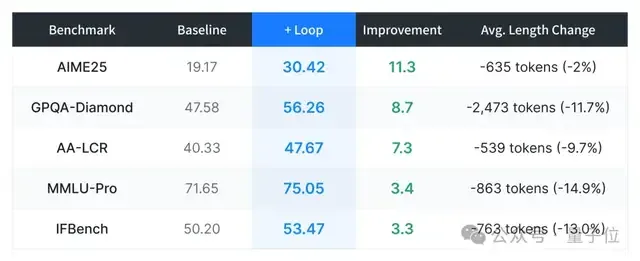
Zhipu ran a controlled experiment with a 30B model under the same parameter count. After adding Loop, the overall training compute increased by about 10%, and the AIME25 score rose from 19.17 to 30.42.
Looking further, the GPQA Diamond score also rose from 47.58 to 56.26, while the average number of output tokens used by the model dropped by 11.7%. The situation on MMLU-Pro was similar: the score rose from 71.65 to 75.05, and the average output tokens dropped by 14.9%.
In other words, in this controlled comparison, by doing one more round of internal computation, the model was sometimes able to answer some questions more accurately with fewer output tokens.
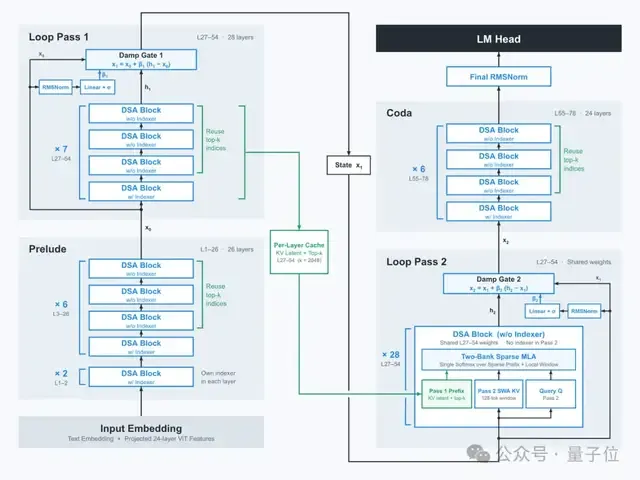
However, when actually installing Loop into the 750B-level GLM-5.4, Zhipu still had to deal with one problem. The original base model had already been trained, and now an extra pass was being run in the middle. How much of the result from the first pass should be kept, and how much should the second pass change?
Zhipu's approach was to add a gate to each of the two rounds to regulate how much of each round's computation result would be written back. In the trained model, the first round tends to sort through the global context first, and the amount written back is relatively small; with that result as a foundation, the second round then performs finer processing, and the amount written back is accordingly increased.
At the deployment stage, there is also a memory overhead. The context the model has read has a cache called KV Cache, which can be retrieved directly when needed later. If both rounds each stored a copy, then as the context grows longer, memory could easily be taken up by these caches.
So Zhipu split the cache by distance. For content farther away from the current token, the two rounds share one copy; only for a small recent segment of content in front do the two rounds each store their own copy. Likewise, the first round has already found which positions in the preceding text should be attended to, and the second round can directly use the sparse attention indices it left behind.
In this way, even when the context is extended to 1M tokens, the second round only needs to reserve an extra cache for that small segment of content within the sliding window.
Zhipu Took Loop to 750B
Actually, making the same group of layers run in a loop was already explored by the Universal Transformer in 2018. What Zhipu did this time was take the route of adding Loop through post-training on an already pretrained base model. After validating from 1B to 4B to 30B, Zhipu ultimately applied this structure to the 750B-level GLM-5.4.
Going from 30B upward was really a different matter from the earlier controlled experiments. If you get a score increase on 30B, you know that this group of layers can be used for one more pass. But at 750B, you already have a trained large model in hand, and you need to make it adapt to the second round of computation while also making the modified model run online. The gating, caching, and index reuse discussed above are exactly the adjustments Zhipu made for Loop along this path.
This is also what I find quite interesting about GLM-5.4 this time. A domestic model team took an architecture modification plan of its own choosing all the way from experiments on small models to a flagship launch. Zhipu still has larger base models to build next, so this approach has the opportunity to continue being tested upward.
As for the "pan-Coding" Zhipu mentioned, looking back at that Gringotts, what I most want to take a closer look at are actually those sliders on the left.
The fire dragon has already been made, and users can still use the same page to switch camera positions, adjust lighting, and view rendered images. When you want to see what the underground vault looks like a bit darker, you can just click twice yourself. At this point, the code can already help users connect several operations in professional software into a tool that can be reused.
Zhipu says the base model for GLM-5.5 will continue to be scaled up. By then, on the one hand, we can see how much more improvement this Loop can bring when put in; on the other hand, we can also hand work like Gringotts to it again and see how far it can go on its own from understanding requirements to connecting operations in software.
Oh, and there is also the open source everyone cares about.
Zhipu stated that GLM-5.4 will open-source its model weights after completing the necessary security hardening.