OpenAI Launches ChatGPT Wallet for Agent-Driven Purchases
OpenAI has launched ChatGPT Wallet, letting AI agents place and pay for online purchases on behalf of users, starting with Pro subscribers in the US. Each payment requires Face ID or fingerprint authorization, and card details are tokenized via partners such as Visa and Mastercard so merchants never see real card data. The move puts OpenAI in catch-up mode against Anthropic, Meta, and Google, which already offer agent shopping features.
Full Report
Contents3 sections
OpenAI rebuilt AI shopping from scratch with ChatGPT Wallet
[Maximilian Schreiner](https://the-decoder.com/author/maximilian-schreiner/) [View the LinkedIn Profile of Maximilian Schreiner](https://www.linkedin.com/in/maximilian-schreiner-b6a5171aa/) Nov 13, 2026 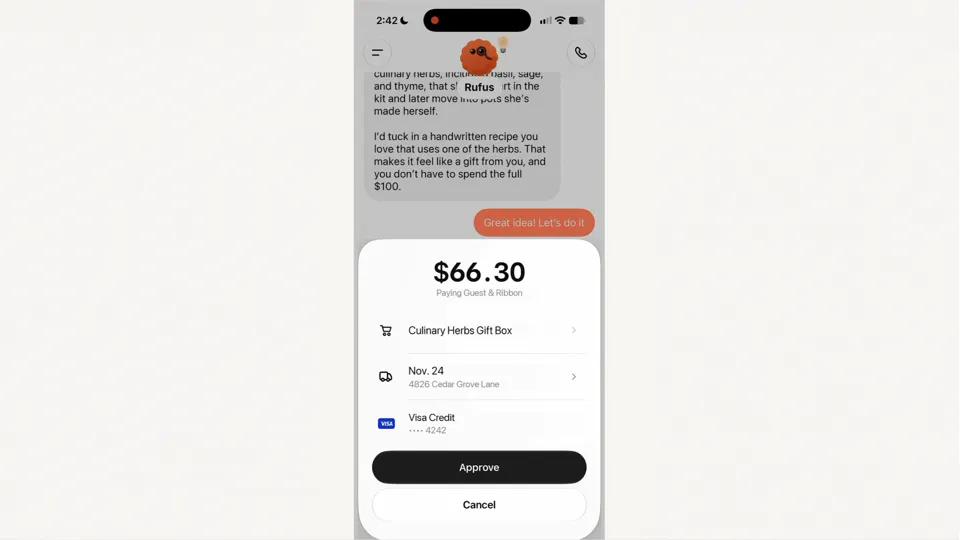
OpenAI
Key Points
-
OpenAI's new ChatGPT Wallet lets AI agents make and pay for online purchases on behalf of users, launching for Pro subscribers in the US.
-
Every payment requires authorization through Face ID or a fingerprint, and actual card details never reach merchants thanks to tokens generated by partners such as Visa and Mastercard.
-
Competitors including Anthropic, Meta, and Google already offer similar agent shopping features, putting OpenAI in catch-up mode.
Text Ask about this article… Search
OpenAI is taking a second shot at AI shopping with ChatGPT Wallet, catching up with rivals like Anthropic, Meta, and xAI, whose agents can already shop online.
ChatGPT Wallet lets AI agents pay on behalf of users. OpenAI built it after scrapping Instant Checkout, its first attempt at letting people buy directly in the chat, because it wasn't flexible enough. At launch, the feature is available only in the US through Dots. Users must be adults and need a ChatGPT Pro subscription and an eligible US bank card.
To get started, users add their card once. Before every purchase, the system displays the items, the total, and the selected card. Users then approve each payment with a security check such as Face ID or a fingerprint.
Neither the agent nor the online store ever sees the real card details. Instead, payment partners American Express, Mastercard, and Visa generate a payment token, a stand-in card number with its own security code. According to OpenAI, existing card rewards and the usual bank protections for eligible disputes still apply. OpenAI plans to eventually let users hand purchases off to their agents entirely, within set spending limits, product categories, and timeframes.
OpenAI maps out a fixed purchase flow from search to checkout
According to OpenAI, a purchase starts with the customer describing what they want, after which ChatGPT searches the open web, APIs, or merchant product feeds for options, and the user compares them and picks one. ChatGPT then completes the purchase either by using a browser on the merchant's existing website or through a plugin that supports structured actions such as managing the cart.
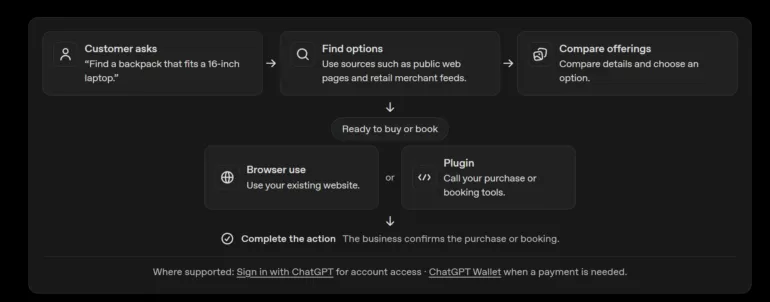
ChatGPT can handle the entire purchase process on its own, from product search and comparison to the final transaction. Merchants connect their existing website through browser integration or a dedicated plugin, while ChatGPT Wallet and Sign-in with ChatGPT handle payment and authentication. | Image: OpenAI
Many websites and payment systems still block AI agents as bots or reject their purchases for security reasons. To address that, OpenAI is also releasing a Commerce Partner Playbook. The guide explains how merchants can adjust their firewalls, provide product data, and work with payment providers such as Stripe, Adyen, and Riskified so agent-driven purchases go through.
OpenAI is playing catch-up on payment features for AI agents. Competitors such as Anthropic's Claude Duet, Meta's Muse, and xAI's Grok Bot already have built-in payments and rely in part on single-use cards via Stripe Link. Google and Perplexity also let users buy through their own checkout tools, such as Google Pay and Instant Buy.
Ad