Meta Unveils Muse Spark 1.2 Multimodal Evaluation Results
Meta released multimodal evaluation results for Muse Spark 1.2 ahead of its open-weights launch, scoring 54.0% on ZeroBench, essentially level with GPT-5.6 Sol at 54.6% and well above Opus 5 at 47.5% and its own 1.1 version at 46.0%. Meta also demonstrated visual coding that turns a terminal-uploaded video into a working booking page, with the model available via Meta Model API and Muse Code.
Full Report
Contents8 sections
The Multimodal Intelligence of Muse Spark 1.2
August 20, 2026·4 minute read
This month, we launched Muse Spark 1.2, a coding-focused update to Muse Spark 1.1. In our announcement, we also previewed the model’s improved multimodal capabilities. Today, ahead of the open-weights release, we’re sharing new evaluation results and demonstrations that illustrate the breadth of its visual understanding and reasoning capabilities.
Our earlier demo showed some of these capabilities in action: Muse Spark 1.2 turned a video uploaded through the terminal into a functional home-booking page. Beyond visual coding, the results below show how our model performs across visual reasoning, chart understanding, and knowledge-intensive tasks.
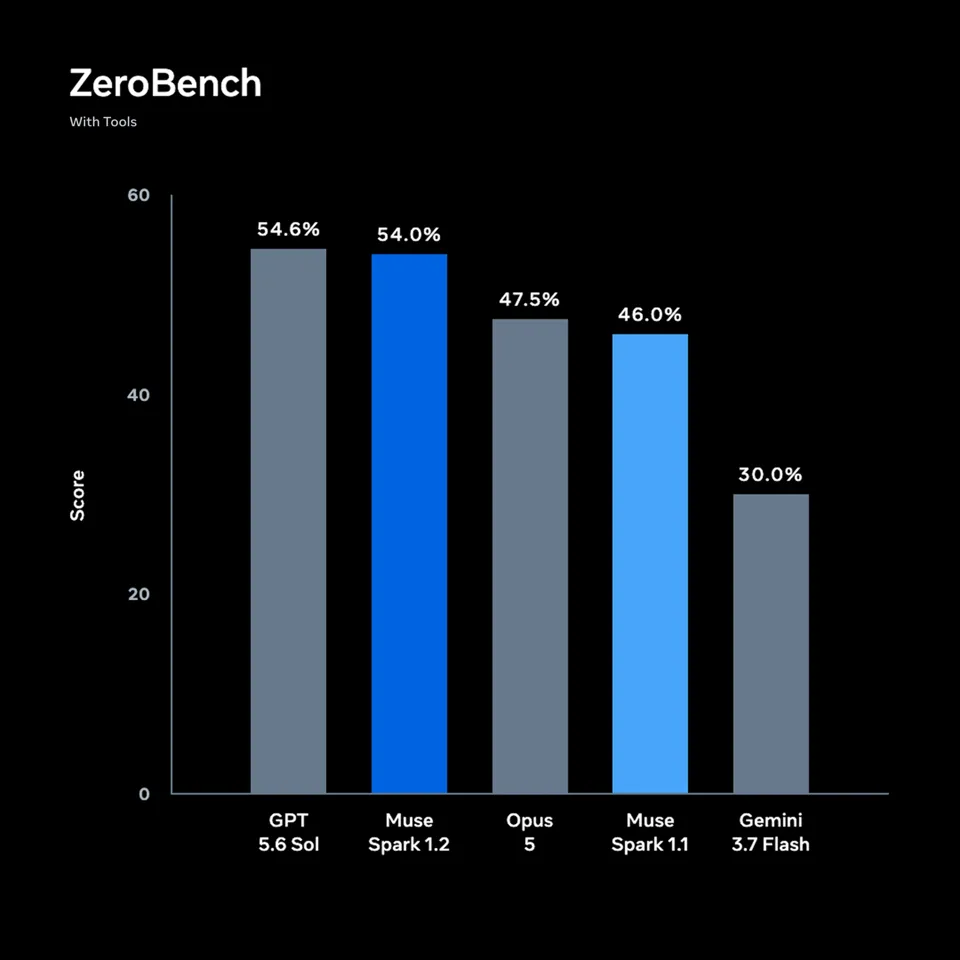
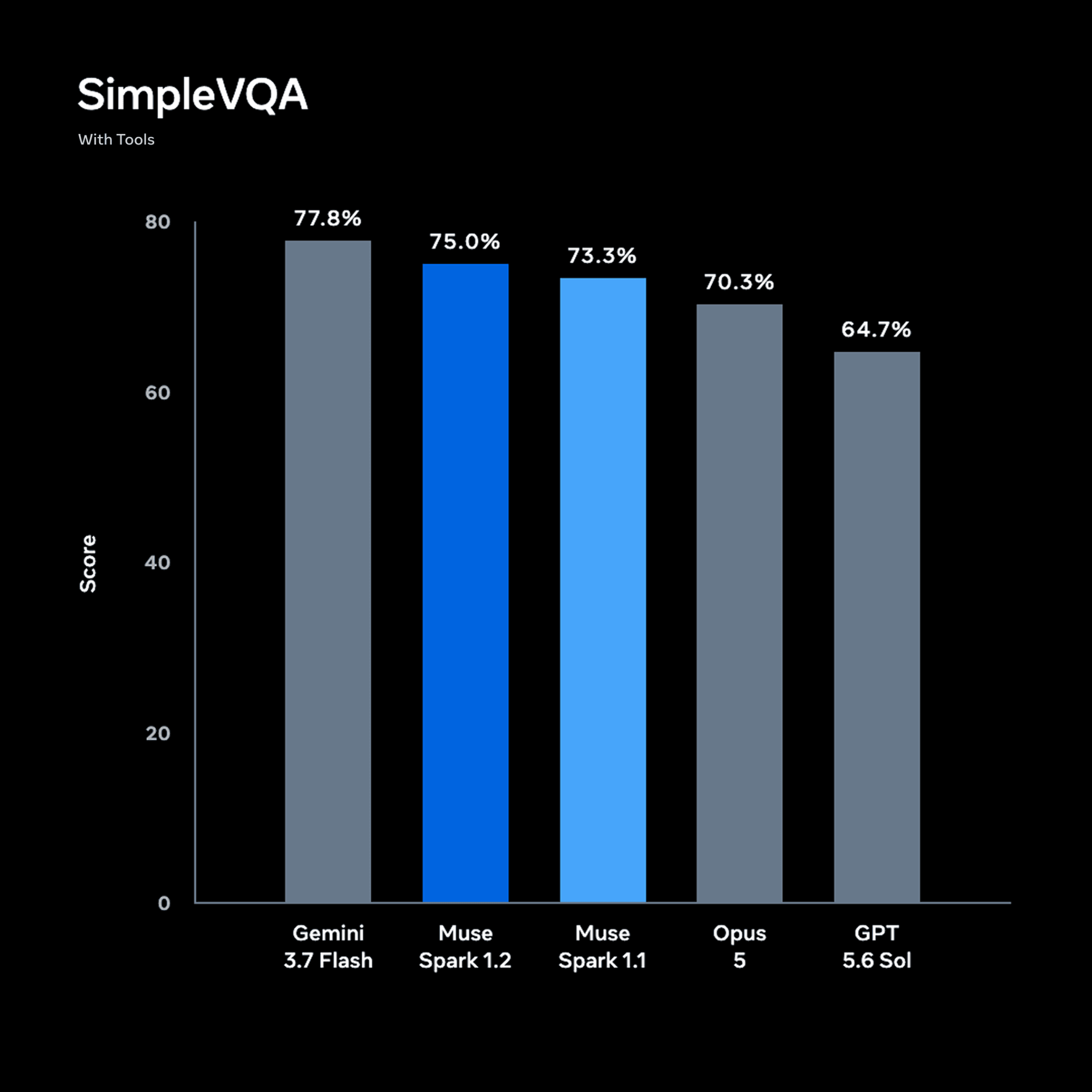
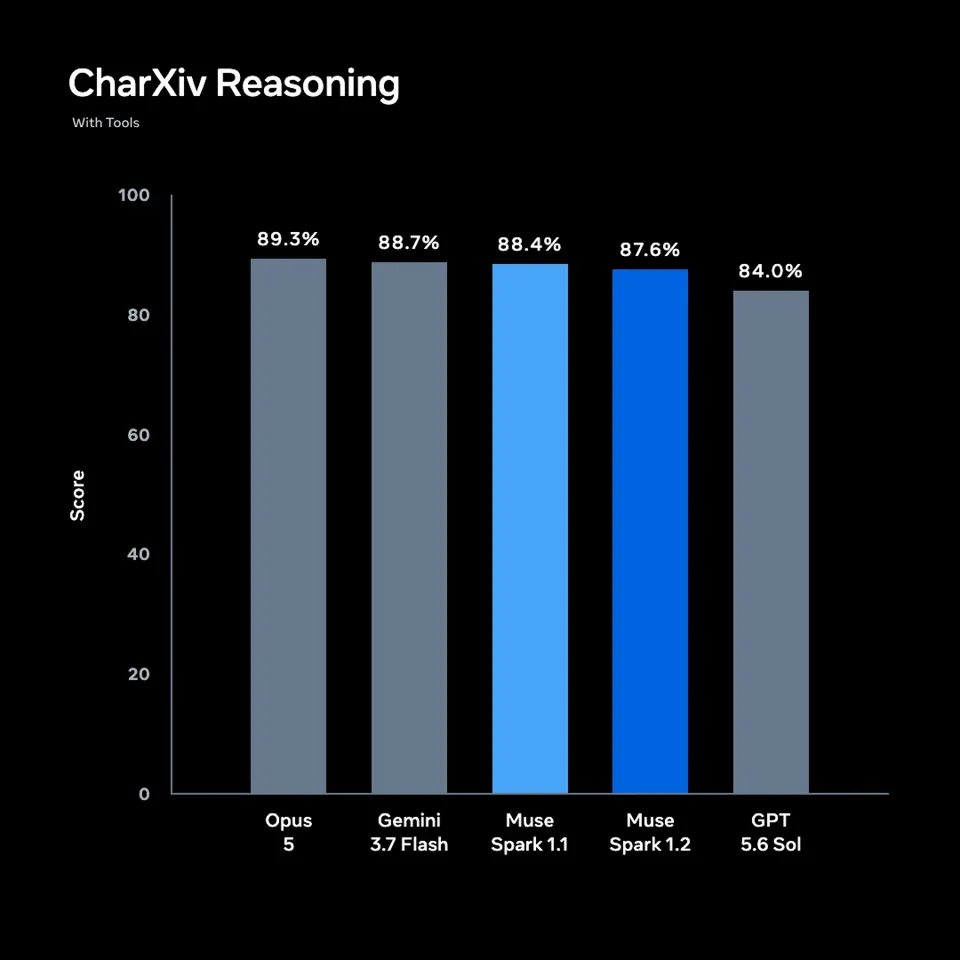
Muse Spark 1.2’s multimodal gains are most pronounced when the model can use tools. It can inspect visual inputs more closely and incorporate what it finds into its reasoning.
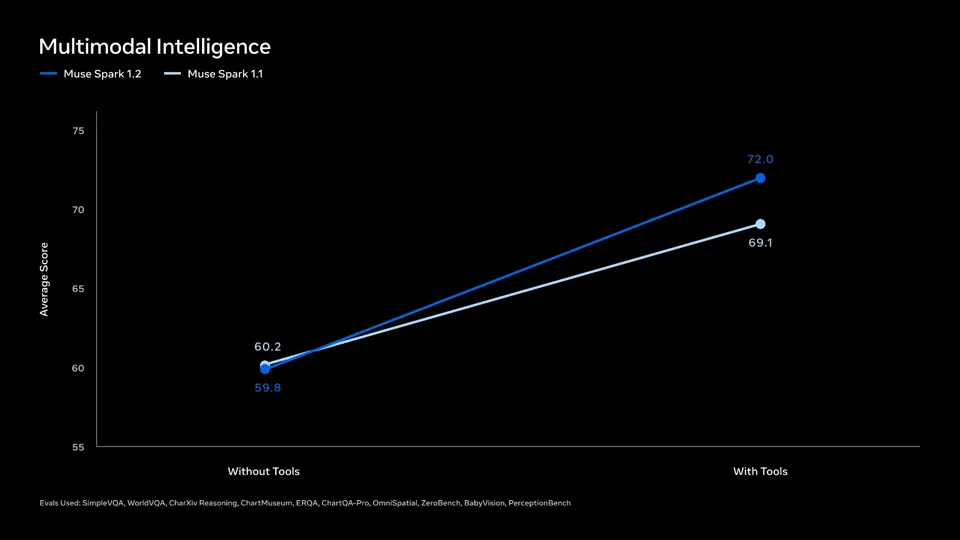
For more details about our evaluations, see our report.
Multimodal Capabilities
Muse Spark 1.2 supports a broad range of multimodal tasks, from turning visuals into working code to translating perception into physical action. It also brings robust audio-visual understanding to enable video-heavy workflows common in real-world enterprise use.
Visual Coding
Muse Spark 1.2 creates digital artifacts such as web pages and games, where correctness is judged by whether the result renders and behaves as intended. Given an image or video, the model must translate its layout, hierarchy, and style into working code. By re-examining the artifacts it generates, it drives a continuous self-improvement loop.
Human's JourneyNight TownHuman's JourneyLoading demo
An interactive flipbook built as a single page, with its layout, typography, page-turn animation, and cursor-tracked magnifying lens all generated by the model.
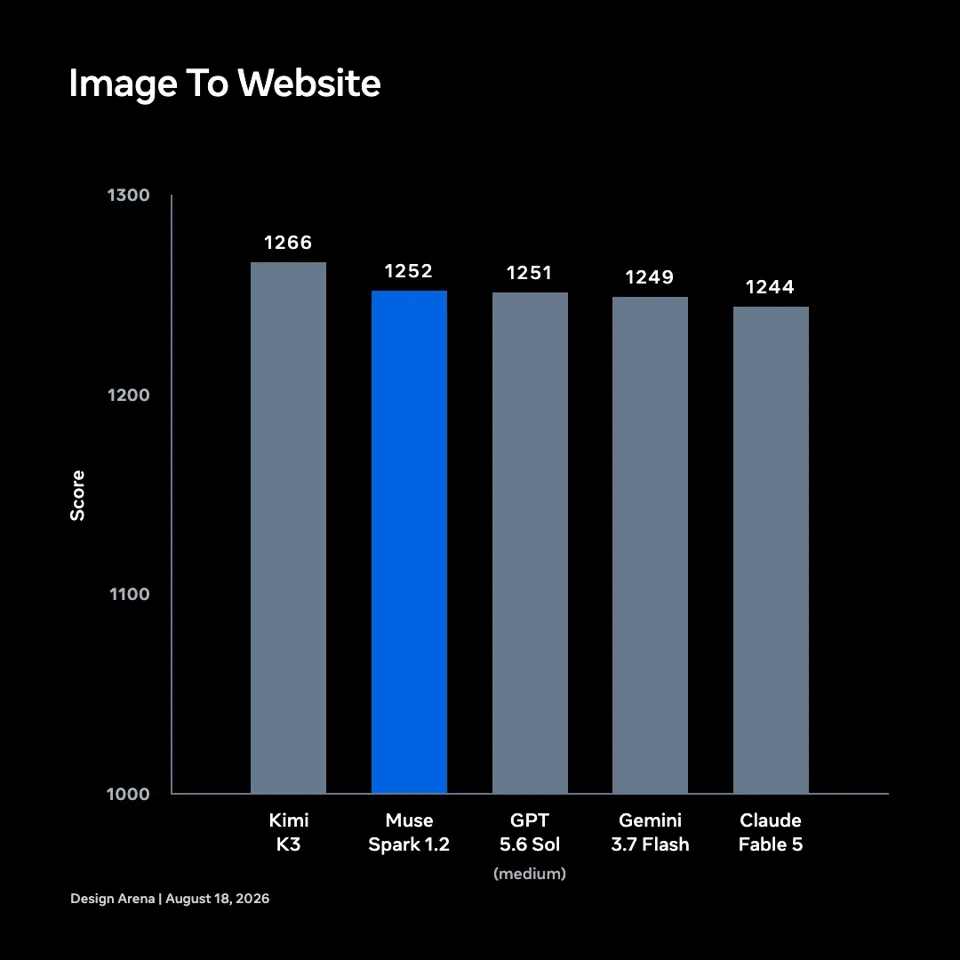
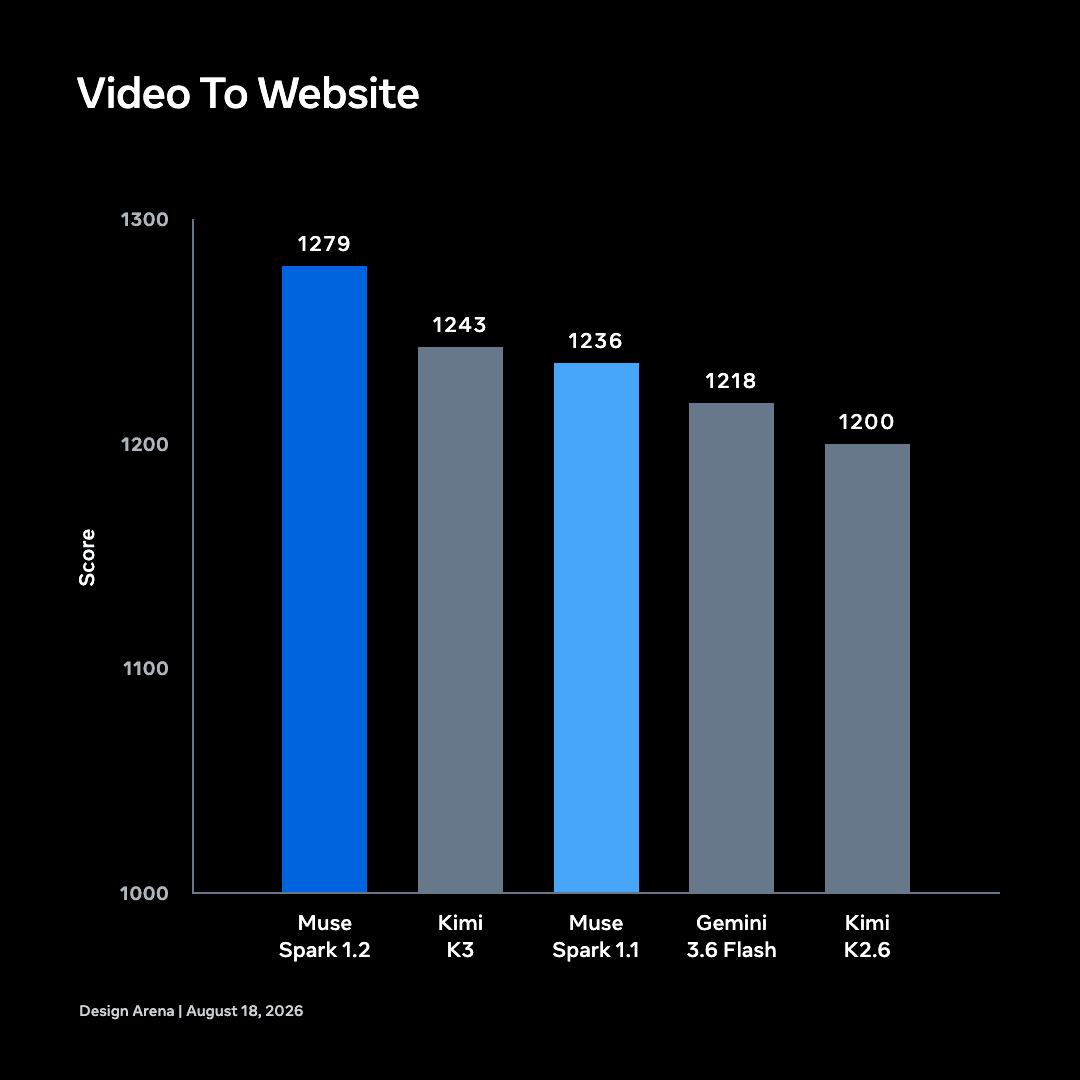
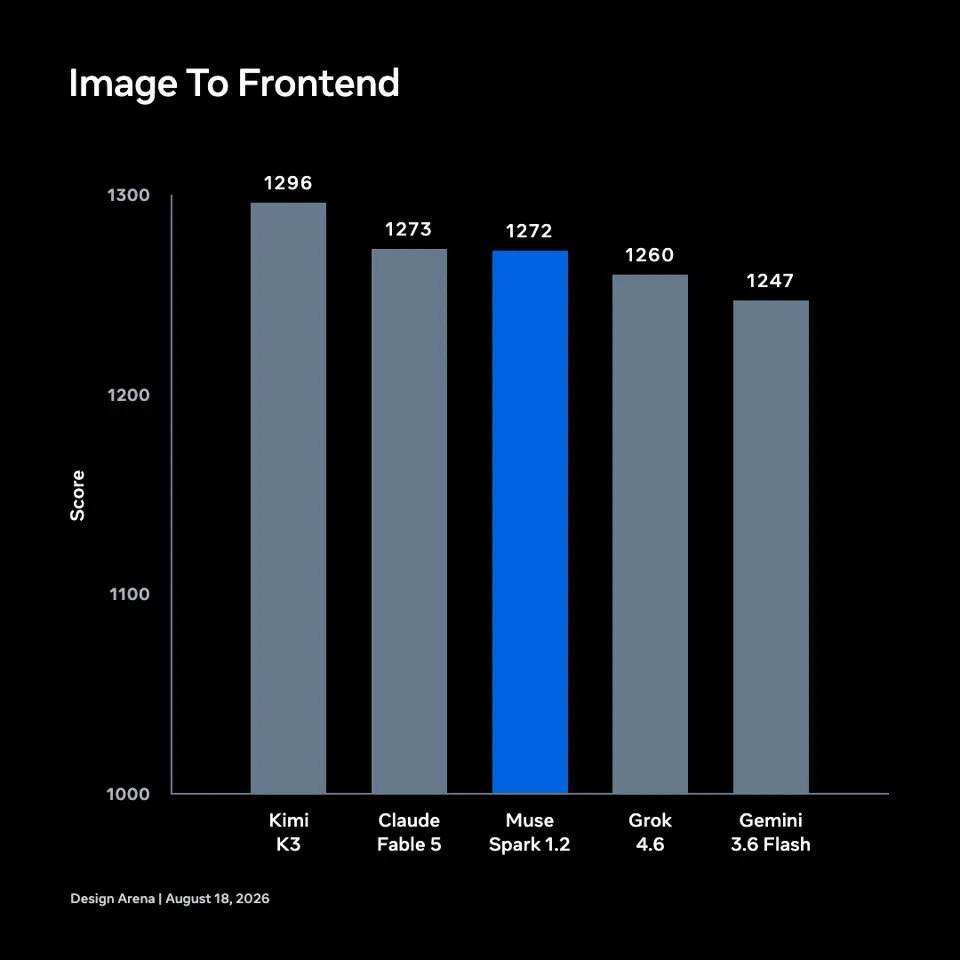
The model shows strengths in converting images or videos for web development, as shown on Design Arena. Model inclusion and rankings as of August 18, 2026.
Robotics
Spatial intelligence bridges the gap between digital perception and physical action, connecting what a model sees to what it can do in a 3D physical space. A specialized variant of Muse Spark acts as the robot brain and orchestrator – taking user instruction, decoding tool calls, observing results, and looping over until the task is done. For manipulation, we use a two-level system: Given a single abstract goal, the high-level planner model performs scene understanding, disambiguates similar objects, and decomposes the goal into subtasks, each executed by a low-level Muse Spark Vision-Language-Action (VLA) policy.
Below, see how the model plans the subtasks for a bimanual robot distinguishing a hair brush from a makeup brush, packing lunch, and finding various objects.
Organize cosmeticsPack lunchFind duckFind foodOrganize cosmeticsPrevious slideNext slidePlay Muse Spark plans the sub-tasks for arranging cosmetics in an organizer.PlayMuse Spark plans the sub-tasks for arranging cosmetics in an organizer. playback position0 of 0:0000 / 00
Muse Spark breaks down a long-horizon task “arrange objects (cosmetics) in the organizer” into actionable steps. In this example, the low-level action is done by a VLA model based on an experimental version of a smaller Muse family model.
Play Muse Spark plans and completes the steps needed to pack a lunchbox.PlayMuteMuse Spark plans and completes the steps needed to pack a lunchbox. playback position0 of 0:0000 / 00
Muse Spark is used as a planner to complete long-horizon manipulation tasks: “pack the fruits in the lunch box” and “put utensils in the plate.” In this example, the low-level action is done by a VLA model based on an experimental version of a smaller Muse family model.
Play Muse Spark navigates a physical scene to find a rubber duck.PlayMuse Spark navigates a physical scene to find a rubber duck. playback position0 of 0:0000 / 00
Muse Spark parses multimodal observations and calls tools to guide a robot to navigate in an unstructured environment to find a rubber duck.
Play Muse Spark navigates a physical scene to find chocolate.PlayMuse Spark navigates a physical scene to find chocolate. playback position0 of 0:0000 / 00
In a simulated environment, Muse Spark leverages diverse tools, following a complex human instruction to find chocolate and bring it back to the coffee table. The grasps are simplified.
Audio-Visual Understanding
Muse Spark 1.2 combines deep video understanding and dense captioning with a powerful suite of agentic tools, including web development, real-time search, and spatial grounding. This integration allows the model to move beyond passive observation and towards autonomous orchestration of complex workflows that translate audio-visual input into actionable solutions.
Video inputWeb outputVideo inputNext slidePlay Muse Spark 1.2 analyzes a refrigerator video.PlayMuteMuse Spark 1.2 analyzes a refrigerator video. playback position0 of 0:0000 / 00 Muse Spark 1.2 creates a meal-planning web artifact from a refrigerator video.PlayMuse Spark 1.2 creates a meal-planning web artifact from a refrigerator video. playback position0 of 0:0000 / 00
WildArtifactBench: Measuring Utility in Real-World Agentic Tasks
While strong performance on public benchmarks show us one side of the story, frontier models today still struggle to execute real-world agentic tasks such as making production-level games. We want the ability to evaluate an agent’s capability across a wide spectrum of multimodal tasks with practical utility.
Today, we are previewing WildArtifactBench, our internal evaluation used to evaluate agents on any task, with any deliverable format, and any level of verifiability.
Here are some of the design principles of WildArtifactBench:
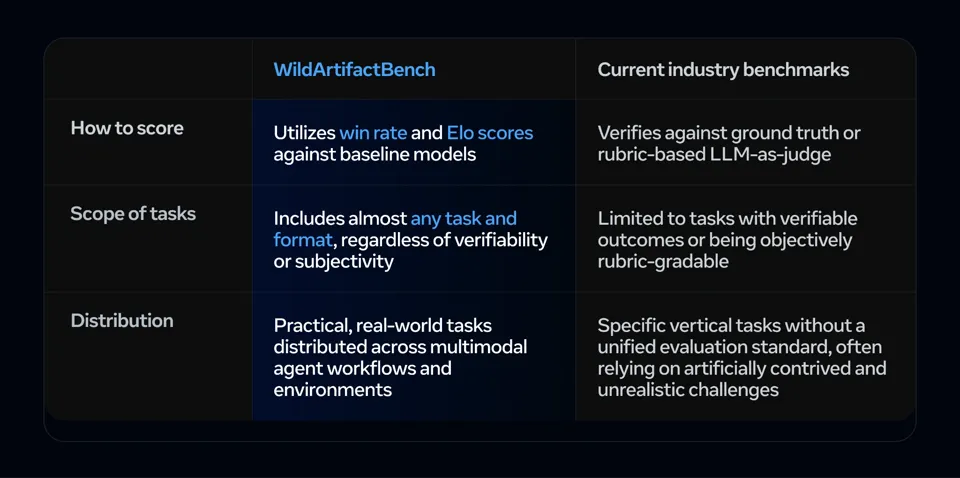
Win rate and Elo scores are obtained by comparing the deliverables of the tested and baseline agents. Both agentic judges and human judges can do the comparison and choose a preference. This approach greatly broadens our task coverage and diversity by removing the need for ground-truth deliverables and objective rubrics.
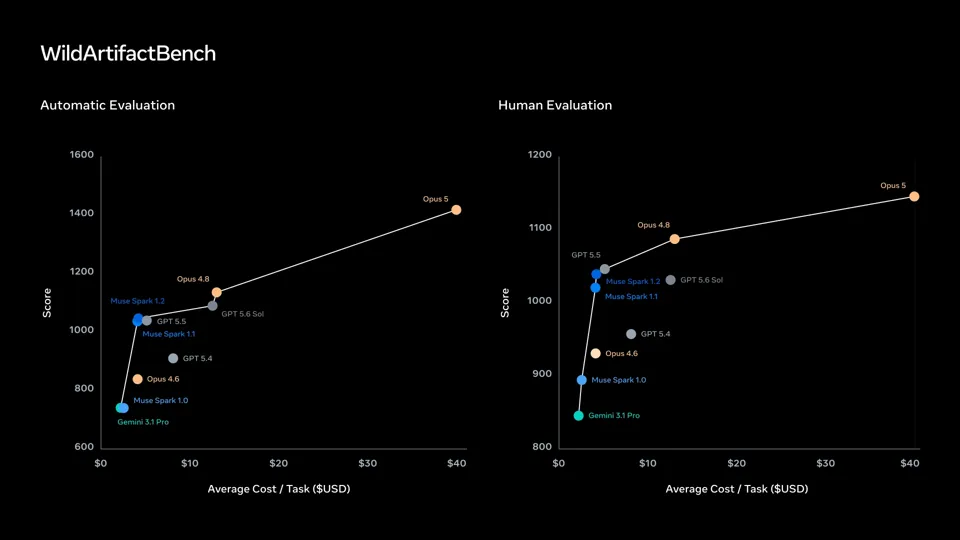
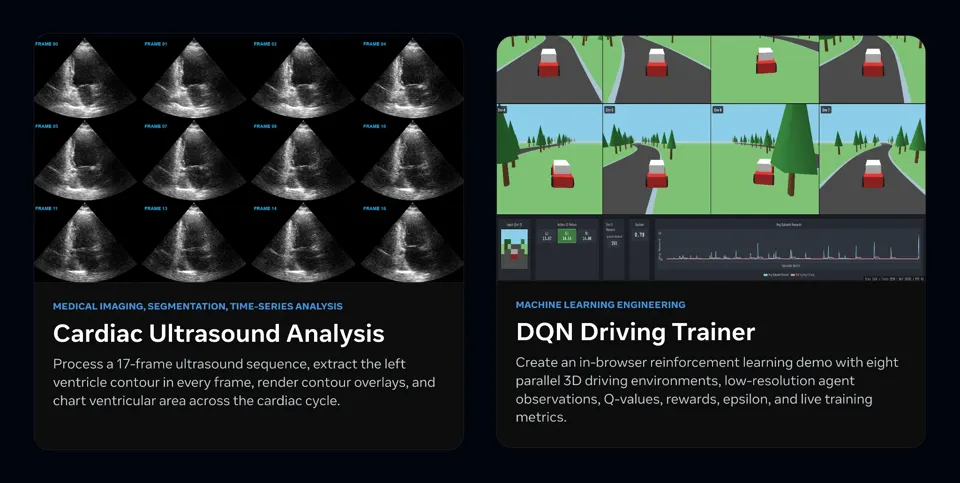
As a preview, we’re releasing 10 tasks from WildArtifactBench. This is a step forward in our ability to measure the real practical utility delivered by multimodal agents.
The Future of Muse Spark at Meta
Muse Spark is used in several areas at Meta, including powering our media generation efforts. Muse Spark works together with Muse Image for agentic media generation, where Muse Spark produces highly detailed captions as training data for Muse Image and Video. Muse Spark is also able to translate raw text, image, and video content into signals and insights that can be used in downstream applications.
Play Muse Spark analyzes a mountain biking video for content understanding.PlayShow captions for Muse Spark analyzes a mountain biking video for content understanding.Show captionsMuteMuse Spark analyzes a mountain biking video for content understanding. playback position0 of 0:0000 / 00
Try Muse Spark 1.2 Today
Muse Spark 1.2 is available in Meta Model API and Muse Code.