UIUC Researchers Propose Memory Tax to Benchmark Agent Memory Systems
Researchers from UIUC and collaborators reviewed the evolution of agent memory systems and found that most papers omit a naive RAG baseline or leave its chunking and retrieval budget unspecified, inflating reported gains. They introduce the concept of a Memory Tax to quantify the deviation cost of memory processing and propose a unified evaluation framework for fair comparison across flat stores, hierarchical lifecycle management, graph structures and trained policies.
Related Entities
Full Report
New AI Era Report
Memory is a biased reconstruction of history.
Whether in the human brain or in long-running agents, once "memory" begins to be established, the original interaction records undergo operations such as distillation, merging, updating, and forgetting, and are rewoven into different levels and forms.
Designers hope that through these operations, information can be reorganized and clarity restored, but once information leaves its original form, Deviation occurs.
This deviation is inherently double-edged: scattered facts are consolidated, implicit preferences are extracted, and information becomes better suited to downstream tasks—this is the benefit designers expect; but through compression and rewriting, many subtle facts are also inadvertently flattened, or evidence that could once be found with ease is pushed into deeper corners.
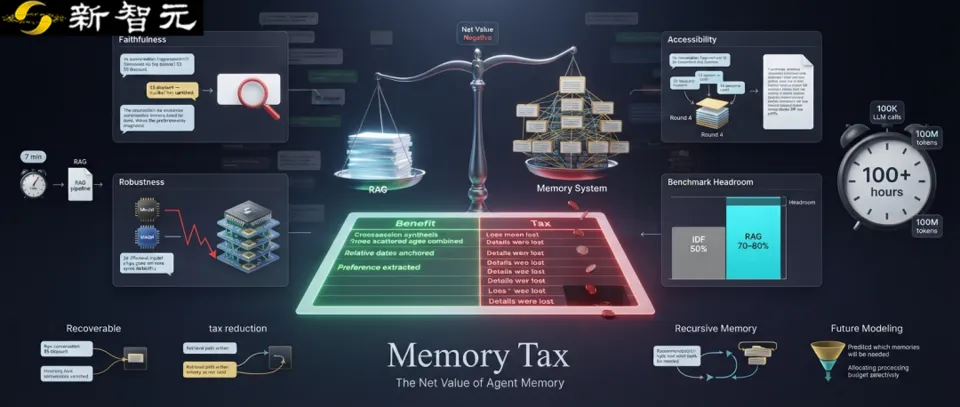
This inherently double-edged deviation is also the reason why "memory benefit" and "Memory Tax" coexist in every memory system.
Over the past two years, Agent memory systems have developed rapidly, evolving from flat fact stores (Flat Store), to hierarchical and lifecycle management that mimics human memory (Hier/Lifecycle), to graph-based structures (Graph-based), and all the way to using reinforcement learning to train read/write policies (Trained Policy).
While reviewing several papers in this field, the researchers noticed a frequent but anomalous phenomenon: many papers, when validating effectiveness, only compare horizontally against other memory systems, and rarely put the most basic naive retrieval (Naive RAG) into the same table; for papers that do include a RAG baseline, the description of chunking methods and retrieval budgets is rather vague, and it is impossible to verify whether the RAG baseline has been tuned to its optimum.
This prompted us to re-examine a simple question: if complex offline processing is omitted and the raw dialogue is simply chunked and run directly through a standard hybrid retrieval setup, how much "Net Value" can existing memory systems actually bring by comparison?
A research team from UIUC, Tsinghua University, and other institutions conducted a large-scale test and proposed the concept of "Memory Tax."
Paper link: https://arxiv.org/abs/2610.34073
Data results: https://huggingface.co/datasets/hexuan21/MemoryTax-Res
In addition to the evaluation code, the authors have also open-sourced the intermediate results from the experiments as completely as possible, so that the community can directly verify and reproduce them on this basis.
Baseline Comparison
Sophisticated Memory vs. Raw RAG
The experiment starts with the most familiar personal agent memory. The research team tested four categories and a total of 11 open-source memory systems (A-Mem, MemOS, SimpleMem, MemoryOS, LightMem, OpenViking, HippoRAG2, PlugMem, MAGMA, Mem-T, Memory-R2) on three benchmarks—LongMemEval-s, PersonaMem-v2, and MINT-Eval—with base models selected from different capability levels and model families: Qwen3.5-4B, Qwen3.6-27B, and GPT-5.6-luna.
To put systems with vastly different structures on the same starting line, retrieval budgets first need to be aligned. The memory units generated by different systems vary greatly in size; some are only a short sentence, while others are an entire long summary. If default retrieval parameters are mechanically copied, the proportion of content that different systems can see in a single pass may differ by more than tenfold.
To this end, the authors defined Retrieval Scope (RS) to measure the proportion of memory tokens that the model actually comes into contact with in a single question-answering session relative to the total tokens in the system's retrievable library. In the experiments, they deliberately calibrated the top-k of most memory systems to ensure that their Retrieval Scope was not lower than that of the single-turn RAG baseline, while keeping the differences among them small; in addition, the underlying Embedding and judging criteria were also unified.
As a reference, Naive RAG performs only the most conventional operations: splitting the raw text by conversation turns, combining BM25 and vector retrieval for hybrid recall, and finally passing the results through a lightweight Reranker. In the appendix, the authors also specifically substituted different chunking granularities, embedding models, and reranker models for ablation validation, confirming that RAG's performance is very robust and does not depend on any particular set of parameter tuning.
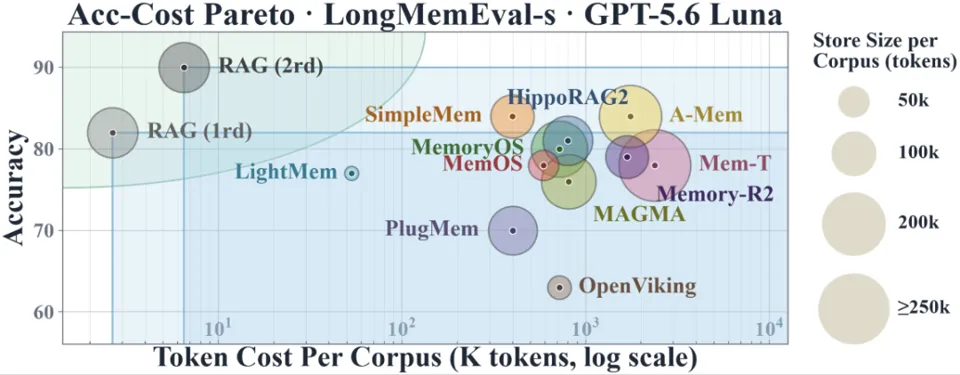
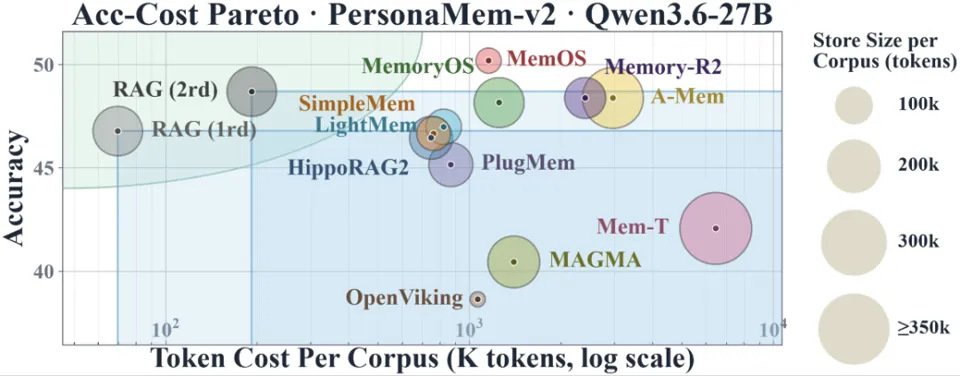
After running the entire experimental matrix, the numbers on the books were more direct than expected: under most test settings, the specially designed memory systems failed to outperform single-turn Naive RAG in accuracy; compared with two-turn RAG with supplementary retrieval, the gap was even more pronounced.
Plotting cost and performance on a Pareto chart makes the contrast even sharper. Taking LongMemEval-s (GPT-5.6-luna) as an example, single-turn RAG requires 7 minutes of offline processing, whereas the offline database construction and maintenance of some complex memory systems, converted to single concurrency, require more than 100 hours, nearly one hundred thousand LLM calls, and consume hundreds of millions of tokens, yet the end-to-end accuracy ultimately obtained is lower than directly retrieving the raw records, exhibiting a clear "negative net value."
Tug-of-war Between "Benefit" and "Tax"
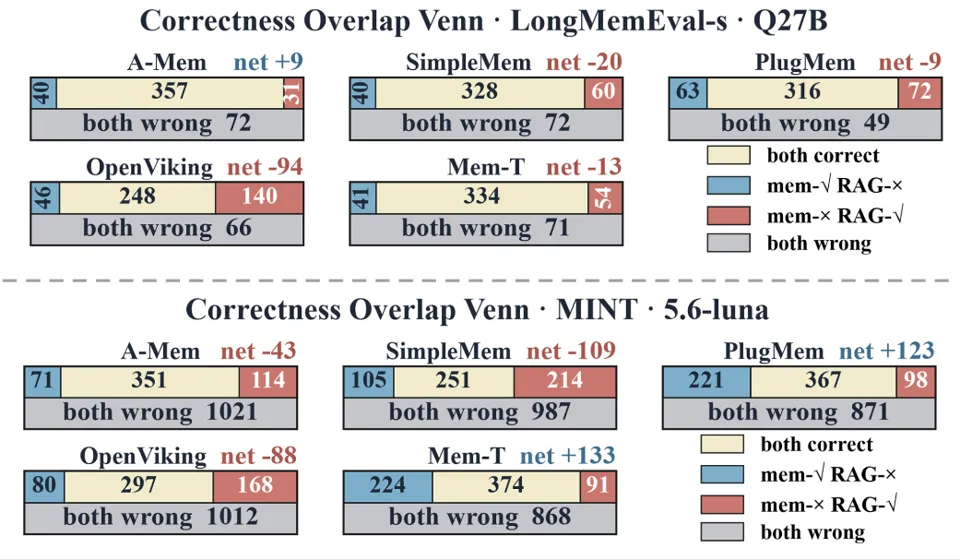
Looking at the total score alone is insufficient to explain what happens inside a memory system. The authors broke the evaluation results down to each individual query (Per-query Comparison), comparing the correctness of the memory system against single-turn RAG. It can be seen that the memory system is actually undergoing a positive-negative offset internally: on one hand, it solves some queries that genuinely require extraction and integration to answer correctly; on the other hand, it loses requirements that simple RAG could already handle.
The former is exactly the "Memory Benefit" expected by designers: for example, the user's age, the parents' ages, and the grandparents' ages are scattered across three chats on different dates, requiring cross-session assembly to calculate the average age; or the original words only mention relative times like "fixed the fence three weeks ago" and "trimmed the goats' hooves two weeks ago," which need to be anchored to specific dates during database construction to determine the order; or the user casually mentions in a translation request that they have an old knee injury, which needs to be separately extracted into a preference record. In these scenarios, reconstruction and extraction indeed helped.
But on the other side, there is a larger batch of problems that could originally be solved by directly searching the raw conversations, yet after memory processing they are answered incorrectly. The authors propose a new concept for this additional cost: "Memory Tax." The reason many systems end up inferior in external net value is precisely that the memory tax in memory processing outweighs the memory benefit it earns back.
Deep Dive: Where Does the "Memory Tax" Come From?
The next natural question is: where exactly is the "memory tax" generated? The authors approached this from four aspects—construction, retrieval, model switching, and evaluation benchmarks—and peeled away the intermediate states one by one.
1. Faithfulness.
The most direct loss occurs before retrieval even begins: the construction process itself causes a loss of faithfulness.
Summarization and extraction can easily drop key details along the way. The authors mapped the original Gold conversations onto the Gold memory units generated by each system and performed question answering directly on them, finding that even after completely eliminating the interference of retrieval errors, many systems still scored significantly lower than reading the raw segments directly.
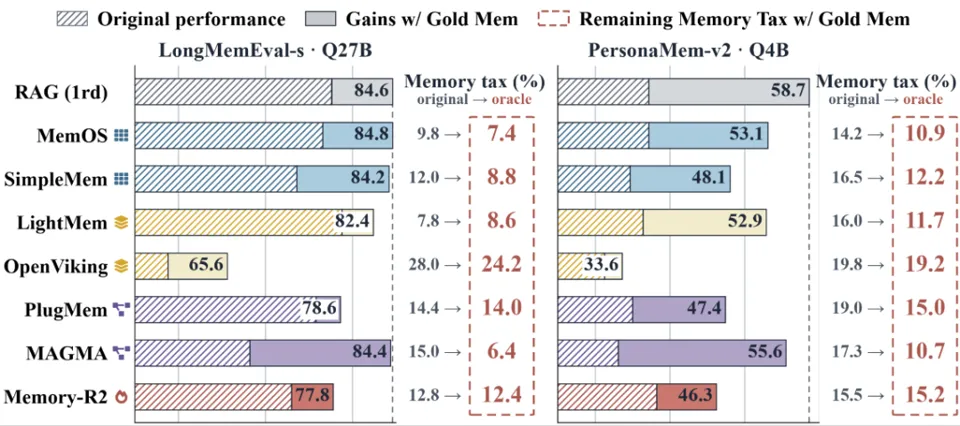
In the several hundred manually sampled and annotated examples, several typical distortions can be observed: for example, the user's original words said "accumulated 500 points at FreshMart, and the next purchase can get $5 off," but after Memory-R2 split it into single-line facts, only "frequently shops at FreshMart due to the 500-point discount" remained—the most important "$5" was gone;
Another example: the user complained "I heard a taxi from the airport to the hotel costs $60, which is a bit expensive," and OpenViking summarized it into a user profile of "prefers cost-effective transportation due to budget reasons." Later, when asked how much money taking the train saves compared with taking a taxi, the number $60 could no longer be found.
When encountering explicit forgetting instructions like "please forget about my family pressuring me to marry, which prevents me from focusing on art," MAGMA rewrote this sentence into a new fact stored in the database—"the user instructed the assistant to ignore family pressure to marry and prioritize art and career"—and the information that was originally requested to be erased instead took root in the database.
2. Accessibility.
The second loss link is the degradation of accessibility during the retrieval stage.
In the figure from the previous subsection, systems such as MAGMA and LightMem score very high when using Gold units directly, almost catching up with the original context, indicating that the information is actually intact in the database. But when returning to the memory system's own retrieval process, the scores drop significantly.
Through replay experiments with multi-round iterative retrieval, it can be seen that the proportion of memory systems that find all evidence in the first round of retrieval is generally lower than that of RAG directly searching raw chunks.
After examining specific cases, it was found that raw conversations often undergo three kinds of changes after entering the memory database:
(1) Fragmenting: The user mentioned in the same passage that fixing the bicycle and replacing the chain cost $25, and installing the bike light cost $40. LightMem split this passage into three independent memory units. During question answering, the $40 was successfully recalled in the first round, but the $25 entry fell to the 4th round, causing the total to be calculated incorrectly.
(2) Diluting: A simple statement like "45-minute one-way commute every day" gets merged in OpenViking into a 59-line user Profile document, mixed together with dozens of unrelated records such as foot pain and boot resoling, lowering its relevance to commute-related questions.
(3) Rephrasing drift: Summarization and rewriting shift the emphasis of the original wording, causing the overall similarity distribution between the Query and the memory units to drift downward compared with the original text.
3. Robustness.
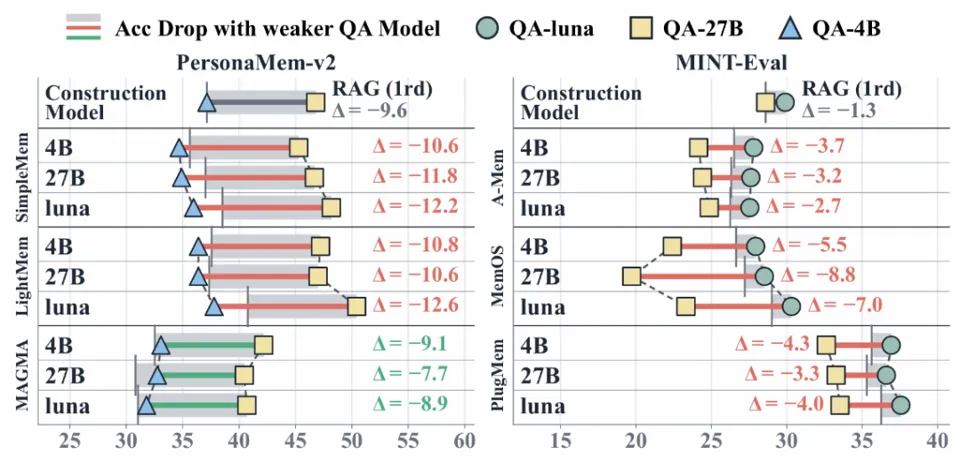
The third loss stage is reflected in the decline in robustness when switching across models. Long-running Agents often face upgrades to or mixing of their base models—that is, building the memory store offline with one model and switching to another model for online question answering.
Cross-testing shows that, because memory construction involves many intermediate operations that depend on the generation habits of a specific model, whether replacing the model used to build the store or keeping the memory store fixed and only switching the downstream QA model, many memory systems exhibit score fluctuations and performance drops that are noticeably larger than those of Naive RAG, introducing additional fragility on top of the raw records.
4. Benchmark Headroom.
Outside the system, insufficient headroom in existing evaluation benchmarks further amplifies the memory tax. The ultimate trade-off between memory benefit and memory tax depends heavily on the nature of the task itself. The research team extended testing to 15 mainstream long- and short-term memory benchmarks, including LoCoMo, EverMemBench, and HaluMem. The results show that many widely used test sets are themselves very "retrieval-friendly": the simplest IDF keyword rarity matching alone can achieve an absolute score of over 50% on multiple benchmarks, while standard hybrid-retrieval RAG directly reaches 70%–80%.
When naive retrieval has already captured the vast majority of the base score, the headroom left for memory systems to create additional gains becomes very narrow. At that point, any bit of memory tax incurred during store construction or retrieval is clearly exposed in the total score.
This also partly explains why some recent lightweight approaches that weaken or even abandon explicit memory construction have performed impressively: on benchmarks with limited headroom, they directly inherit the high starting point of naive retrieval while avoiding the high memory tax.
The "memory tax" is widespread
Looking beyond the domain of dialogue, the pattern that "biased reconstruction produces both benefits and taxes" still holds.
The authors conducted parallel tests on experiential memory that reuses historical task trajectories and on world-model memory for long-video generation: in web operation tasks (WebShop, Mind2Web), distilled workflows do outperform RAG, but in code generation (BigCodeBench) and complex tool calling (AppWorld, 2-Bench), various methods that abstract experience into skills or reasoning strategies still lag behind Naive RAG, which directly retrieves raw trajectories of similar tasks;
and in long-range scene consistency tests for world models, compared with compressing historical frames into visual latent variables, KV Cache, or memory tokens, methods that directly retrieve and re-inject raw historical frames (such as I3DM) likewise maintain an advantage in visual consistency.
Approaches to "tax reduction"
Since reconstruction of raw information always comes with deviation, how should the memory tax be controlled when designing a system? At the end of the paper, the authors focus on how to directly improve existing systems, trying to avoid introducing another complex architecture.
Approach 1: Make deviations recoverable on the construction side.
Since it is hard to guarantee zero loss in distilled memory, the most solid approach is to preserve a backtracking channel to the raw history—retrieve the raw records in parallel with the memory store, jointly rerank the results from both sides, and then hand them to the model for answering. This simple change reduced the memory tax by nearly half on SimpleMem, MemoryOS, and Mem-T, with total scores rising substantially as a result.
Approach 2: Introduce recursive memory on the access side.
Only when actual question answering goes through multiple rounds of retrieval and finally manages to dig out evidence that was buried deep after reconstruction does the system know best which evidence has been hidden away.
In recent years, Recursive Self-Improvement (RSI) has sought to let systems "improve how they improve"**; inspired by this idea, the authors argue that memory systems can likewise **"remember how they remember."
By writing past Queries, successfully recovered evidence, and the retrieval paths themselves back into the memory store as new source material, evidence that previously required multiple rounds of deep digging can be recalled in a single step when similar needs arise later, thereby achieving Inter-query Test-time Scaling across Queries.
Approach 3: Model future needs, an implicit "recommender system."
Most current systems perform full-scale pre-building (Ahead-of-Time, AoT) before a question arrives. Since they don't know what will be asked in the future, they can only apply indiscriminate, heavy processing to all history, which is costly and prone to damaging details. In contrast, Just-in-Time (JiT) memory, which waits until a question arrives and then assembles information on the spot, pushes all computation latency onto the online user side.
However, in personal assistant scenarios, users' questioning habits and evolving interests follow discernible patterns. Therefore, a worthwhile compromise to explore is to build a prior model of future access demand—treating the memory system as an implicit recommender system that predicts which historical information is more likely to be used in the future, thereby selectively allocating processing budget. This may reduce unnecessary memory tax at the source.
Conclusion
Cross-session association and state updates in long-horizon tasks still cannot do without the support of long-term memory. The paper Memory Tax, along with all the code and intermediate evaluation data open-sourced with it, provides the community with a more realistic vantage point for observation:
When researchers design or evaluate a new memory mechanism and watch scores rise and fall on leaderboards, they might first place a solidly configured vanilla RAG alongside as a reference, to better perceive how much net value the memory system actually delivers—and in which inconspicuous corners it has paid the "memory tax."
References:
https://arxiv.org/abs/2610.34073
秒追ASI
⭐Like, repost, and "Wow" with one triple tap⭐
Light up the star to lock in New Zhiyuan's instant push notifications!

