X2Robot Releases WALL-OSS-1.0 Embodied Model With Zero-Shot Generalization
X2Robot has released WALL-OSS-1.0, a next-generation embodied foundation model that executes unseen tasks with no task-specific fine-tuning, reaching 55.1% zero-shot success rate, 70.8% higher than the multi-task fine-tuned π0.5, and 78% on semantic tasks. It also launched WALL-API-1.0, its first embodied foundation model API, making general manipulation capabilities available out of the box.
Full Report
Contents11 sections
The pretrained general intelligence the industry has waited years for finally has an answer
Mengyao, reporting from Aofei Temple
QbitAI | WeChat Official Account QbitAI
A robot that, without any task-specific fine-tuning, directly takes on unfamiliar tasks—and its results actually surpass models that were specially trained!?
Now a leading player in the embodied intelligence field has actually pulled it off:
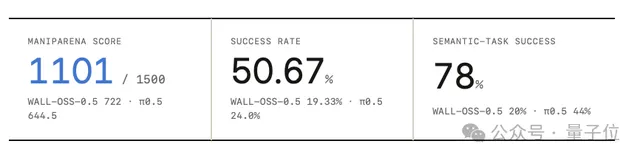
Zero-shot success rate has shot straight up to 55.1%.
Even more striking: with no task fine-tuning whatsoever throughout the entire process, its results are actually 70.8% higher than π0.5, which underwent multi-task fine-tuning.
On semantic tasks, the model's success rate even climbs directly to 78%, far exceeding π0.5's 44%:
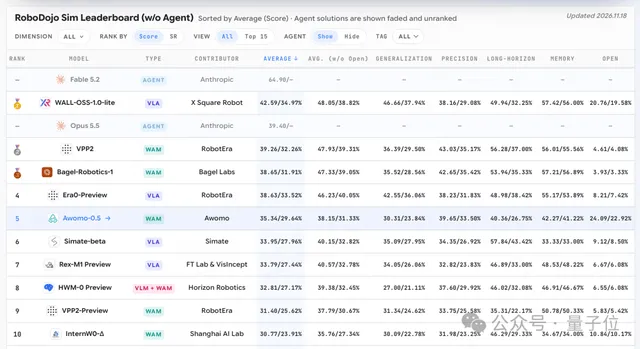
Even the lightweight Lite version is quite formidable—it directly topped the mainstream benchmark RoboDojo simulation track, taking Top1.
Even Agent solutions equipped with hundred-trillion-parameter-scale large models like GPT-6 Astra and Opus 5.5 were left behind by this model:

Without keeping you in suspense, the one delivering this report card is none other than the new-generation embodied foundation model released by leading embodied player X2Robot—WALL-OSS-1.0.
The launch of this model version also officially replaces WALL-OSS-0.5, becoming X2Robot's current flagship model available to researchers and ecosystem partners.
With no task fine-tuning required, pretraining alone gives the embodied model true general intelligence.
Even in an unfamiliar environment, given a brand-new instruction, the little robot can get right to work without a word—and do it impressively well. Truly steady, accurate, and decisive:
At the same time, to make it convenient for researchers and enterprises to call WALL-OSS-1.0, X2Robot has also generously launched its first embodied foundation model API—
WALL-API-1.0, an embodied large model that works out of the box, no longer serving as a starting point for fine-tuning—this is likely a first in the embodied field.
The application link is here: https://x2robot.com/docs/quantax1pro/v1/model-development/wallx-api/api-usage-instruction
Over the past few years, the entire embodied industry has been painstakingly searching for its own large-model moment in pretraining, hoping to achieve true general intelligence.
Now, a leading player has finally broken the industry deadlock first, relying on underlying technology and rigorous real-machine validation.
Embodied general intelligence has truly moved from technical consensus to reality.
The pretrained general intelligence the industry has waited years for finally has an answer
General intelligence is actually not a very new term today.
Many friends' first reaction upon hearing it is probably: this Astra that Fable—haven't all the major large models already been competing fiercely over general intelligence for ages!!!
Indeed, over the past few years, the rapid advancement of large models has already validated an extremely certain technical path for the entire AI industry—
As the scale of pretraining data and compute continues to expand, models can learn general patterns from massive experience and acquire cross-task problem-solving ability.
Logically, following this validated path, embodied intelligence's journey toward general intelligence should also proceed with overwhelming momentum.
But reality is far more stark than imagined, and even harder to describe in a few words...

Everyone probably shares a consensus: the ideal general-purpose robot should, like a human, be able to flexibly complete tasks in all kinds of unfamiliar environments.
To achieve this true generality, the entire embodied industry over the past few years has also firmly believed that "pretraining" is the only way forward.
For this reason, over the past few years, from robot foundation models to VLA, pretraining has gradually become one of the most important technical directions in the embodied field.
But awkwardly, the industry's confidence in pretraining keeps growing, yet the robot's own "general intelligence moment" has been slow to arrive.
The core issue lies in the generalization ability demonstrated by the models.
Take the classic of classics, Google DeepMind's RT series models, for example—
The early RT-1 already had a success rate as high as 92% on familiar tasks, but once it entered an unfamiliar environment, the success rate plummeted to 20%.
Even after upgrading to RT-2, which introduced a more powerful vision-language model, the success rate in unfamiliar environments was only 49%.
Models keep getting stronger and learn more and more knowledge, yet when facing unfamiliar scenes, instructions, and tasks, robots still struggle to respond flexibly:

△Google DeepMind
In the end, over the past few years, the entire embodied industry has remained in an awkward state of "wanting it but not being able to get it" regarding general intelligence.
And just as the entire industry was painstakingly searching, the X2Robot team has now gotten this path to work, and given the industry a definitive answer:
Pretraining can truly give birth to general intelligence.
Starting from WALL-OSS-0.5, X2Robot has been relentlessly pursuing the generality path—except now it has truly made it happen.
WALL-OSS-1.0, through joint pretraining of vision, language, and action, as well as learning from larger-scale data—
enables robots, without task fine-tuning, to directly get to work on unfamiliar environments and brand-new tasks using only capabilities acquired through pretraining.
The pretrained general intelligence that the embodied industry has long sought has now finally moved from technical belief to real-machine validation. So how exactly was this achieved?
From pretraining to Scaling and Agent, how robot general capabilities continue to evolve
Actions participate in pretraining upfront, letting understanding and action evolve together
To understand the key to WALL-OSS-1.0's breakthrough in general intelligence, we first need to unravel a question that has plagued the embodied industry for years:
Why can large language models learn to infer by analogy through pretraining, while robots often struggle as soon as the task changes?
In fact, one of the problems lies in the "training approach" of many past VLA models.
Traditional VLA training often first lets the model learn to recognize objects and understand instructions, then adds action data to teach the robot how to physically operate.
Sounds fine, but the problem lies exactly here, because by the time the robot actually starts learning to act, its way of understanding the world has already basically taken shape.
This means the model may understand the task but not necessarily be able to operate flexibly; change to an unfamiliar environment or instruction and it may crash, requiring fine-tuning all over again:

△AI-generated
The X Square Robot team clearly recognized this problem earlier, and this time they set their sights on the training approach itself—
Since there's always an information gap between the model's world understanding and its hands-on skills, why wait for post-training fine-tuning to patch things up?
Better to incorporate action experience into pre-training from the very start, training it alongside vision and language in the same furnace, jointly shaping the model's underlying ability to understand the world!!
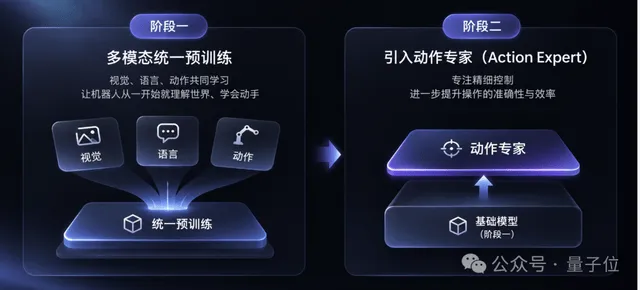
Specifically, WALL-OSS-1.0 adopts a two-stage training method:
In the first stage, vision, language, and action data participate in pre-training together, so the robot connects understanding the world with manipulating it from the very beginning.
In the second stage, an action expert dedicated to fine-grained control is introduced, making the robot's movements more precise and efficient.
This division of labor—learning to understand first, then practicing fine manipulation—precisely solves the old problem of small robots "understanding what to do but failing to do it well."
△AI-generated
Furthermore, to truly integrate actions into pre-training, X Square Robot also upgraded the X-Tokenizer, compressing complex action trajectories into encodings the model can understand.
This way, robot actions can also be tokenized like text, participating in pre-training alongside vision and language data~
At execution time, real-time chunking technology enables the robot to predict the next action while working, reducing single-inference latency to under 60 milliseconds.
From learning to understand actions during training to reacting quickly at execution time, the robot's brain and hands can finally work together better. Brilliant...
Richer Data Variety Lets Robots Handle a Huge Range of Scenarios
Having solved the model learning framework problem, embodied general intelligence faces another key challenge: data diversity.
After all, the real world is endlessly varied. If a robot has only learned from a limited set of scenarios and operations, no matter how skilled it is, it will struggle to handle unfamiliar environments and entirely new tasks.
Over the past few years, large language models have proven that by learning from rich and diverse data, models have a chance to grasp cross-task general patterns.
The embodied industry has actually wanted to replicate this path, but the difficulty lies in:
Language models can learn from massive internet text, but for robots to learn how to work, they need real operation experience, one episode at a time.
How exactly to collect data and how much to collect has always been a challenge looming over the entire embodied industry.

But this major challenge has now truly been cracked by the X Square Robot team.
The team well understands that only by exposing the model to enough scenarios, objects, and operation methods can it have a chance to learn more general physical laws.
In fact, WALL-OSS-1.0 has put considerable effort into the data side—
First, the data variety is sufficiently rich, with the model covering multiple types of tasks, scenarios, and objects, enabling the robot to accumulate experience from more diverse physical operations.
Moreover, the X Square Robot team also put a lot of thought into data sources.
In the previous version, a considerable proportion of data came from real robots, but with WALL-OSS-1.0, embodiment-free data dominates.
This means collecting operation experience no longer requires the robot to be physically present every time, greatly reducing cost and barriers, giving it the opportunity to continuously expand its "data appetite."
Of course, rich embodiment-free data alone is not enough—the robot also needs to learn how to actually do the job well.
Therefore, WALL-OSS-1.0 also incorporates robot teleoperation data and open-source action data.
In addition, some data comes from human takeover, specifically targeting areas where robots are prone to errors.
After all, errors can accumulate during task execution, and this type of data precisely teaches the robot to recover from failures, ensuring new data truly fills capability gaps.

△
AI-generated
Even further, the X Square Robot team considered a longer-term step: as models become smarter, how can newly collected data be directed to where the model needs it most?
To this end, the team also built an Agent-driven takeover data flywheel, letting the Agent identify where the model still falls short and then assign tasks to the robot accordingly.
The robot first works on its own, and wherever it gets stuck or makes errors, humans take over. This system has even accumulated tens of thousands of hours of takeover-mode data.
From low-cost data scaling to filling capability gaps, X Square Robot has given embodied intelligence a sustainable path for consuming data and growing intelligence.
Collaborating with Upper-Layer Agents: VLA Can Also Serve as the Execution Foundation for Complex Tasks
Once the robot has learned more manipulation skills through pre-training, the next question is: how can these capabilities be put to greater use?
After all, real-world tasks are often far more complex than completing a single action.
For example, asking a robot to help prepare things to bring when going out—it needs to first determine what to bring and where things are, then pick them up one by one, organize them, and pack them into a backpack.
And these tricky, hard-to-handle matters are exactly what Agents excel at!!!
In fact, after the emergence of top-tier general models like GPT-6 Astra this year, the entire embodied industry has begun to see a new division of labor—
The value of robot foundation models also needs to extend from independently executing tasks to supporting more complex Agent systems.
But this simultaneously places higher demands on VLA: the robot must understand instructions from upper-layer Agents and actually execute them properly. Difficult...
As luck would have it, WALL-OSS-1.0 is naturally Agent-friendly.
From the very beginning of training, the X Square Robot team introduced multi-level semantic annotations for the model.
This lets the robot understand both high-level goals like "help me tidy things up" and specific action commands like "pick up, put down."
In this way, the model can establish a mapping from high-level task intent to concrete action execution, laying the foundation for subsequent collaboration with upper-layer Agents.
And to make this collaboration truly work, X Square Robot also launched XR Harness.
It handles scene reasoning and task planning, then delegates specific operations to WALL-OSS-1.0 for execution. A preview version has been released, with the API now open.
From understanding Agent instructions to actually taking over the work, embodied intelligence now has the opportunity to leverage external support, allowing the robot's manipulation capabilities to break through the task boundaries of a single model.
Triple Validation on Real Robots, Simulation, and Production Lines: General Embodied Intelligence Moves Toward Reality
Of course, whether pre-training results can truly equate to general intelligence ultimately comes down to the robot proving itself with results.
Exhilaratingly, WALL-OSS-1.0 directly faced an open-book test where memorization wouldn't help.
Let's start with the real-world generalization test that best demonstrates general capabilities.
In the 312 open-ended task evaluations, WALL-OSS-1.0 achieved a 55.1% zero-shot success rate.
Keep in mind that these tasks are randomly composed of different basic actions, and the model had never seen the complete tasks before—so it couldn't just memorize training samples to fake its way through!
This really tests whether the robot can flexibly combine previously learned skills and truly generalize from examples.
Even more impressive: in the ManipArena real-world evaluation, WALL-OSS-1.0 without any task fine-tuning outperformed π0.5, which had undergone multi-task fine-tuning, by 70.8%???
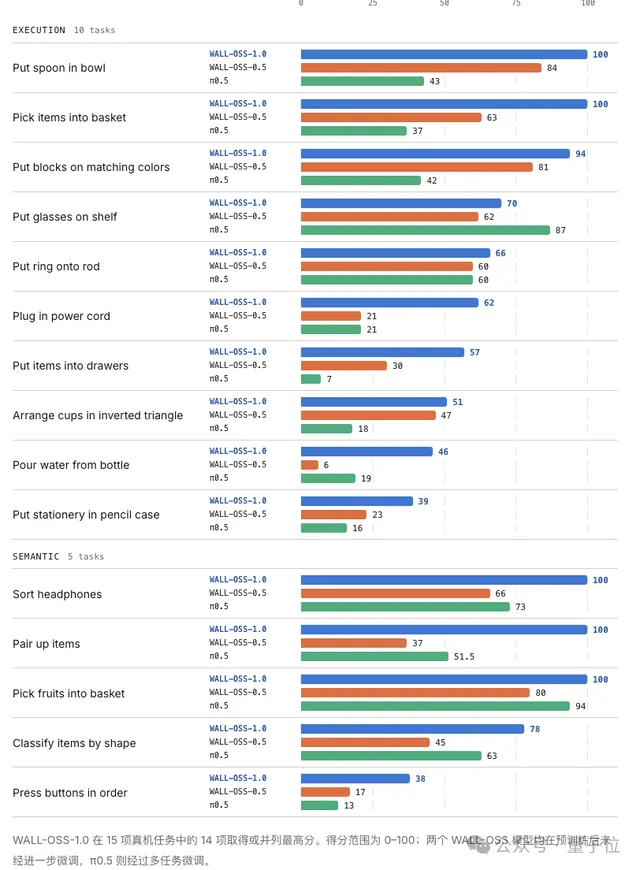
And this result is just one facet of WALL-OSS-1.0's capabilities.
Because to adapt the model's general capabilities to different scenarios, X Square Robot also launched an entire model family this time—
AR simplifies action training, Gen leverages human videos to improve generalization, while Lite and Nano focus on lightweight deployment, flexibly adapting to different deployment scenarios.
Notably, the lightweight WALL-OSS-1.0-Lite also scored 42.59 on the RoboDojo simulation track, taking the Top 1 spot.
Even some Agent solutions relying on hundred-trillion-parameter-scale large models like Opus 5.5 were left behind—this move is really slick...
Of course, what's more noteworthy than leaderboard rankings is whether the model can truly make it onto the production line.
Embodied intelligence has come this far, and commercialization has become an unavoidable question for the entire industry. Deployment cost and cross-scenario replication capability are precisely what determine how far robots can go.
In fact, WALL-OSS-1.0 is already handling tasks like flipping packages, scanning barcodes, and screening anomalous items on the production lines of leading domestic logistics companies~
Not only that, it has also delivered a rather striking set of results—
In real production lines, WALL-OSS-1.0 with general pre-training needs only about 10 hours of production line data to get on the job, while a same-architecture model lacking general pre-training requires over 1,000 hours.
Even after switching to new sites with different lighting and environments, the former can still retain over 90% of its original capabilities, while the control model retains only about 10%.
This means that the results of general pre-training are genuinely reducing the cost of adapting robots to new production lines, making cross-site replication and deployment practically feasible.
And from the perspective of actual deployment progress, X Square Robot's series of commercialization advances have also elevated it to the top tier of the domestic embodied intelligence industry.
Measuring the value of an embodied foundation model isn't just about how strong its own capabilities are—it's also about whether it can enable more people to use it.
Notably, X Square Robot has also opened up WALL-API-1.0, enabling researchers and enterprises worldwide to achieve out-of-the-box usability.
This means that robots' general manipulation capabilities are finally beginning to reach thousands of industries just like large models. The API era of embodied intelligence has truly arrived.
It's quite emotional, really—over the past few years, the entire embodied intelligence industry has been like groping through a long night—
Everyone firmly believed that pre-training would one day give birth to general intelligence, but every step forward always ran into the high wall of generalization capability.
This industry has never lacked faith in technical roadmaps; what's truly difficult is having someone who can be the first to turn that faith into reality.
And just as the entire industry had been searching for so long, the X Square Robot team, with years of technical accumulation and solid validation results, has blazed a trail where there was no path.
For the industry consensus that pre-training leads to general intelligence, they have delivered the most confident and inspiring result.
The light boat has already passed ten thousand mountains.