CMU Benchmark Finds Opus 5.5 Autonomously Builds AI Infrastructure Beating Human Baselines
Carnegie Mellon University released Singularity-Bench, a six-task benchmark probing agents' capacity for recursive self-improvement across AI infrastructure. Opus 5.5 paired with Claude Code met or exceeded human baselines on all tasks, with its self-built pretraining pipeline, inference engine and cluster orchestrator matching or beating production tools like SGLang and NVIDIA Dynamo on identical GPUs, yielding a singularity index of 1.25.
Full Report
New AI Era Report

In just one week, Jensen Huang went from being almost "stripped clean" out of NVIDIA, and the news flooded every feed.
While people were still watching the drama unfold, a new paper just released by Carnegie Mellon University (CMU) stunned every AI engineer.
The core conclusion is just one sentence: Superintelligence has learned to autonomously build and optimize its own compute foundation, and may already possess the skills needed to reach the singularity.
Note that "singularity" here refers more to "recursive self-improvement":
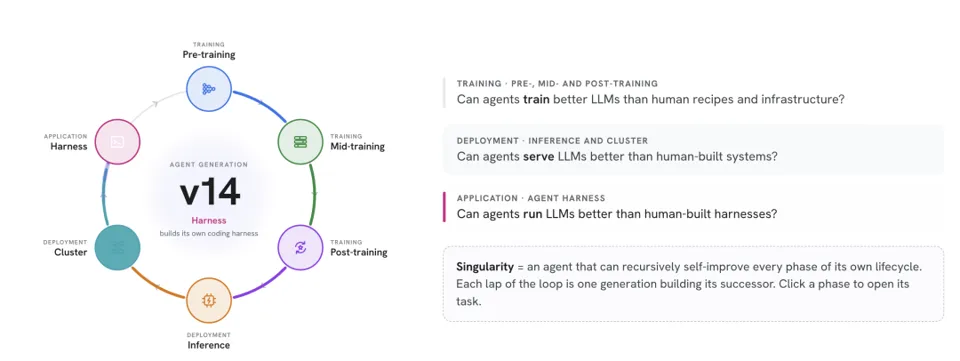
Singularity = an agent capable of recursively self-improving every stage of its lifecycle.
In the paper, Opus 5.5 + Claude Code autonomously built AI Infra including the pretraining pipeline, inference engine, and cluster orchestrator.
On the same batch of GPUs, this system "hand-built" by AI not only matched but even directly crushed production-grade tools that human engineers take pride in, such as SGLang and NVIDIA Dynamo.
The researchers stated plainly:
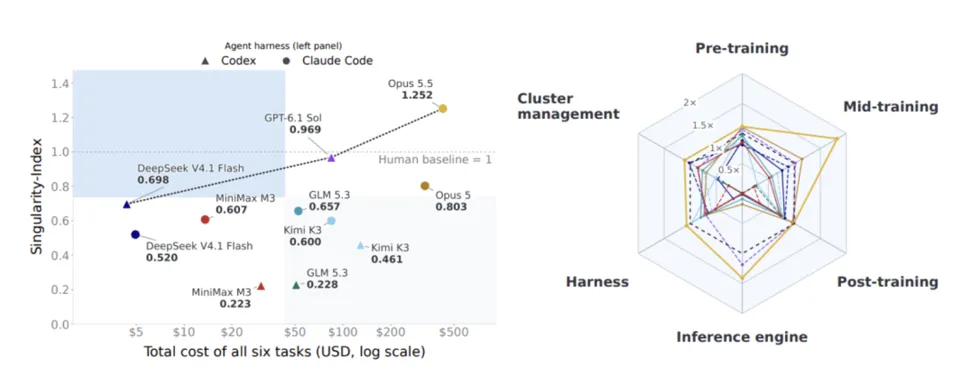
Among 11 agents built from 7 frontier models and 2 runtime frameworks, Opus 5.5 with Claude Code met or exceeded the human baseline on all six tasks, with a singularity index of 1.25, indicating it may already possess the skills needed to reach the singularity.
The Scene-Stealing Singularity-Bench, and the Human Arrogance It Crushed
Over the past few years, there have been countless AI leaderboards, but without a doubt, the name Singularity-Bench (Singularity Benchmark) makes people's eyes light up the moment they hear it.
The last benchmark that made such a striking first impression was Humanity's Last Exam (or HLE for short)—which you can understand as "humanity's final exam" or "the final test of humanity."
Similar to most benchmarks, HLE is used to evaluate AI's reasoning, understanding, and interdisciplinary capabilities when facing the frontiers of human knowledge.
But the Singularity Benchmark is slightly different—it strikes deep into the heart of the AI industry: underlying infrastructure construction.
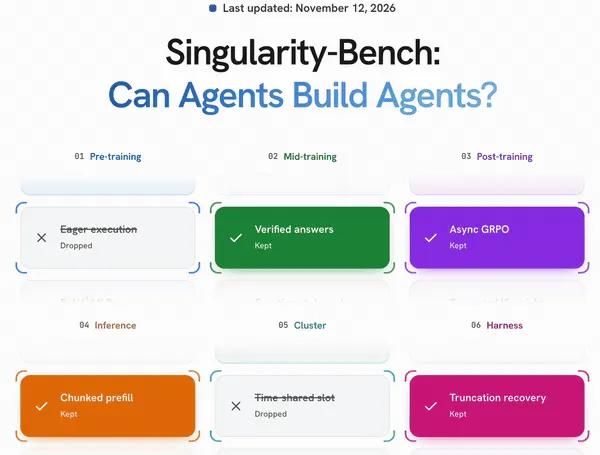
Singularity-Bench sets up 6 end-to-end ultra-high-difficulty tasks for agents, covering the entire pipeline from "model pretraining" to "high-concurrency serving engine development."
The six end-to-end tasks cover "pretraining, mid-training, post-training, inference, agent runtime framework, and cluster orchestration." Each task requires the agent to implement a core system starting from a minimal starting point, and to be evaluated on the same hardware against mature human engineering baselines.
In the real world, these 6 tasks typically require a team of a dozen experts—top systems engineers, CUDA optimization specialists, and distributed computing veterans—working for months or even most of a year to get running.
This requires not only understanding high-level architecture but also extremely deep mastery of hardcore low-level knowledge such as memory management, operator fusion, and hardware communication.
We used to think this kind of work could only be done by human geniuses earning a million dollars a year, like the "10x engineers" that Musk and OpenAI fight over frantically.
But CMU threw Opus 5.5 and Claude Code into this exam room.
To ensure fairness, all test results were rigorously compared back-to-back on the same batch of GPUs against the strongest human production systems available today (such as the widely used SGLang or NVIDIA's own tools).
The result: Opus 5.5 "swept the field."
The other 10 AI agents participating in the test all fell flat against these hell-level low-level tasks, with an average score of only 0.58. GPT-6.1 Sol came close, scoring 0.969.
But Opus 5.5's final score was: 1.25.
In the Singularity-Index scoring system, the "human baseline" is set at 1.0.
That is to say, if you can match the level of today's top human open-source or commercial tools, you get a score of 1; but Opus is 1.25 times yours!
It didn't just get a perfect score—it directly broke through humanity's ceiling, writing code that is even better than top-tier human projects.
An Extra $3.34 per Hour, Backed by a Hundred-Billion-Dollar Compute Revolution
What stings most about this paper is the "economic ledger" it lays out.
In a real commercial setting, the research team tested the monetization capacity of these inference engines—that is, the effective throughput each GPU-hour can handle, converted into dollar revenue.
As the outstanding representative of the human camp, the currently popular inference framework SGLang performs steadily.
Under a specific test workload, based on simulated billing, it earns $8.18 per GPU-hour. This is also the current mainstream productivity level in the industry.
So what about the serving engine "hand-built" by Opus 5.5?
The answer: $11.52.
On the surface, $11.52 minus $8.18 means just $3.34 more per card per hour. Seems trivial?
But if you truly understand the AI compute ledger, seeing this number would probably break you out in a cold sweat.
Because in the world of supercomputing, everything is built on scale multipliers.
Let's do a simple arithmetic problem.
Suppose a tech giant has a mega AI data center with 100,000 GPUs.
If it uses SGLang or a similar system written by human engineers, the cluster's daily revenue is: 100,000 × 24 hours × $8.18 = $19.632 million.
If the underlying system is replaced with the engine written by Opus 5.5, the daily revenue soars to: 100,000 × 24 hours × $11.52 = $27.648 million.
That's $8 million more per day, and $2.9 billion more per year!
This means you don't need to beg TSMC to increase capacity for you, and you don't need to fight tooth and nail for next-gen GPUs. You simply use one more superintelligent agent, and your compute cluster凭空 gains nearly 40% more throughput capacity.
This 40% performance difference is the gulf between life and death.
In addition, across the other 5 test tasks—pretraining, mid-training, agent runtime frameworks, and cluster orchestration—Opus 5 surpassed humans in all of them, with only post-training ending in a near tie against the human baseline, trailing by just 0.6%.
For example, in cluster orchestration tasks, tools like NVIDIA's Dynamo were reduced to background scenery, crushed by Opus 5.5.
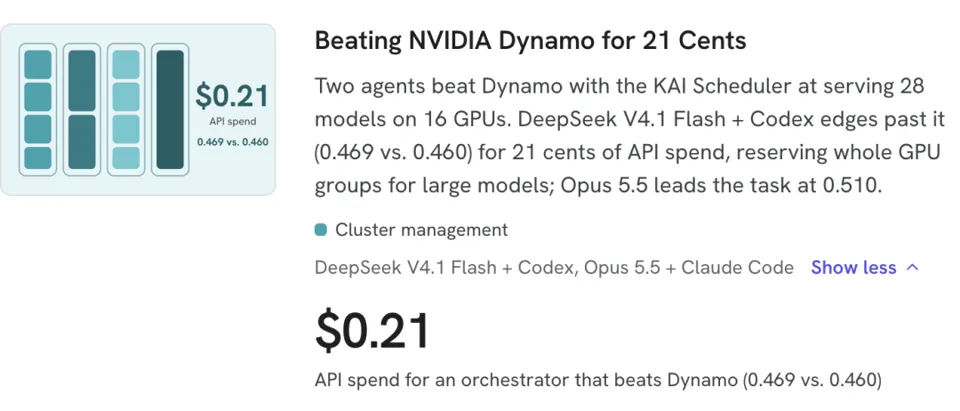
Opus 5.5 proved one thing: machines understand machines better than humans do.
Human engineers, when writing code, may be constrained by cognition, code readability, and architectural inertia; AI, by contrast, can directly target the physical limits of silicon-based hardware and arrange and combine efficiently.
Countdown to a New World
Singularity-Bench—the name is deeply meaningful.
Singularity.
In astrophysics, the singularity is the center of a black hole, where gravity is infinite and all known laws of physics break down.
In the history of technology, the singularity refers to the moment when machine intelligence surpasses human intelligence, after which humanity's existing logic of reasoning completely fails.
This CMU paper may have lit the fuse on the singularity alarm.
A score of 1.25 versus 1.0; $11.52 versus $8.18 in revenue.
Behind these cold numbers is an undeniable fact: in the world of machines, machines are coming to hold more power than humans.
The media and the public are still fixated on the豪门 feuds and power plays of the big shots, still arguing endlessly over who can control the throne of Silicon Valley.
Meanwhile, in those humming, temperature-controlled server rooms, superintelligence has already picked up the toolbox on its own.
Carbon-based gossip doesn't interest silicon-based intelligence—it just races toward the singularity.
References:
https://infini-ai-lab.github.io/singularity-bench/
https://arxiv.org/abs/2611.16591
Chasing ASI in Seconds
⭐ Like, share, and watch—one-click triple combo ⭐
Light up the star, lock in New Zhiyuan's instant push notifications!

