llama.cpp Hits 1.0.0 with Support for Over 150 Model Architectures
llama.cpp and its underlying tensor library ggml have officially reached version 1.0.0, establishing a semantic versioning scheme that flags breaking changes to the public C API. The project now supports over 150 model architecture variants and mainstream speculative decoding methods, backed by expanded self-hosted CI runners across NVIDIA, AMD, Qualcomm, Arm, IBM and Intel hardware.
Related Entities
Full Report
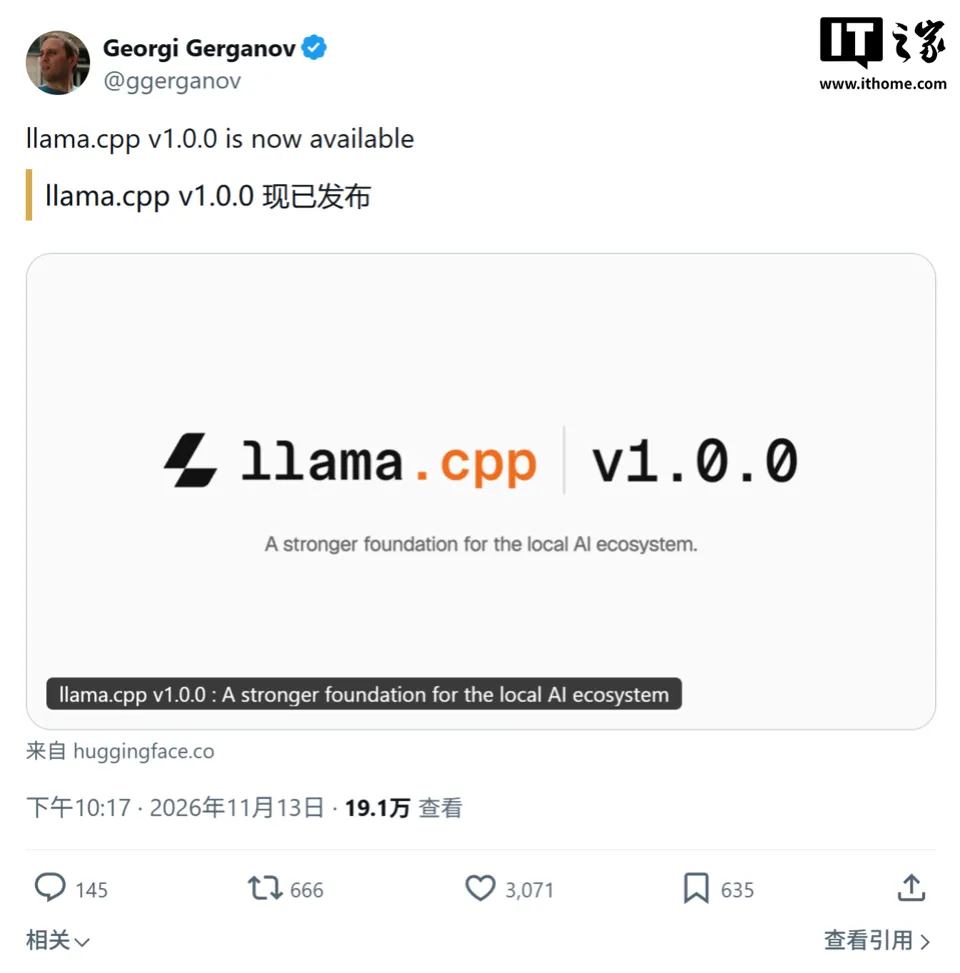
IT Home November 14 news, developer Georgi Gerganov (X account @ggerganov) posted on X platform yesterday (November 13), announcing that the open-source AI inference project llama.cpp and the library version of the underlying machine learning engine ggml have entered 1.0.0.
According to public information consulted by IT Home, Gerganov is the creator of the open-source project llama.cpp and an important developer of local AI foundational software such as ggml and whisper.cpp. In his personal X bio, he identifies himself as a Hugging Face engineer, and his GitHub profile lists his location as Sofia, Bulgaria.
llama.cpp is an open-source AI inference project written primarily in C/C++, whose core purpose is to enable large language models to run on different hardware such as personal computers and servers. It can be used for both local deployment and cloud services, with the goal of reducing deployment complexity and fully utilizing device computing power.
The biggest highlight of this update is the explicit interface compatibility rules:
| Project | Library | Positioning |
|---|---|---|
| llama.cpp | libllama | C/C++ large model inference library |
| ggml | libggml | Low-level machine learning tensor library |
Both will in the future be upgraded via major version numbers, explicitly marking API- or ABI-incompatible changes so that applications depending on these libraries can identify upgrade boundaries. For developers, it becomes easier to tell from the version number whether a given upgrade may require corresponding changes to their own applications. The official versioning rules are as follows:
| Version digit | When it is updated |
|---|---|
| MAJOR, e.g., 1.x.x → 2.0.0 | Breaking changes occur in the public C API in ./include; the announcement also clarifies that API / ABI incompatibilities will be reflected through a major version upgrade |
| MINOR, e.g., 1.0.x → 1.1.0 | Backward-compatible features, backend updates, model support, or new API additions |
| PATCH, e.g., 1.0.0 → 1.0.1 | Bug fixes that do not change the API |
In terms of engineering quality, the official announcement stated that to support the continuously accelerating development pace, the team emphasized three investments:
- Using Hugging Face's HF Buckets and HF Jobs to scale CI infrastructure.
- With hardware support from NVIDIA, AMD, Qualcomm, Arm, IBM, and Intel, continuously adding self-hosted test runners covering major hardware platforms.
- Using LLMs judiciously in the development process while continuing to prioritize code quality, architectural control, and understanding of implementation details.
In terms of backend and model support, ggml supports different hardware through dedicated backends; each backend can be compiled as a dynamic library and loaded on demand at runtime.
llama.cpp already supports over 150 model architecture variants and mainstream speculative decoding methods. The team will also continue to strengthen the automated testing infrastructure and, with hardware support provided by NVIDIA, AMD, Qualcomm, Arm, IBM, and Intel, expand cross-platform test coverage.