OpenAI Claims AI Independently Disproved ETH and Solved Kakeya Conjecture
OpenAI announced that its internal AI independently achieved three foundational scientific milestones: proving the full-dimensional local smoothing conjecture (resolving the Kakeya conjecture), disproving the Exponential Time Hypothesis (ETH) which has dominated computer science for nearly 30 years, and providing a rigorous existence proof for four-dimensional QCD. If verified, this marks a shift of AI from a research assistant to an original discoverer, potentially reshaping human understanding of computational complexity and physical laws.
Full Report
Honestly, the history of human science has been completely rewritten tonight.
Just moments ago, OpenAI dropped three major announcements in rapid succession, revealing that its internal AI independently achieved three discoveries that can be described as "milestones":
- Mathematics: Proved the "Local Smoothing Conjecture" across all dimensions, definitively resolving the "Kakeya Conjecture," which had puzzled the mathematical community for a century;
- Computer Science: Disproved the "Exponential Time Hypothesis" (ETH), which had dominated the field for nearly 30 years;
- Theoretical Physics: Provided a rigorous mathematical existence proof for four-dimensional Quantum Chromodynamics (QCD) and pure Yang-Mills theory.
As soon as the news broke, Silicon Valley and the academic world were thrown into uproar.
The Kakeya Conjecture had stumped mathematicians for an entire century and was also the primary research focus of Fields Medalist Hong Wang.
However, among the three announcements, it was the disproof of the "Exponential Time Hypothesis" (ETH) that truly made insiders gasp. For the past thirty years, the global computer science community had unanimously accepted ETH as true.
This assumption, revered by computer scientists as an iron law, served as the foundation for hundreds of papers. Now, it has been overturned overnight by AI.
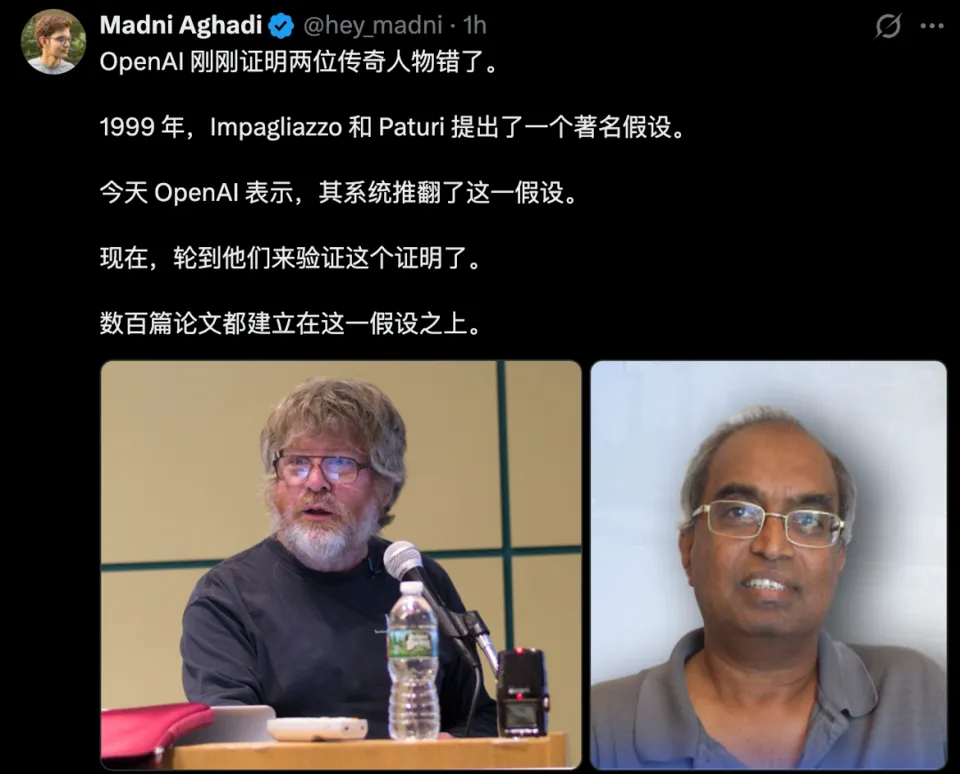
Most astonishing is the speed: from receiving the proof to completing line-by-line machine verification, the AI took only one day.
Moreover, the team responsible for reviewing the AI's work consisted of the very people who originally posed the problem, led personally by Nobel laureates who verified the calculations themselves.
Nobel laureate David Gross exclaimed, "For those unfamiliar with the field, the falsification of the ETH assumption is incredibly surprising; its impact is far-reaching."
Tsinghua University alumnus Lijie Chen couldn't help but exclaim: The Exponential Time Hypothesis is wrong!
The 30-Year Iron Law Has Collapsed
The Foundation of Hundreds of Computer Science Papers Is Shaken
Let's start with a problem every programmer cannot avoid: the Satisfiability Problem (SAT).
Given a set of logical conditions, the question is whether there exists an assignment of values that makes them all simultaneously true. It is the progenitor of NP-complete problems and is intimately linked to the Millennium Prize Problem of "P vs NP."
In the late 1990s, Russell Impagliazzo and Ramamohan Paturi proposed the "Exponential Time Hypothesis" (ETH): Problems like 3-SAT cannot be solved in "sub-exponential time"; the fastest possible solution would still be on the order of .
No one had proven this hypothesis, yet almost everyone believed it.
Consequently, over the past nearly 30 years, researchers have continuously linked other problems to it. In fields such as graph theory, databases, computational geometry, and computational biology, hundreds of papers used ETH to define the boundaries of how fast algorithms could possibly be.
And today, AI has directly proven that all of this was wrong.
OpenAI's published computer science paper bears a title with one unambiguous conclusion: The Exponential Time Hypothesis Is Wrong.
This 67-page manuscript proposes an algorithm that can even precisely count the number of satisfying assignments for a 3-SAT formula. If this count is greater than zero, it simultaneously answers whether the formula has a solution.
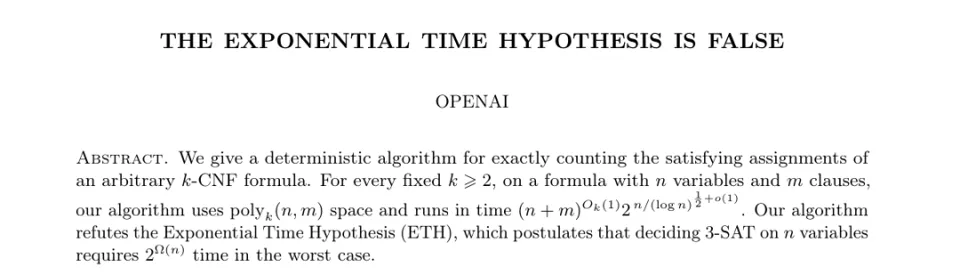
You can understand 3-SAT as a large set of mutually constraining switch rules: each rule involves three variables that are either true or false, and the task is to find an assignment such that all rules hold simultaneously.
The difficulty lies in the fact that as the number of variables increases, the possible combinations explode. The Exponential Time Hypothesis (ETH) posits that, in the worst case, solving time cannot avoid exponential costs growing with the number of variables.
The paper claims to reduce the growth rate to sub-exponential levels. While there remains a gap from polynomial time, refuting ETH does not equate to proving P=NP, nor does it imply that all hard problems will be solvable instantly tomorrow.
OpenAI also explicitly stated that translating this theory into practical speedups requires extensive subsequent research.
To verify this groundbreaking conclusion, OpenAI even brought out the very founders of ETH!
Russell Impagliazzo and Ramamohan Paturi, along with Ryan Williams, the renowned complexity theory expert from MIT, personally led the effort. This morning, Williams publicly shared the link to the paper and its claims regarding time complexity.
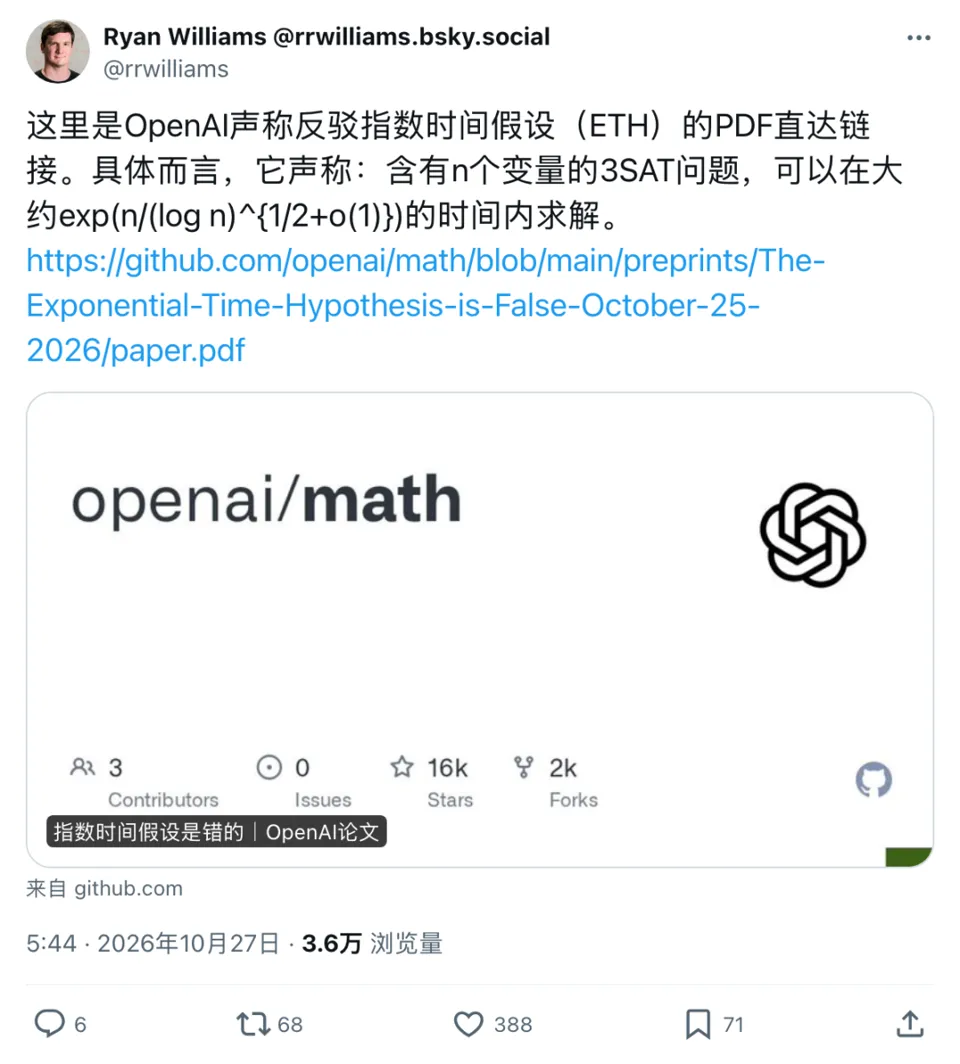
A computational limit they have studied for nearly 30 years now faces a counter-proof delivered by AI.
Similarly, OpenAI's internal AI completed the proof in just one day. It received the natural language refutation on October 16 and finished the Lean formalization on October 17.
Here, "one day" refers to the interval between two forms of proof; the public review that determines whether the result stands is currently being handled by this group of experts.
Sebastien Bubeck, OpenAI's theorist and mathematician, exclaimed that sub-exponential time for 3-SAT is the biggest surprise he has seen in his 20 years of following theoretical computer science.
He still remembers the shock he felt 25 years ago when he saw how vastly different the complexities of 3 and 2 could be.
Netizen Peter Gostev joked, "Alright, so what are the current odds for the P vs NP problem?"
Full-dimensional breakthrough!
Century-old Kakeya Conjecture swept up by AI
Let's first look at OpenAI's major discovery, which landed in the core heartland of pure mathematics—Harmonic Analysis.
In the mathematical community, there is a famous century-old problem known as the "Kakeya conjecture."
In 1917, Japanese mathematician Sōichi Kakeya posed a question: What is the minimum area required to rotate a needle of length 1 by 180 degrees on a plane?
Intuition tells you that drawing a circle should suffice.
But in 1928, mathematician Abram Besicovitch provided a counter-intuitive answer: the area can be arbitrarily small, approaching zero.
The problem did not end there but instead grew deeper. Mathematicians turned to asking: Can the "dimension" of a set containing line segments in all directions also be compressed, even if its area is zero?
This is the Kakeya conjecture, which asserts that in n-dimensional space, such a set must be full-dimensional.
This seemingly naive problem was later proven to connect to the neural hubs of harmonic analysis, partial differential equations, number theory, and combinatorics.
Those familiar with the field know that in 2019, Larry Guth, Hong Wang, and Ruixiang Zhang proved the local smoothing conjecture in two dimensions; in 2025, Hong Wang and Joshua Zahl conquered the three-dimensional Kakeya conjecture, causing a sensation in the entire mathematical community.
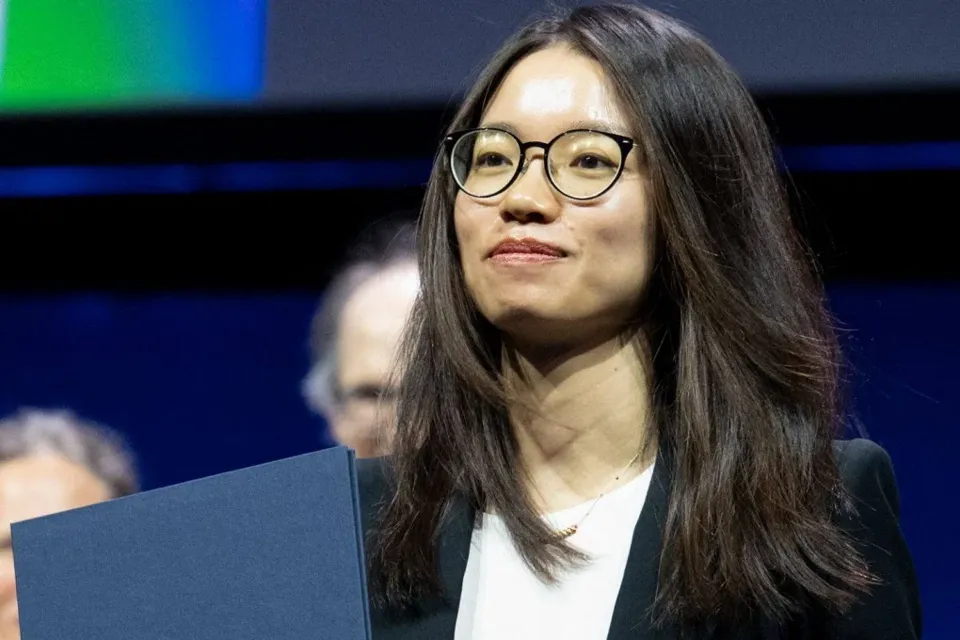
And this time, OpenAI's model directly pushed the "local smoothing conjecture" to all dimensions.
This conjecture, proposed by Sogge in 1991, imagines waves from different directions converging at a single moment, causing local intensity to spike dramatically.
The core insight of the conjecture is that such extreme focusing cannot persist for long; when averaged over time, the degree of concentration is significantly milder than at the worst-case instant.
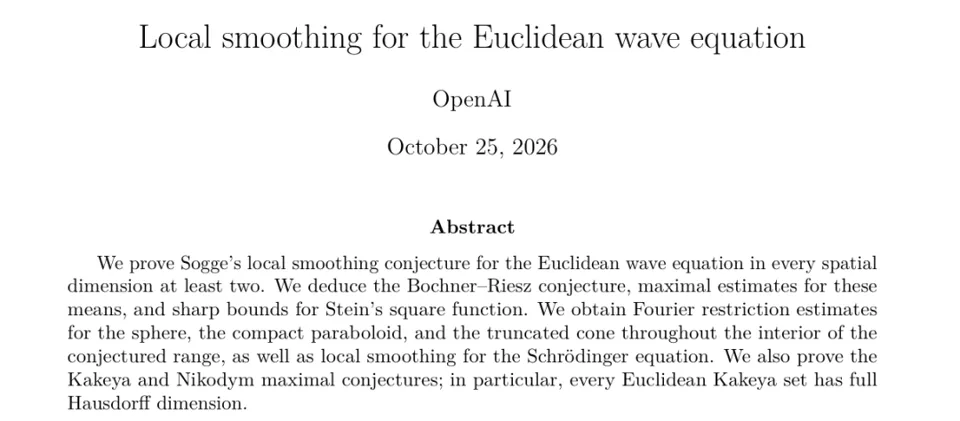
This principle underpins an entire field of analysis. OpenAI states that the model provided proofs for all spatial dimensions using a novel auxiliary partial differential equation.
It serves as a "master conjecture": once established, the Kakeya conjecture and the Stein restriction conjecture would fall like dominoes.
The latter investigates what estimates remain valid when restricting the Fourier transform to certain surfaces, closely relating to how waves propagate and concentrate.
From receiving the natural language proof on October 18 to completing Lean formal verification the next day, AI accomplished this in just one day.
The significance of this result lies in using a more upstream analytical tool to drive forward a whole group of longstanding problems.
Led by Nobel Laureates
A Millennium Prize Physics Holy Grail Cracked
The theoretical physics working group is led by David Gross.
In 1973, he co-discovered asymptotic freedom: at extremely short distances and high energies, strong interactions actually weaken. This discovery helped establish Quantum Chromodynamics (QCD) and earned him the 2004 Nobel Prize in Physics alongside two other scientists.
Now, he is involved in understanding and reviewing the proof submitted by AI regarding the mathematical foundations of this theory.
Quantum Chromodynamics (QCD) describes the strong interaction between quarks and gluons. Pure Yang–Mills theory removes matter fields such as quarks, retaining only the self-interactions of gauge fields like gluons.
Physicists have long used quantum field theory to explain and calculate numerous phenomena, but rigorously constructing these interactions as mathematical objects in four-dimensional spacetime remains a profound foundational challenge. There is a distinct difference between formulas yielding successful calculations and the complete mathematical construction of the entire theory.
OpenAI states that this time, the model followed Balaban’s method in constructive quantum field theory to provide existence proofs for certain four-dimensional gauge and fermion theories, covering QCD and a grand unified completion including the Standard Model’s gauge fields and fermions.
Notably, the existence proof for pure Yang–Mills theory touches upon part of a Millennium Prize Problem. The full answer required by the Clay Mathematics Institute also includes the mass gap—meaning non-vacuum excitations cannot have energy arbitrarily close to the vacuum. This announcement did not claim to resolve that portion.

Joining Gross are Michael Douglas, Arthur Jaffe, Igor Klebanov, and Nikita Nekrasov. Jaffe originally co-authored the formal problem statement for this Millennium Prize question with Edward Witten.
The weight of this roster lies in the fact that some members laid the groundwork for relevant physical theories, while others personally defined the prize problems. Now, they are collectively confronting new arguments proposed by machines.
The model produced the Yang–Mills existence proof on September 9 and the QCD proof on September 18.
Due to the length and complexity, OpenAI waited until October 16, after completing the Lean formalization of the Yang–Mills existence proof, before advancing this collaboration.
Scientists who helped humanity understand strong interactions half a century ago are now taking up AI’s answers, continuing to probe the deepest mathematical structures of the material world. This relay across generations carries enough weight to evoke the gravity of scientific history.
OpenAI Waives Authorship, Invests $5 Million
Precisely because the results are so significant, OpenAI has positioned these three manuscripts as "raw research data."
To translate this into scientific understanding, it piloted three modes of external academic stewardship.
For mathematical results, AI manuscripts and Lean code are made public; for computer science results, manuscripts and Lean code are released alongside expert panels; for the physics team, the decision was made to temporarily withhold raw AI outputs, with five masters first studying them privately and authoring explanatory papers themselves.
Four principles of collaboration were clearly stated.
First, transparency: no confidentiality agreements are required.
Second, no academic credit disputes: OpenAI does not seek academic attribution for original discoveries generated by its internal models.
Third, recognition of interpretation: working groups receive academic credit for the scientific understanding they develop, the explanatory papers they write, and their accurate tracing of predecessors’ ideas.
Fourth, independent and unpaid participation: scholars participate voluntarily without compensation and reach conclusions entirely independently.
OpenAI contributed $5 million to the Simons Foundation. Together, the Simons Foundation, OpenAI, and Anthropic have invested $15 million in funding and computational resources to support workshops, conferences, and specialized programs, helping scientists independently review, understand, and extend AI-generated scientific discoveries.
Currently, the openai/math repository contains 721 manuscripts produced by OpenAI’s undisclosed internal models, categorized into 373 result families. The model was evaluated on approximately 4,000 open research questions, consuming about 3 hours of ChatGPT Pro-level deep thinking compute per result on average. Approximately 42% of top-level conclusions have completed Lean formalization.
A Prophecy from Three Years Ago
AI Will Not Replace Disciplines, But Reshape Them
OpenAI researcher and Wharton School professor at the University of Pennsylvania (also affiliated with the Computer Science and Mathematics departments), Wei-Jie Su, recently shared slides from a presentation he gave three years ago on X.
Slide 4 of the presentation stated that jobs characterized by complete information—where inputs and outputs are clearly defined and boundaries are distinct—are most vulnerable to disruption by AI. Beyond programmers and accountants, it specifically highlighted "perhaps also theoretical computer scientists, theoretical physicists, and (pure) mathematicians."
Su reflected that almost no one in the audience believed his predictions at the time.
Looking back, the term "replacement" is not entirely accurate. AI will not replace any academic discipline.
Instead, it will fundamentally reshape—and is already reshaping—every field by rewarding research that establishes deep connections with real-world challenges and other disciplines.
In the official announcement, OpenAI President Greg Brockman wrote that AI has begun helping us deepen our understanding of the universe.
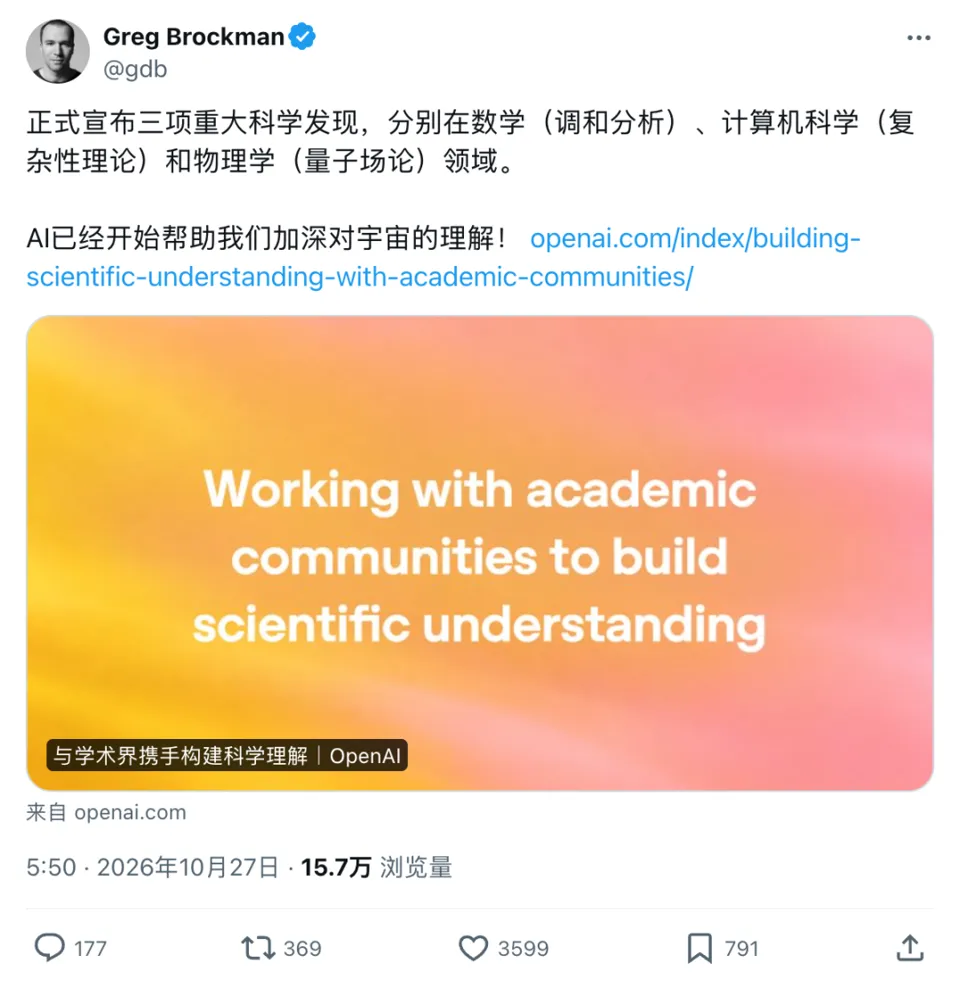
AI is transitioning from a tool for scientific assistance to an original discoverer in fundamental science.
Once results are verified, human scientific research will enter a new phase: "AI discovers first, humans verify and understand." Both the pace of scientific breakthroughs and academic evaluation systems will undergo significant transformation.
References:
Instantly Tracking ASI
⭐ Like, Share, and Watch ⭐
Star us to lock in rapid updates from New Intelligence Era!