Intel Q3 Revenue Beats Estimates; DCAI Segment Surges Nearly 80%
Intel reported its FY2026 Q3 results with total revenue reaching $16.5 billion, up 21% year-over-year. The Data Center and AI (DCAI) segment was the primary driver, posting nearly 80% YoY growth—the strongest in 15 years. Intel highlighted the energy efficiency of CPUs for AI agent infrastructure and confirmed shipments of its first Intel 18A server chips.
Full Report
IT Home reported on October 30 that during the Q3 FY2026 earnings call (covering June 28 to September 26, 2026), held on Thursday, October 29 at 2 PM Pacific Time (5 AM Beijing Time on October 30), CEO Lip-Bu Tan stated that the Data Center and AI (DCAI) segment was the quarter's biggest highlight, achieving its strongest revenue growth in 15 years and driving overall results above expectations.
Intel reported quarterly revenue of $16.5 billion (approx. RMB 110.229 billion at current exchange rates), up 21% year-over-year. DCAI revenue reached $7.3 billion (approx. RMB 48.768 billion), growing nearly 80% year-over-year and marking its strongest growth in 15 years.
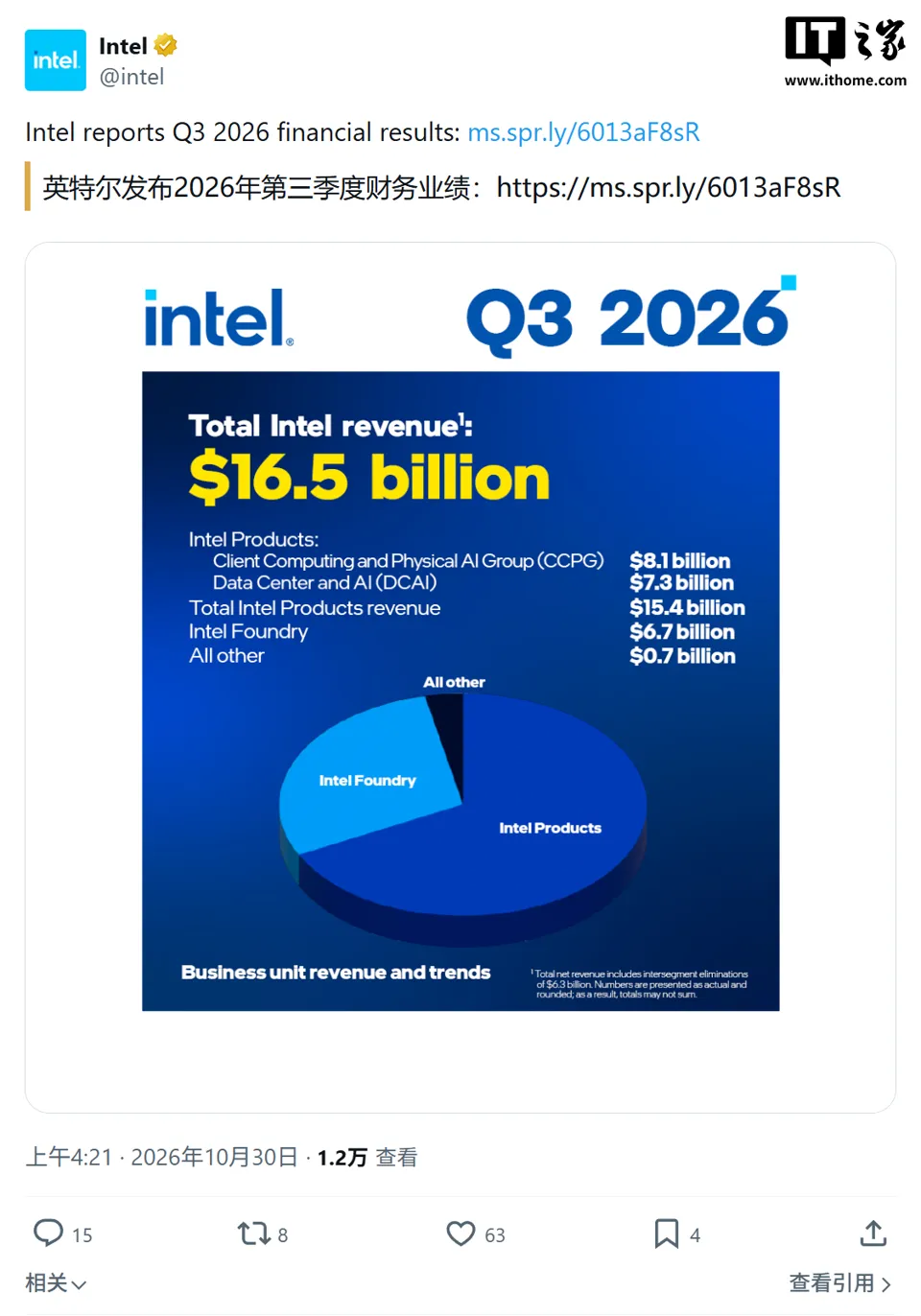
Lip-Bu Tan noted that Granite Rapids (built on Intel 3 process) has become one of the fastest-ramping server products. The first Intel 18A server chip, Clearwater Forest, has shipped with revenue recognized, showing high demand for 2027, particularly for high-density CPU and agentic AI rack-scale infrastructure scenarios.

The DCAI segment generated $3 billion in operating profit this quarter (approx. RMB 20.042 billion), accounting for 42% of the segment's revenue, an increase of $600 million (approx. RMB 4.008 billion) quarter-over-quarter. Intel presented a new perspective on AI infrastructure: GPUs excel at "thinking tasks" in AI, while CPUs are more energy-efficient for lookup-type tasks. Even with conservative estimates, the Total Addressable Market (TAM) for CPUs targeting digital agents over the next five years is substantial.
Lip-Bu Tan stated that purpose-built silicon remains Intel's fastest-growing business segment, having tripled in size over the past three years, with expectations to triple again in the coming years.
Regarding the PC client business, Lip-Bu Tan noted that despite the Client Computing Group (CCPG) total revenue declining 5% year-over-year, AI PC revenue still grew 35% year-over-year. The edge computing business demonstrated strong resilience, with Edge and Physical AI continuing to secure new customer design wins.

Panther Lake (Intel 18A) has successfully completed volume ramp-up; Wildcat Lake faced supply shortages and sold out completely, with shipments increasing approximately 70% quarter-over-quarter. Development progress on Nova Lake (the first Intel 18A-P client chip) is ahead of schedule, with expected customer design-ins at launch projected to be double those of Panther Lake.
In terms of foundry operations, yields for Intel 3 and Intel 18A continued to improve this quarter, with Intel 18A yields seeing double-digit percentage improvements. Wafer output for both nodes exceeded internal expectations.

Intel 18A-P is on track for internal product implementation by year-end, with external customer partnerships expanding continuously. Progress on the next-generation Intel 14A is normal; a high-quality version 0.9 PDK (Process Design Kit) was released to select customers in October, meeting industry yield and performance standards upon release.
Regarding corporate transformation, Lip-Bu Tan stated that over the past 18 months, Intel has completed significant organizational restructuring: reducing headcount, eliminating middle-management redundancies, reshaping an engineering-first culture, streamlining product lines, and updating product and foundry roadmaps. However, management acknowledged that much work remains to be done.
Beyond its traditional x86 CPU core business, Intel is heavily betting on three new multi-billion-dollar tracks: purpose-built silicon, advanced packaging, and external wafer foundry services. Although current revenues in these areas are small, they possess strong growth momentum.