OpenAI Models Launch on Google Cloud, Completing Big Three Coverage
OpenAI has partnered with Google Cloud to launch the GPT-6 series and Codex on its platform. This move ends OpenAI's exclusive distribution era with Azure, completing coverage across all three major US cloud providers (AWS, Azure, GCP) and allowing enterprises to access competing models via unified billing.
Full Report
Contents10 sections
Wow, Google Cloud has started selling GPT models.
By Wen Ting
Quantum Bit | Official Account: QbitAI
Whoa, GPT is moving into the Gemini household!
Just today, OpenAI and Google Cloud officially announced a partnership:
GPT-6 Astra, GPT-6.1 Sol, GPT-6 Luna, and Codex will be officially launched on Google Cloud. The first batch of models is currently available to select enterprise customers, with plans to integrate them into Google Antigravity and Gemini Agent soon.
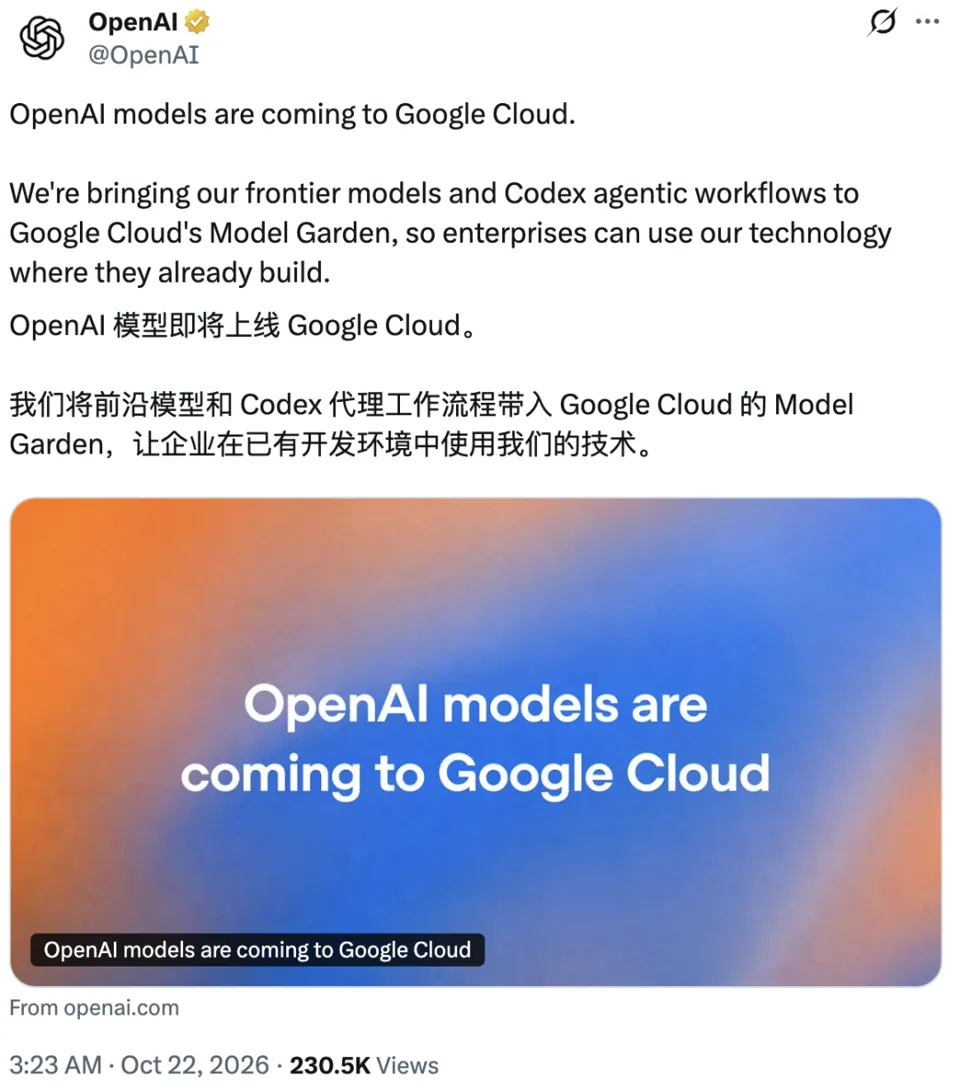
△**Official announcement post, see Blog for details
Wait, aren't these two still fiercely competing in the large model, search, and coding agent arenas?!
How did they suddenly transform from arch-rivals into channel partners, doing business with each other?

More importantly, following Azure and AWS, OpenAI has now officially secured partnerships with all three major US cloud providers.
Once tightly locked into Azure, OpenAI is completely ending its era of exclusive distribution.
Arch-Rivals Start Selling Each Other's Goods
Currently, GPT-6 Astra, GPT-6.1 Sol, and GPT-6 Luna have entered Google Cloud's Model Garden and are open for private preview to select enterprise customers.
Enterprises can directly call these models via Google Cloud APIs, or connect their local Codex CLI and desktop workflows to Google's Gemini platform, allowing Codex to perform inference through Google Cloud.
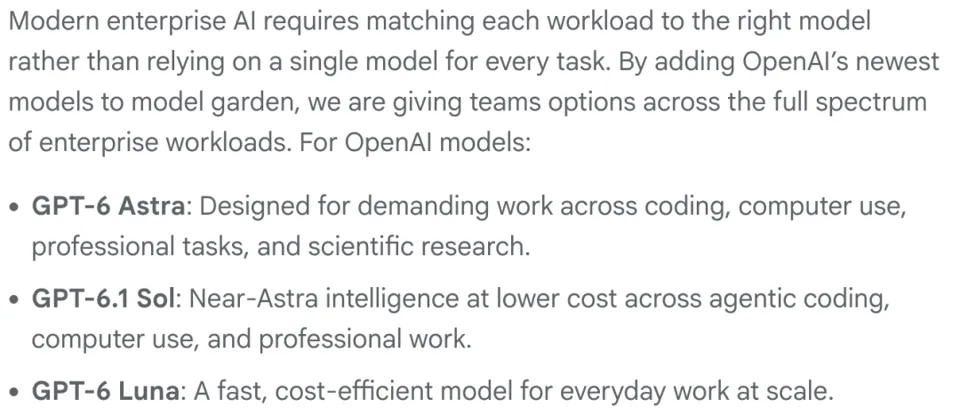
△**Image source: Google Blog
OpenAI stated that they will roll out full availability plans within the next few weeks.
Two key aspects of this collaboration likely resonate most with enterprise customers:
-
Enterprises can purchase OpenAI models directly from the Google Cloud Marketplace using funds from their Google Cloud accounts.
-
Billing for calls to different models can be consolidated onto a single Google Cloud invoice, and may even be included in cross-model Flexible Savings Plans.
This means enterprises can freely switch between models from both vendors without renegotiating contracts or opening separate billing accounts.
When needed, users can simply select the desired models within their familiar Google Cloud environment.
Meanwhile, enterprises can continue to leverage existing Google Cloud data governance, security, and access control systems; prompts, context, and outputs remain within designated data boundaries, while model calls pass through isolated gateways and unified authentication.
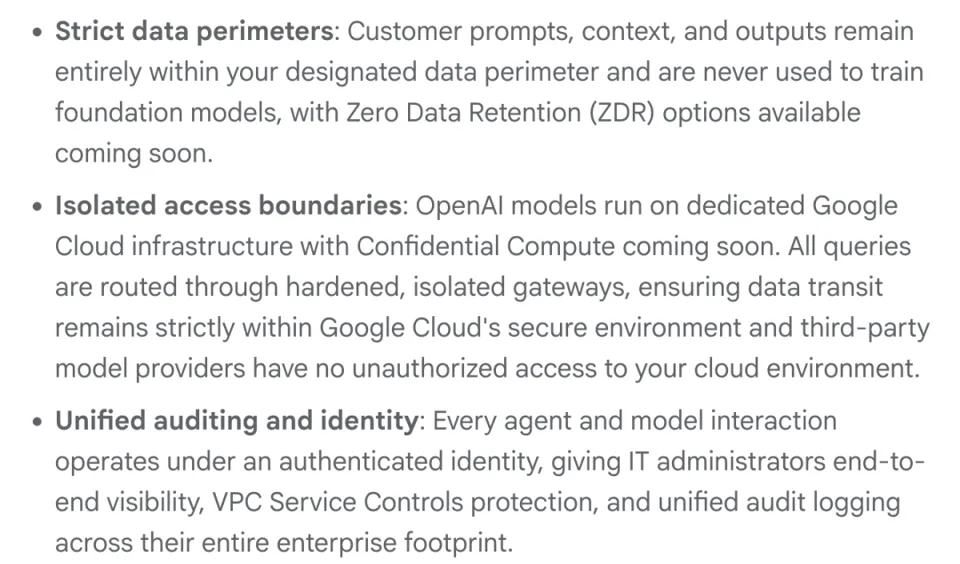
Once OpenAI's models are integrated into Google Antigravity and Gemini Agent in the future, users will be able to flexibly switch models based on specific needs.
Google Cloud seems quite proud of this development, boasting in their blog post:
We are the only hyperscale cloud provider offering the top three closed-source large models, along with over 200 proprietary, third-party, and open-source models!
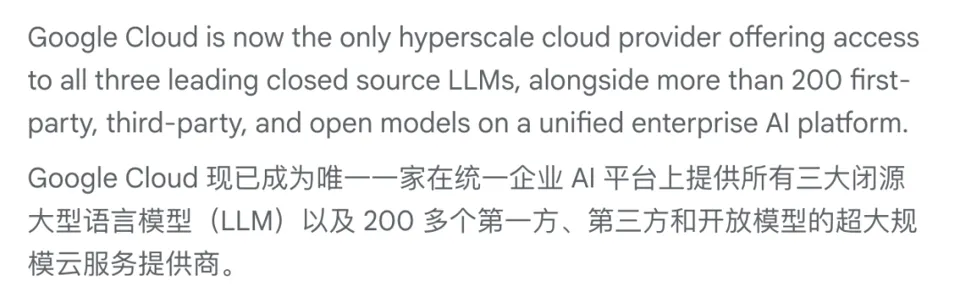
△**Look at that pride
OpenAI Completes the Big Three Clouds in Six Months
At this point, some readers might ask:
Wait, wasn't OpenAI previously exclusively bound to Azure?

Correct.
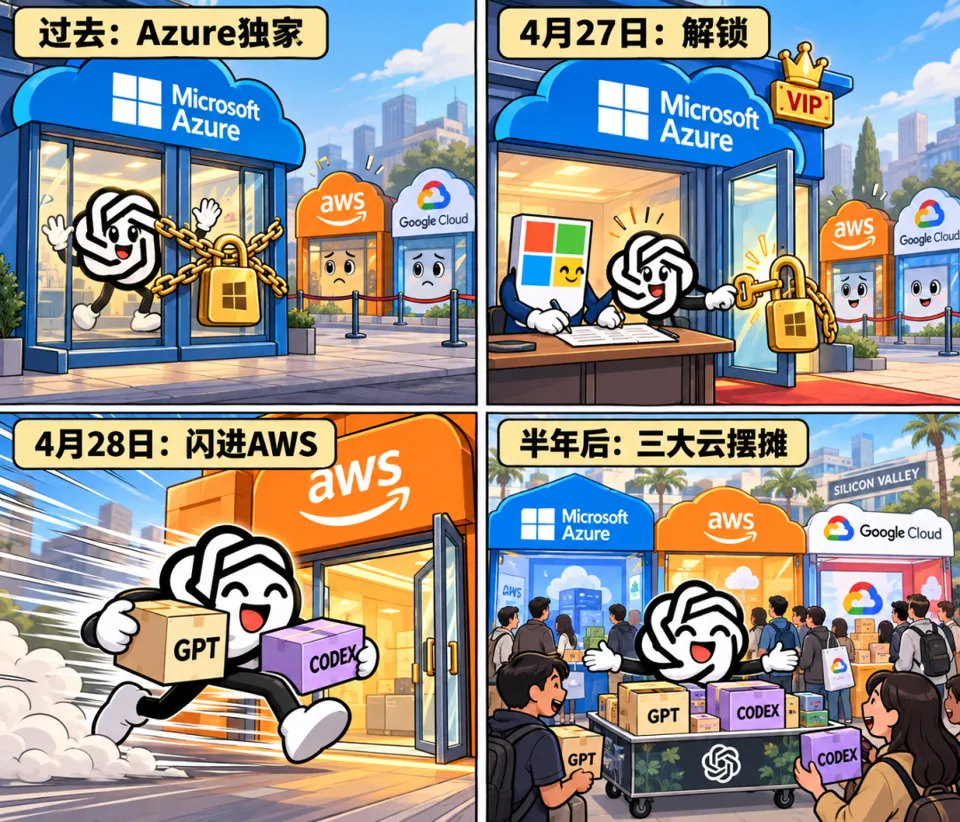
In the past, Azure held the exclusive cloud distribution rights for OpenAI's stateless APIs.
Even if OpenAI partnered with other vendors, related API calls were, in principle, required to run on Azure.
However, on April 27th of this year, this exclusive binding finally loosened.
Microsoft and OpenAI revised their partnership agreement, removing this exclusivity clause.
From then on, OpenAI can deliver products to customers through any cloud platform, and Microsoft's licensing of OpenAI models and products has become non-exclusive.
The door had barely opened when OpenAI slipped into AWS the very next day.
On April 28, GPT and Codex rapidly migrated to Amazon Bedrock.
AWS customers can now invoke these models using their existing identities and enterprise control frameworks, with costs eligible for credit against committed cloud spend.
Now, OpenAI has taken another step into Google Cloud.
From Azure exclusivity to AWS, and then to Google Cloud, OpenAI managed to deploy its models across all three major US cloud providers in just six months.
Wherever enterprise workloads reside, OpenAI follows suit to sell there—adopting a strategy of "selling wherever they go."
Meanwhile, Microsoft hasn't been left behind by OpenAI.
Under the new agreement from April, Microsoft remains OpenAI's primary cloud partner, and OpenAI products will continue to launch on Azure first.
True to its status as the "first love," Microsoft's position remains secure.
However, Azure is no longer exclusive; neighboring AWS and Google Cloud can finally offer the same models.
**
△**AI-generated image
Models Fight Hard, Cloud Providers Quietly Collect Revenue
As everyone knows, GPT and Gemini are long-standing rivals, constantly battling in the arena.
So why have OpenAI and Google Cloud suddenly joined hands?
In reality, both parties are calculating their own strategic advantages.
OpenAI is targeting enterprise customers.
When enterprises procure AI models, their decision criteria have moved beyond leaderboard rankings.
Data residency, existing contractual commitments, and where security and audit frameworks operate on specific clouds directly influence final choices.
Consequently, OpenAI is leveraging the customer relationships already established by cloud providers.
If an enterprise hosts workloads on Azure, OpenAI sells there; if workloads run on AWS, it integrates into Bedrock;
If data resides in Google Cloud, it brings GPT and Codex into the Model Garden.
Customers don't need to bypass OpenAI's own API platform; GPT enters the environments where clients work daily.
**
△**AI-generated image
Google Cloud, on the other hand, is focused on the platform business.
If customers choose Gemini, Google earns revenue directly from the model;
If customers choose GPT, even though the model belongs to a competitor, Google still secures revenue from Marketplace, cloud infrastructure, data governance, and security services.
Indeed, the fiercer the competition between models, the more enterprises seek to switch between them based on specific tasks, thereby increasing the value of Google Cloud as a "model marketplace."
**
△**AI-generated image
As for enterprises, what they really want comes down to two words: convenience.
Without needing to migrate data, switch cloud platforms, or sign a new set of vendor contracts, they can route different tasks to Gemini, GPT, or Claude based on capability, latency, and cost.
Previously, choosing a model often felt like betting on one horse and having the whole family follow suit;
But now, within the same cloud platform, there is already a full shelf of options. You pick whoever works best, switch to whoever is cheaper—it’s truly much more convenient.
**
△**AI-generated image
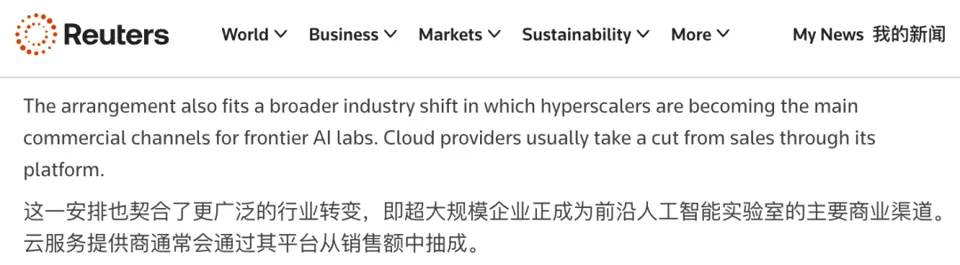
Reuters also summarized this as a broader industry trend:
Hyperscale cloud providers like Microsoft, AWS, and Google Cloud are becoming the most important commercial distribution channels for frontier model labs.
In this dynamic, model companies focus on building products and competing on capabilities;
Cloud providers, meanwhile, hold onto enterprise customers, procurement entry points, and billing systems, taking a cut from every transaction.
**
△**Image source: Reuters
So, in the arena of model competition, GPT and Gemini will still have to fight it out;
But off the stage, Google Cloud has quietly set up a shelf for GPT.
Competition is competition, business is business—these folks in Silicon Valley certainly know how to manage their affairs (doge).
One More Thing
Ironically, while they shook hands where necessary, Sam Altman and Sundar Pichai haven’t held back on the rivalry either.
Recently, Altman made a snide remark:
Google is just bolting AI onto legacy products like Search. OpenAI’s approach of building AI-native products from scratch is the true path to success.
In an instant, Pichai fired back sharply on the same Alex Kantrowitz podcast:
The Gemini App was built from the ground up as an AI product. By that logic, since everyone is now integrating Agents into their products, isn’t OpenAI also bolting Agents onto ChatGPT?
The boomerang had barely completed its loop when, the next day, GPT was served up on Google Cloud.
Hmm... you two keep loving and fighting like this.
References: [1]https://x.com/OpenAI/status/2112988118471295323 [2]https://www.cnbc.com/2026/10/21/openai-bring-its-ai-models-to-googles-cloud-expands-beyond-microsoft.html [3]https://cloud.google.com/blog/products/ai-machine-learning/google-cloud-brings-openai-models-to-customers?utm_source=chatgpt.com [4]https://openai.com/zh-Hans-CN/index/openai-models-google-cloud/?utm_source=chatgpt.com
Like, Share, and Save!
We welcome your thoughts in the comments section!
— End —
🌟 Star Us 🌟
Daily updates on cutting-edge tech developments