Anthropic Kicks Off IPO Roadshow at $1.4 Trillion Valuation
Anthropic has officially launched its IPO roadshow, planning to offer 825 million shares at $70-78 each for a deal size of up to roughly $64.35 billion, with trading on Nasdaq under ticker ANT expected November 19. Amid a broad AI sector selloff, its potential valuation has fallen from about $2 trillion to roughly $1.4 trillion, a drop of around 30%, while early shareholders could cash out $22.1-24.6 billion on day one.
Related Entities
Full Report
Contents2 sections
The whole world is hitting the brakes, while Dario alone steps on the gas
henry, reporting from the Non-Office QuantumBit | WeChat Official Account QbitAI
Even if it means catching a falling knife bare-handed, he's determined to land a big result!
Honestly, at the start, probably no one could have imagined that A-Society's once-largest-ever IPO could turn out this brutally, or that Dario Amodei's head could be this tough.
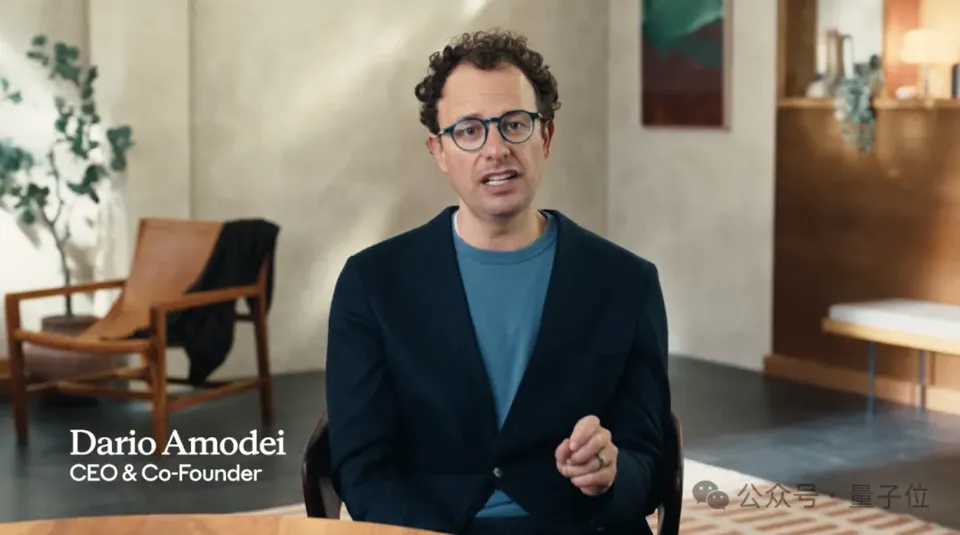
Just moments ago, the IPO roadshow for Anthropic, the parent company of Claude, officially kicked off, dispelling earlier rumors of withdrawal and postponement.
As planned, Anthropic intends to issue 825 million shares at a price of $70–78 per share, with the IPO transaction size reaching up to approximately $64.35 billion, scheduled to begin trading on Nasdaq on November 19 under the ticker symbol ANT.
At that time, non-founder directors, executives, current and former employees, and consultants may sell up to 10% of their prescribed baseline holdings starting from the first trading day, corresponding to up to approximately 316 million shares.
In other words, on the first day of listing, A-Society's early shareholders will have the opportunity to cash out $22.1–24.6 billion (roughly RMB 150 billion).
Similarly, investors looking to buy A-Society that day will face the same amount of selling pressure.
TBH, in the eyes of ordinary folks like us, those $20-plus billion would be more than enough for many people to settle down comfortably in the Bay Area, but measured against A-Society's earlier expectations, we have to say this is a severely shrunken, middling result.
Why? First, some background:
On November 2, Anthropic updated its prospectus. Although Q3 still surged 47%, the growth rate had already slowed by 67% compared to Q2.
On November 5, the Nasdaq Composite Index fell about 5.5% in a single day, marking the largest single-day drop since April 2025.
On the same day, bonds of AI cloud service provider CoreWeave were sold off, with some bond yields spiking above 17%.
...
It's fair to say that right as A-Society approached its big listing day, the global AI sector had already collectively descended into panic: valuations that needed to be slashed were slashed, blowups that needed to happen happened, and debts that needed repaying were repaid.
Back and forth, A-Society's potential IPO valuation has shrunk from the $2 trillion previously discussed in the market to about $1.4 trillion, a decline of roughly 30%.
Even more, on a fully diluted basis, this figure is already below the approximately $1.77 trillion market cap of SpaceX at its listing.
Quite a few employees also took advantage of this period to skip waiting for Dario to ring the bell at Nasdaq and fled from A-Society to OpenAI overnight.
And so, rumors of A-Society postponing or suspending its listing emerged...
However, with today's roadshow, we can only say that the lone ranger Dario has withstood the pressure.
Falling knives from the periphery can be caught, its own valuation can be lowered, employees can leave, and shareholders can line up waiting to cash out—but this trillion-dollar IPO's big result?
I, Dario, must absolutely nail it.
The whole world is hitting the brakes, while Dario alone steps on the gas
Although the valuation has shrunk severely, to be fair and objective, Anthropic's growth rate is already enough to earn a place in the history of technology.
Anthropic was founded in January 2021 by former OpenAI VP of Research Dario Amodei, his sister Daniela Amodei, and several former OpenAI researchers.
According to the roadshow PPT, since officially launching commercialization in Q1 2023, by Q3 2026, Anthropic's single-quarter revenue has already approached $17 billion.
Interestingly, according to the pie in the sky that A-Society has drawn, this $17 billion is merely the midpoint of the exponential curve.
Further up, there's knowledge work estimated to be worth over $40 trillion in economic value annually, as well as life sciences, robotics, and more fields.
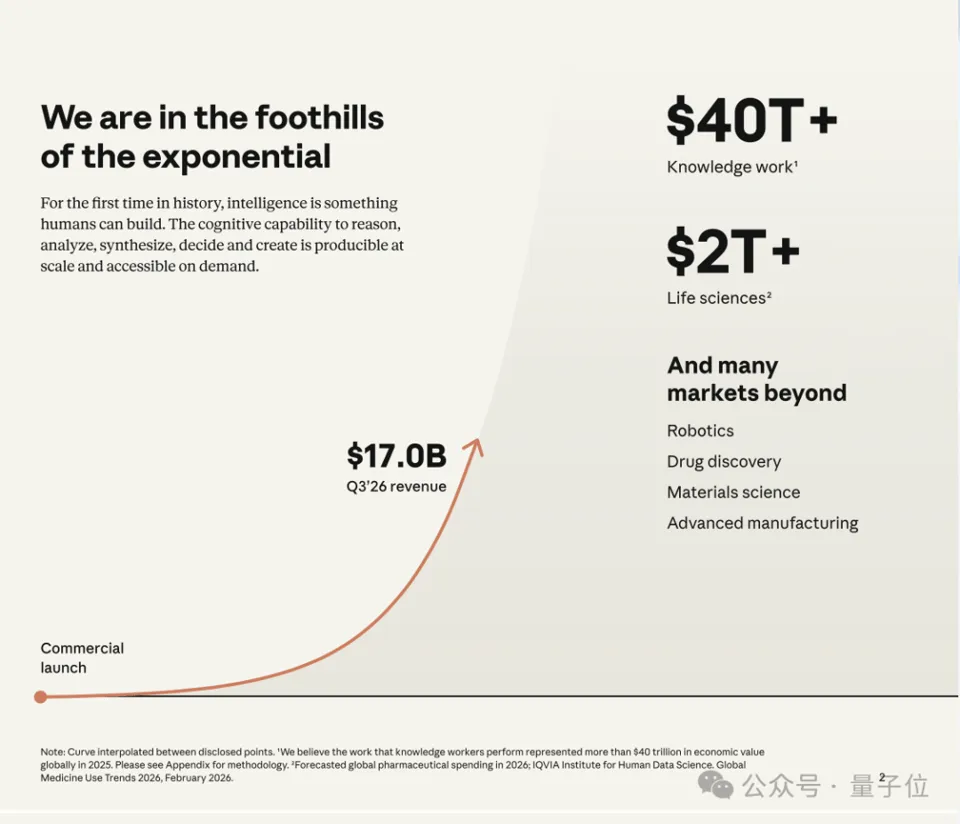
Although the picture is drawn a bit too starry-eyed, one has to admit that in less than six years, from an AI startup to what was once the largest IPO in history, A-Society has indeed delivered growth close to exponential.
Based on the upper limit of the offering price and post-issuance basic share capital, A-Society's equity value is approximately $1 trillion, equivalent to about four Alibabas.
On a fully diluted basis including options, restricted stock, and other potential shares, the valuation reaches approximately $1.4 trillion, second only to the largest IPO in history that merged xAI and SpaceX.
According to the roadshow materials, the 825 million shares offered in A-Society's IPO include approximately 801 million newly issued shares and approximately 23.65 million shares sold by existing shareholders.
What's truly worth mentioning here is the $26 billion in private placement funds that a group of compute sugar daddies are preparing to fork out simultaneously.
Among them, Google and Nvidia each contribute $10 billion, AMD $2.5 billion, Broadcom, Micron, and Microsoft $1 billion each, and TSMC's investment entity $500 million.

In other words, the IPO itself raises up to $64.35 billion, plus this $26 billion strategic private placement, bringing the overall financing scale to nearly $90.4 billion at most.
Of course, as for how this money will ultimately flow and at what price it will enter the sugar daddies' pockets, that still depends on Dario's subsequent maneuvers.
On the operating data front, as we said at the beginning, A-Society's revenue growth remains exaggerated, but compute spending is still expanding further, and the growth curve has thus been flattened.
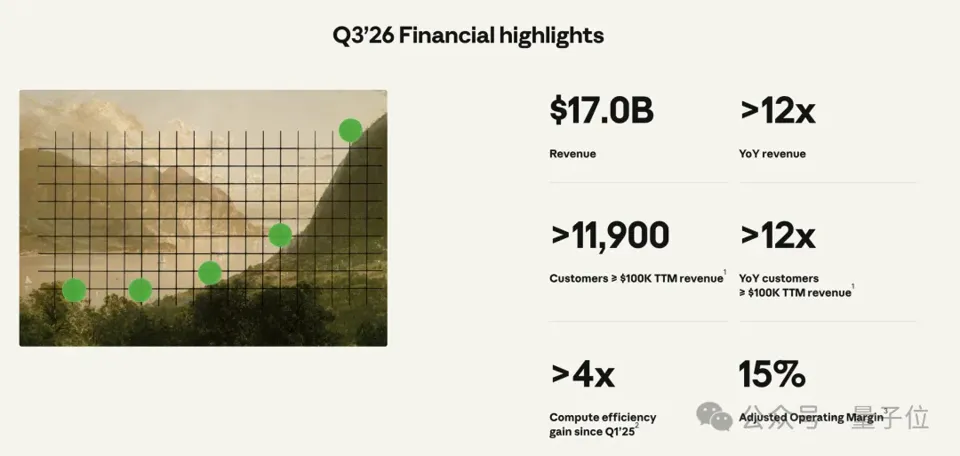
In Q3, Anthropic's revenue was $16.956 billion, 12.27 times that of the same period last year, up about 47% quarter-over-quarter, but markedly slower compared to Q2.
Looking at the full year, A-Society's cumulative revenue for the first nine months was $33.242 billion, and the annualized revenue run rate disclosed on October 31 had already reached approximately $81 billion.
Meanwhile, customers contributing at least $100,000 in revenue over the past 12 months have exceeded 11,900. Compared to more than 950 at the end of September 2025, that's over a 12-fold increase in one year.
Among them, more than 1,900 customers contribute $1 million or more in annual revenue, and about 250 customers contribute over $10 million.
Even more exaggerated, by A-Society's own accounting, the net revenue retention rate of existing customers has reached approximately 900%.
This also means that Anthropic's growth does not rely entirely on constantly acquiring new customers, but rather on continuously tapping the payment potential of existing enterprise customers.
From this perspective, Dario has indeed delivered a rather impressive commercialization report card.
But the problem lies precisely here.
As reflected by the panic on Wall Street over the past two days, the market is no longer really doubting whether AI is useful; instead, it has begun seriously reckoning with another question:
Can the revenue brought in by AI actually cover the massive compute spending and data center investment behind it? Does this business really have sufficiently good economics?
For Anthropic, expensive compute procurement is making this nearly exponential growth curve come at an increasingly high cost.
In the third quarter, Anthropic's compute and infrastructure expenses reached $9.863 billion, rising from 48% of revenue in the previous quarter to 58%.
The company explained that the newly delivered compute in the quarter included about $5 billion of short-term resources, priced significantly higher than comparable resources procured through multi-year agreements.
In plain terms, because demand grew too fast, Anthropic had to pay a premium for short-term compute that could be put into service immediately.
As a result, Anthropic's adjusted operating profit rose from $2.235 billion in the previous quarter to $2.463 billion, but its adjusted operating margin fell from 19% to 15%.
Calculated under US GAAP, the quarter's operating loss was $567 million.
Beyond the current quarter's costs, Anthropic and Dario also have a massive bill stretching out over the next decade.
It is reported that to support future growth, Anthropic has already signed approximately $900 billion in related procurement and leasing commitments.
Of that, about $451.6 billion is expected to be incurred before the end of 2030, with most of the remainder scheduled between 2031 and 2045; about $70.7 billion needs to be paid within the 12 months after the end of September 2026.
In other words, while businesses beyond Coding that can sustainably generate cash still need further validation, Anthropic has already locked in data center and chip resources for the next decade or more.
Is this borrowing from the future, or continuing exponential scaling? At least today, that remains an open question.
How to cut costs and improve efficiency?
During this roadshow, Anthropic also presented its cost-cutting and efficiency-improvement plan.
On one hand, it combines multiple chips—AWS Trainium, Google TPU, Nvidia and AMD GPUs—to match more suitable compute to each task;
on the other hand, it directly leases chips and deploys data centers through Anthropic Direct to lower long-term compute costs.
Meanwhile, according to roadshow disclosures, the amount of code contributed daily by Anthropic engineers has reached 45 times the 2024 average.
Previously, when adapting to AMD GPUs, the company even had Mythos complete the porting and writing of nearly all low-level compute kernels within three days.
It is fair to say that when it comes to getting AI involved in a company's own R&D and production processes, Dario has already charged ahead—
using AI to lower training and R&D costs on one side, while also making AI generate more revenue on the other.
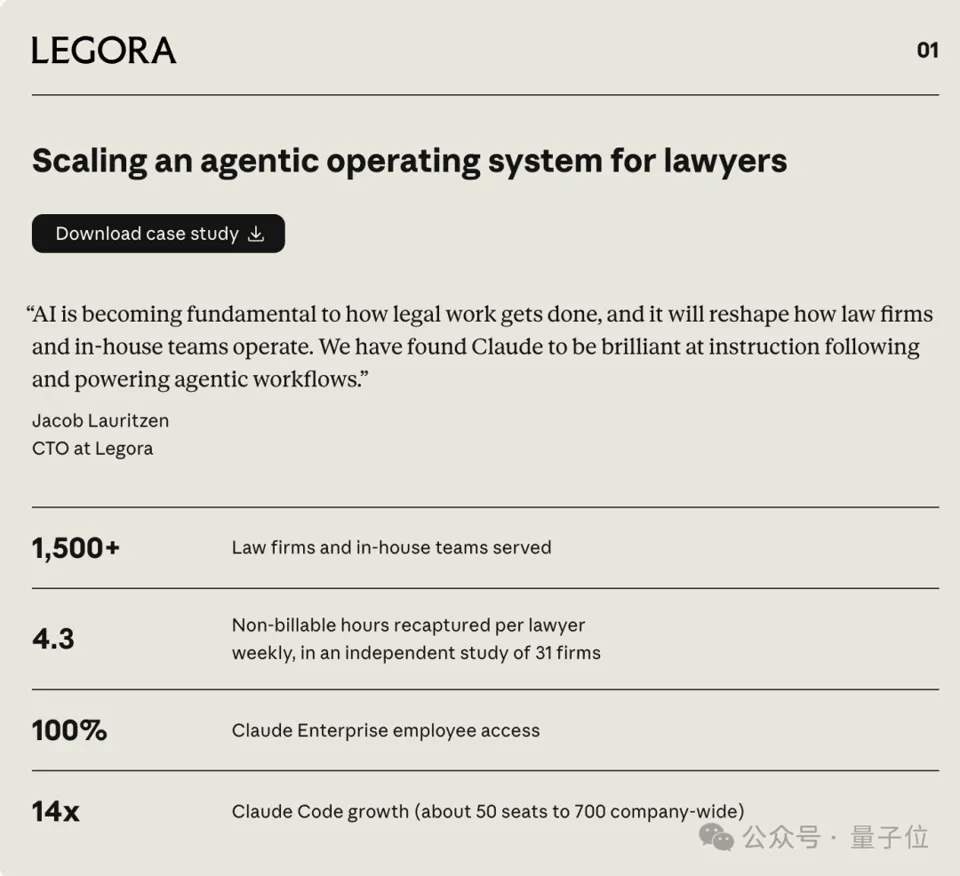
Anthropic is also further replicating the business model already validated by Coding into more knowledge-work scenarios.
For example, just today, Claude released a series of office products, including Claude Sheets, Claude Whiteboards, and Claude Data.

Combined with integrations with third-party applications such as Adobe and Notion, Claude is trying to connect spreadsheet processing, data analysis, collaboration, and content production.
In the short term, office AI will be the core scenario Anthropic bets on, while further out there are even larger markets such as life sciences and robotics.
However, now that the story has reached this point, Wall Street still seems to have its own views.
In the comment section of CNBC's report on this IPO roadshow, the screen was full of short sellers:
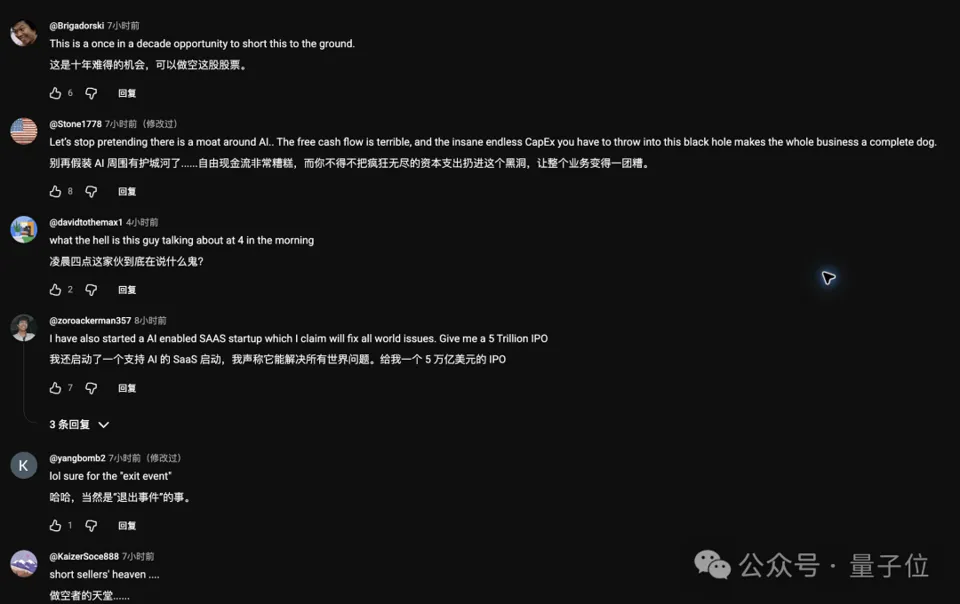
Dario is still doubling down on the future of AI, while the bears have already set their sights on this IPO.
Whether next week brings more danger than promise, or whether the clouds will finally part, will be clear when the time comes.
By the way, according to Bloomberg, Dario also plans to hold a live conversation with JPMorgan CEO Jamie Dimon tomorrow. Those interested can tune in.
Reference links [1]https://ipo.anthropic.com/us/#founders-letter