Princeton and Meta Propose Self-Direction for Continuous Agent Improvement via LoRA Adapters
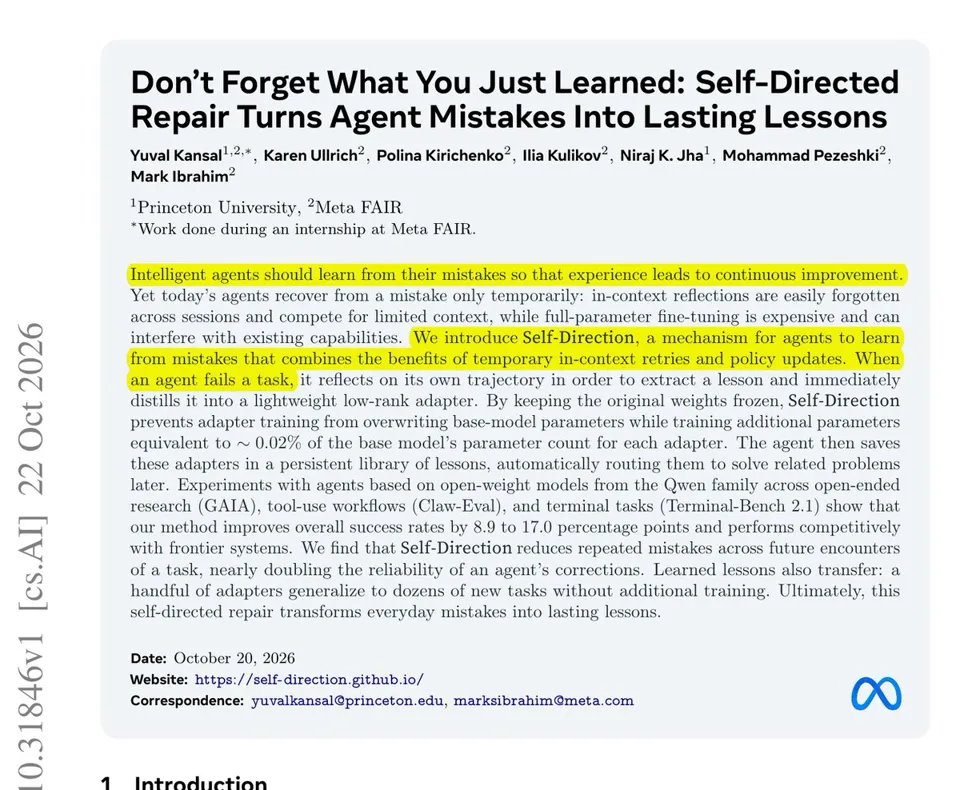
Princeton University and Meta released a new paper proposing the 'Self-Direction' framework, which trains error-fixing experiences into tiny LoRA adapters and dynamically routes them to solve issues of forgotten context notes and costly full fine-tuning. Using Qwen3.6-27B, this method boosted GAIA task success rates from 38.8% to 55.8%, significantly outperforming prompt-based reflection techniques.
Full Report
Rohan Paul (@rohanpaul_ai) · 2026-10-29 20
Nice new paper on continuous improvement of AI agents from Princeton and Meta
Finds that agents repeat fewer mistakes when each fix is saved as a LoRA adapter and reused on similar tasks.
Agents can fix a mistake within a session, then often repeat it in the next one. Notes in context get forgotten, and full fine-tuning is costly and can disrupt other skills.
With Self-Direction, a failing agent reflects on its run and trains the lesson into a LoRA adapter about 0.02% of the model's size. A router later loads the closest adapter when the agent fails a similar task.
With Qwen3.6-27B, task success on GAIA rose from 38.8% to 55.8%, beating in-context reflections and a Skills.md file. Across 185 earlier mistakes, 67.3% of repairs still worked by the third encounter, against 42.9% for plain retrying.
If your agents keep making the same mistakes, save each fix as a small adapter they can reload, not only as prompt notes.