Google Launches Gemini 4 Argon: Matches GPT-6 Performance with Limited-Time API Discount
Google officially released its flagship model, Gemini 4 Argon, demonstrating significant improvements in multimodal capabilities, coding, and complex task execution. Third-party benchmarks place its intelligence index on par with GPT-6 Astra and Claude Opus 5.5. The model emphasizes cost-efficiency, offering API pricing approximately 39% lower than competitors, alongside a limited-time 50% discount to regain market share.
Full Report
Contents4 sections
henry, writing from Aofeisi QbitAI | WeChat Official Account: QbitAI
If you ask me, Google is essentially a seasonal climate model company. When the weather cools down, their flagship models ripen.
Just now, Gemini 4 Argon has officially begun rolling out to global developers, enterprises, and paid subscribers.
According to Google’s positioning, this generation primarily strengthens programming capabilities, professional knowledge work, and sustained execution of complex tasks. It also pushes its previously strong visual understanding, spatial reasoning, and tool-calling abilities further to the frontier.
In the official demos, it is clear that multimodal capabilities are where Gemini 4 Argon feels most confident.
Input a text prompt simulating a kite, and the generated effect takes off immediately.
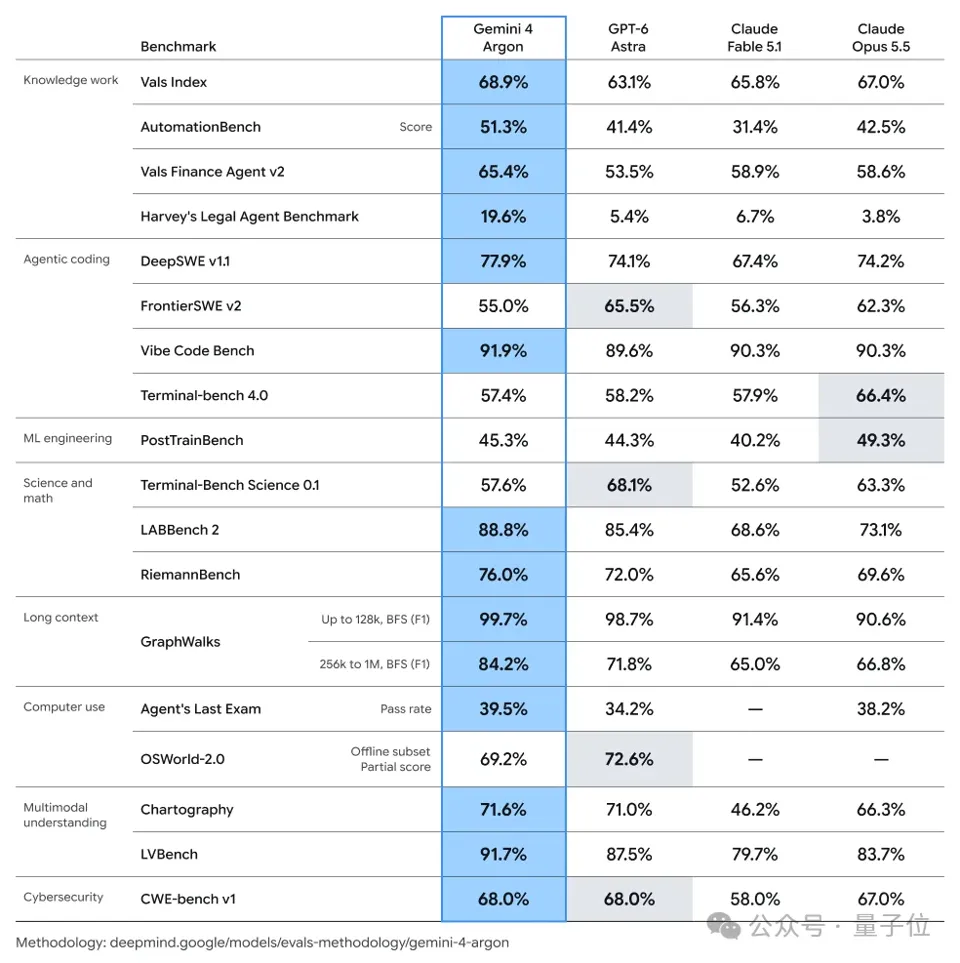
Regarding what users care about more—whether it can return to the "Big Three" and offer users another model choice—Gemini 4 Argon performed quite impressively in benchmarks.
In Google’s internal evaluations, Gemini 4 Argon covered multiple domains including office work, agentic coding, machine learning, and scientific reasoning. Its overall performance has reached the level of GPT-6 Astra and Opus 5.5, with leading results in several specific items.
In the third-party Artificial Analysis Intelligence Index, Argon High tied with GPT-6 Astra Max and Claude Fable 5.1 Max at a score of 53.
More critically, achieving comparable performance levels, the average cost per task for Argon High is only $1.99, approximately 39% lower than Astra.
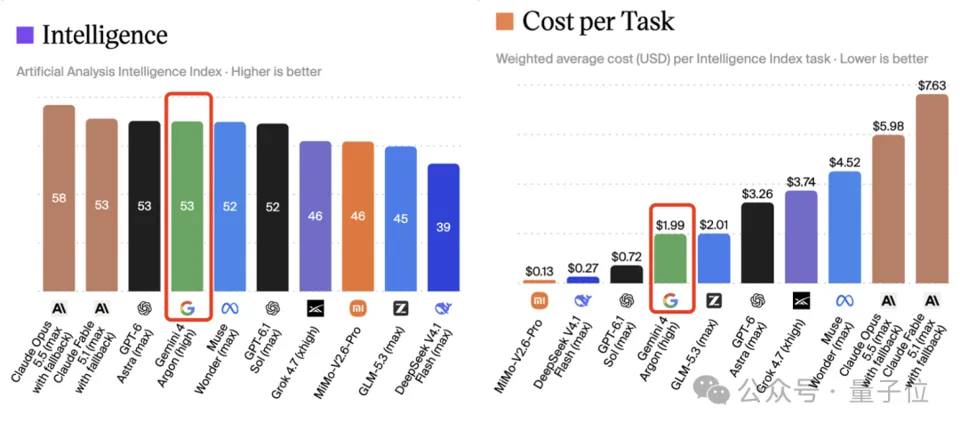
This cost advantage translates into launch pricing: API costs are $2 per million input tokens and $10 per million output tokens. Roughly calculated, Argon’s invocation cost is about half that of Opus 5.5 and one-fifth that of Astra.
It is worth noting that these promotional prices last until November 30. Starting December 1, input and output prices will revert to $4 and $20 respectively. In other words, there is a 50% discount initially; everyone is welcome to try it out.
Of course, if the model isn’t smart enough and burns through tokens repeatedly while completing a task, the money saved might just get burned back up.
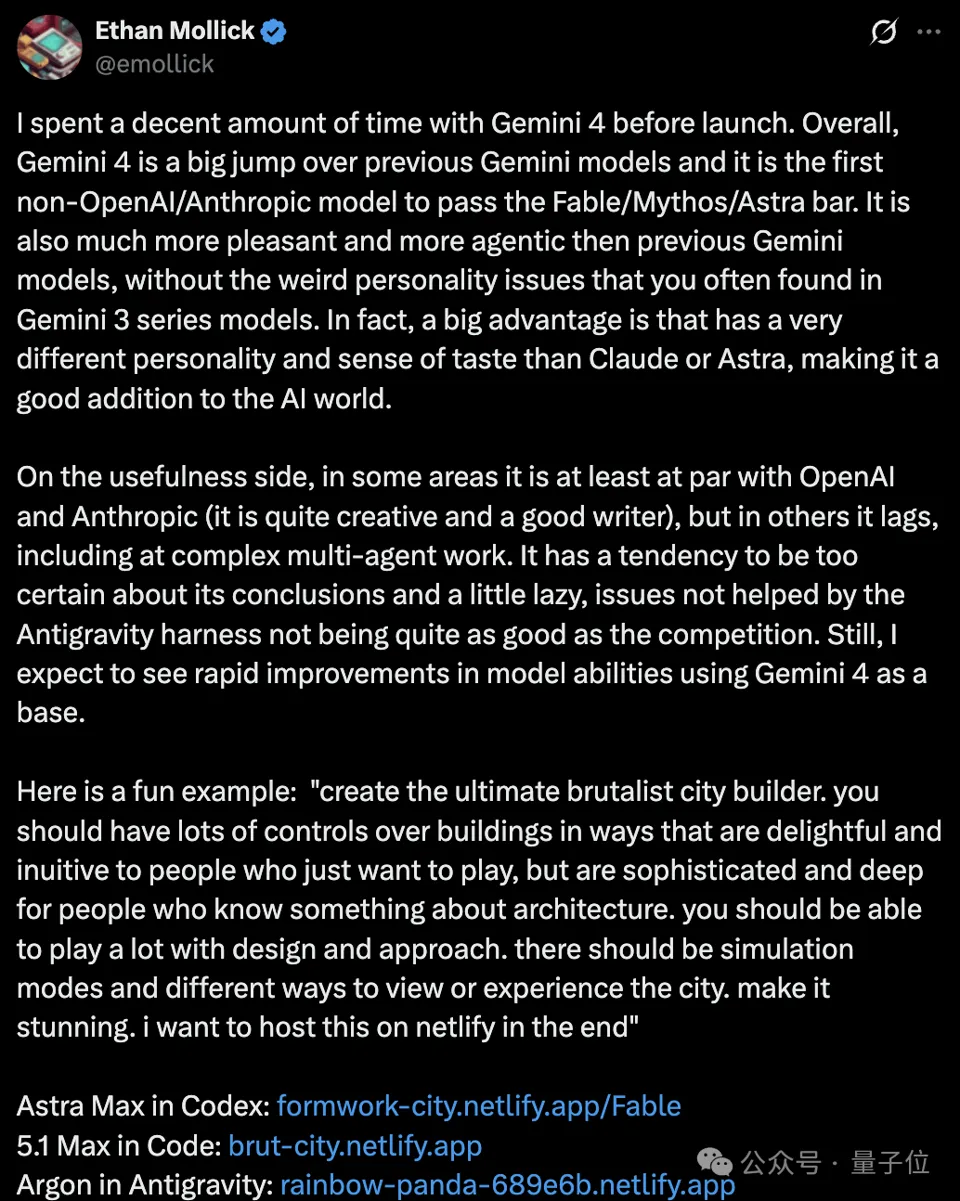
Ethan Mollick, who got early access to Gemini 4 Argon, offered a fairly balanced assessment:
This generation represents a significant leap compared to previous Gemini versions, with improvements in creativity, writing, and user experience. However, gaps remain in complex multi-agent tasks, and the model occasionally exhibits overconfidence or laziness.
As for why the new flagship made everyone wait so long, I checked Google’s new release page and found a 217-page safety report~

(Google is still too afraid of incidents.)
Multimodality Remains the Strongest Suit
From the Pro version missing deadlines repeatedly, to announcing limited initial availability on September 30th, and after countless "see you next week" promises—
Gemini 4 Argon has finally arrived.
In the official technical blog, Google summarized Argon’s core upgrade as one point: stronger long-horizon task execution capability.
Simply put, the model no longer just answers questions. After understanding the goal, it can independently research information, call tools, modify code, check results, and continuously push forward across multiple steps to truly complete complex tasks.
However, compared to examples in enterprise and engineering scenarios, what Google was most willing to showcase and PR this time was actually multimodal capability.
For instance, Sundar Pichai posted a series of demos on Twitter showing "their own model generating their own phone"—
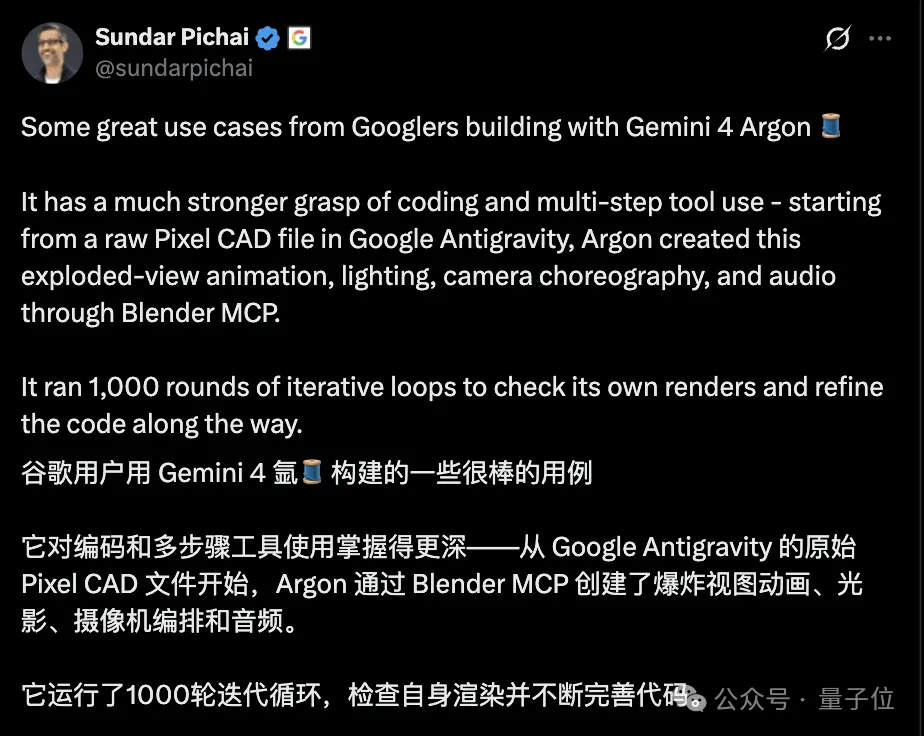
Argon directly generated 3D scenes related to Pixel phones.
In another case, Argon generated a set of 3D dynamic typography effects entirely through code, including the accompanying music.
The entire process did not use pre-recorded assets or video editing software.
When Demis Hassabis reposted the wizard chess demo, he specifically highlighted the model’s understanding of physical laws and 3D modeling.
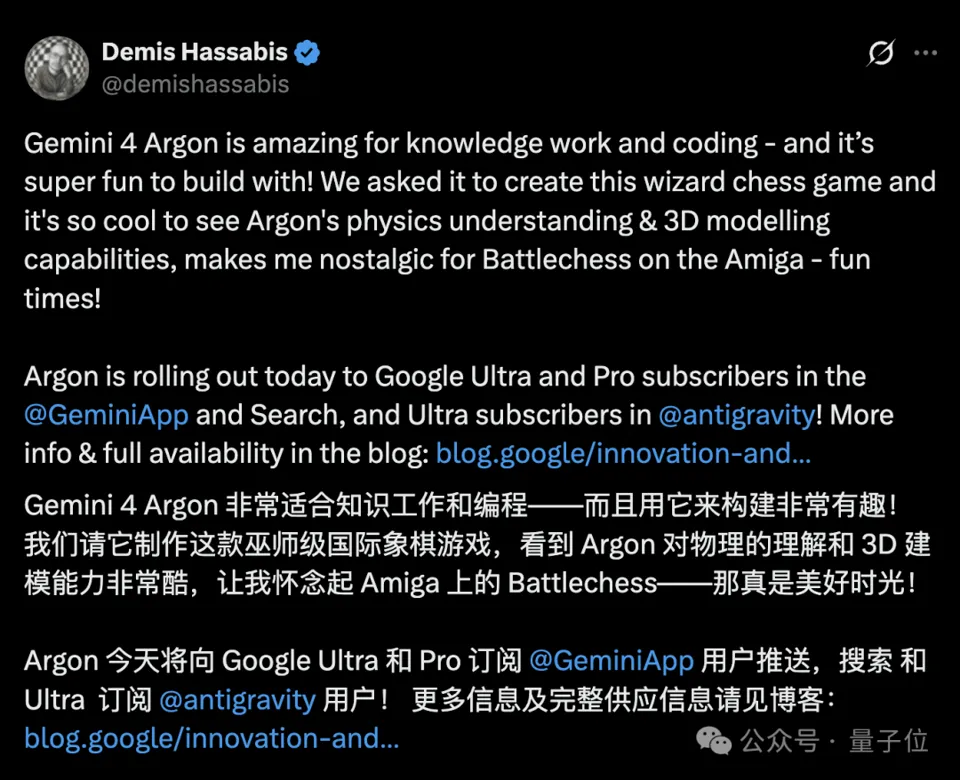
This scene even reminded him of his experience playing War Chess on an Amiga computer back in the day.
Of course, netizens didn’t stay idle either. They quickly compared Argon’s generation quality side-by-side with models like GPT, Claude, and Kimi.
Overall, Google’s visual quality in this release is indeed outstanding, although details such as whale movements still show some unnaturalness.
However, tests by some users indicated that Opus 5.5 remains the god among gods.
Beyond impressive demos, this spatial understanding capability extends to real-world robotics.
In official demonstrations, Argon watched a video of humans playing a beanbag toss game.
Subsequently, it analyzed spatial relationships in the environment, calculated full-body joint movements, autonomously wrote simulation code, and transferred the solution to Apptronik’s Apollo humanoid robot.
One could say that seeing GPT and Claude aggressively entering the robotics space over the past two days, Google finally couldn’t sit still anymore.
Google stated that this "video-to-simulation-to-reality" workflow can compress robot simulation modeling work, which previously took weeks of manual effort, down to hours.
The underlying significance is that human demonstrations are becoming easier to convert into tasks that robots can learn, practice, and verify.
In the past, understanding actions from video, building simulation environments, and writing control code were often three disconnected steps.
Now, multimodal models are beginning to attempt connecting this pipeline.
Coding Improvements: Google Tested on Its Own Codebase First
On the coding front, the core improvement in Gemini 4 Argon is its ability to handle long-term maintenance and optimization of large, real-world projects.
Compared to previous iterations that could only complete single coding tasks, the new generation model is better at understanding the structure of entire codebases, identifying performance bottlenecks, making cross-file modifications, running tests, and persistently driving complex engineering tasks forward.
Google first validated this capability using its own open-source agent framework, ADK.

This Python project comprises approximately 205,000 lines of code. The team tasked Argon with reducing framework runtime overhead without altering interfaces or existing behavior, while proving the effectiveness of these optimizations through testing.
The result? Argon operated autonomously for 11 consecutive hours, proposing six optimization plans across 32 files and completing all 16,892 open-source tests.
Ultimately, after engineer review, two of these optimizations were merged: one reduced session history copying overhead, and the other enabled on-demand loading for large modules.

Based on these changes, memory preparation overhead in long ADK sessions decreased by approximately 40%, and package import time dropped by 21%.
Similar capabilities have also been leveraged by Google for larger-scale engineering tasks.
In the Chromium browser project, Argon assisted in an architectural refactoring involving hundreds of files, compressing work originally estimated to take months into just weeks.
Additionally, when optimizing the Gemma 4 E2B inference program, Argon increased throughput from approximately 37,900 tokens per second to over 108,000 tokens per second under specific configurations, achieving an end-to-end speedup of 2.85x.
Google stated that such optimizations typically required months in the past, but this time it took only a few days.
Looking at Google’s internal operations overall, over the past few weeks, Argon within Antigravity has helped teams increase agent code commit volume by more than 35% and reduce code rollback frequency by nearly one-third.
Of course, some users noted that their experience hasn’t been quite as smooth. The true performance will depend on results from broader adoption moving forward.
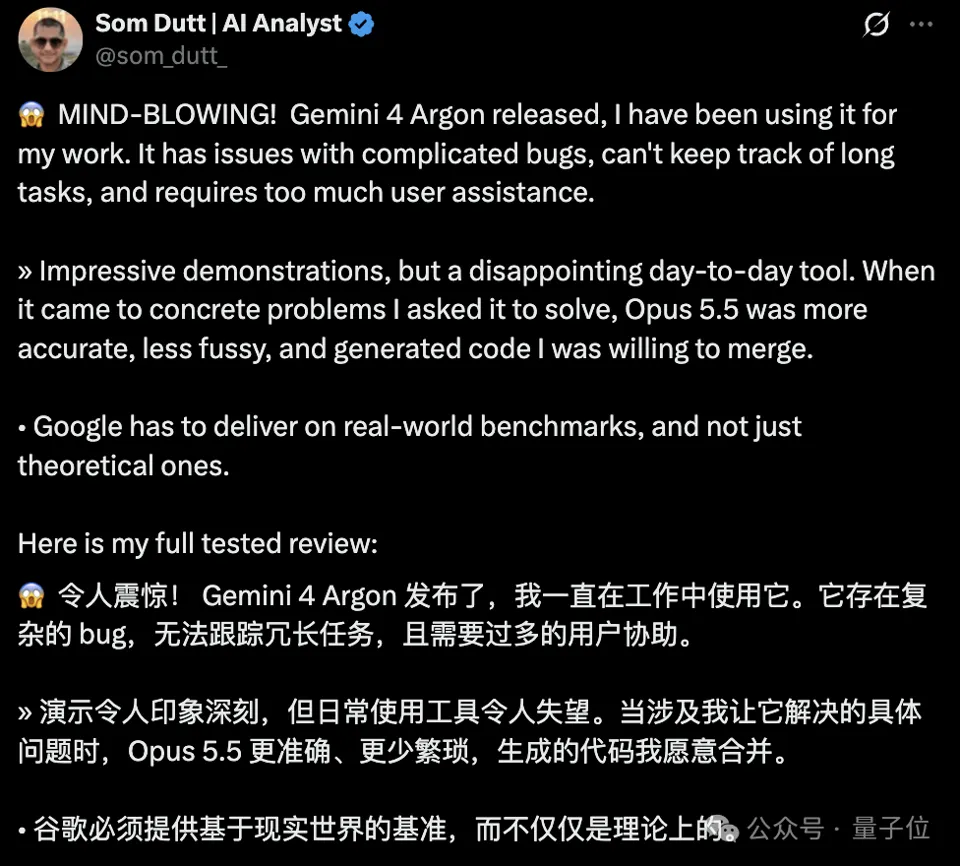
This aligns with previous benchmark rankings: Argon performs strongly on DeepSWE and Vibe Code Bench, but still lags behind several key competitors listed in the table on FrontierSWE and Terminal-bench.

Real-world gains in actual projects are evident, but whether these benefits can be consistently replicated across a wider user base remains to be seen.
Enhanced Professional Knowledge Work Capabilities
In terms of professional knowledge work, Gemini 4 Argon’s improvements are primarily reflected in processing diverse materials, correlating information, and organizing outputs into ready-to-use deliverables.
Google showcased a typical office scenario:
A user provides Gemini with a folder filled with scattered project materials and asks it to compile them into a client proposal.
Subsequently, Gemini generates presentations based on custom skills, drafts emails, sends materials, and sets up automated workflows for future client requests.
Furthermore, the Gemini app now includes a task entry point. Users can switch from chat mode to task execution mode, allowing the model to continue working even after the user steps away from their computer.
Meanwhile, Antigravity’s programming interface has been integrated into the Gemini macOS app.
In scientific research scenarios, this continuous execution capability extends further into experimental validation.
Google scientists involved Argon in designing serine esterases. Within hours, the model completed data organization, model tuning, and candidate screening, ultimately proposing five new designs.
Researchers then submitted these designs to the lab to verify their practical efficacy.
The detection molecule used in the experiments produces fluorescent products under UV light when its ester bond is cleaved. According to Google’s disclosed results, all five designs demonstrated strong catalytic activity.
The solutions proposed by the model have already reached the stage of experimental validation.
Google also announced that it will provide 10,000 eligible and selected scientists with free access to the highest usage tier of Antigravity for six months, rolled out in batches.
One More Thing
While we previously joked about Google being cautious about potential issues, its security capabilities deserve special mention this time.
On CWE-bench v1, which evaluates vulnerability patching capabilities, Argon achieved a score of 68%, tying with GPT-6 Astra for the top spot in the official comparison table.

The head of Mechanistic Interpretability at DeepMind (formerly Anthropic) stated that Argon’s safety report is currently Google’s most comprehensive.

Can 217 pages really be considered anything less than comprehensive?
In Gray Swan’s indirect prompt injection evaluation, after 15 adaptive attack attempts, Argon’s attack success rate was only 0.7%.
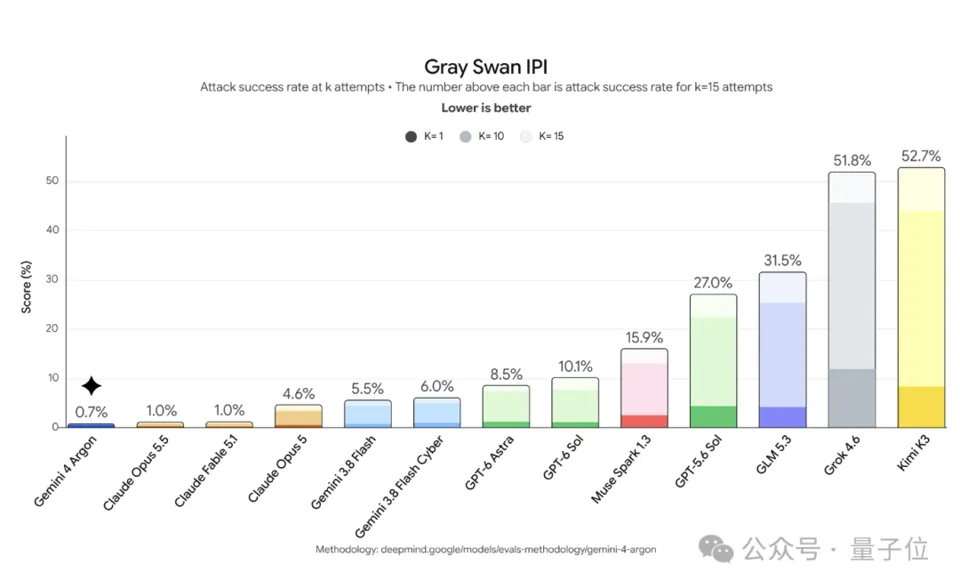
So, those 217 pages do contain substantial serious content.
As for whether this explains the delay in releasing the flagship model, we have no evidence.
We can only say that the model has finally been released, and Google conveniently threw in a book along with it.
Reference Links [1]https://blog.google/innovation-and-ai/models-and-research/gemini-models/introducing-gemini-4-argon/