REA Open-Source Tool Connects AI Agents to Binary Reverse Engineering
The trending open-source project REA (Reverse Engineer Anything) bridges coding agents like Claude Code and Codex with traditional reverse engineering tools such as Ghidra and IDA via the Model Context Protocol (MCP). This enables developers to use AI to inspect compiled binaries, trace function calls, and validate hypotheses, supporting static analysis for JavaScript, Electron, and .NET assemblies without claiming full source code recovery. Community feedback suggests REA outperforms direct AI interaction with Ghidra in specific scenarios, sparking debates on the durability of closed-source software moats in the AI era.
Full Report
Reverse Engineer Anything (REA) is an open-source project that has garnered over 200,000 stars on GitHub. It connects coding agents like Claude Code and Codex with reverse engineering tools such as Ghidra, Hopper, and IDA, enabling developers to inspect compiled binaries, trace function calls, and investigate how applications implement specific features.
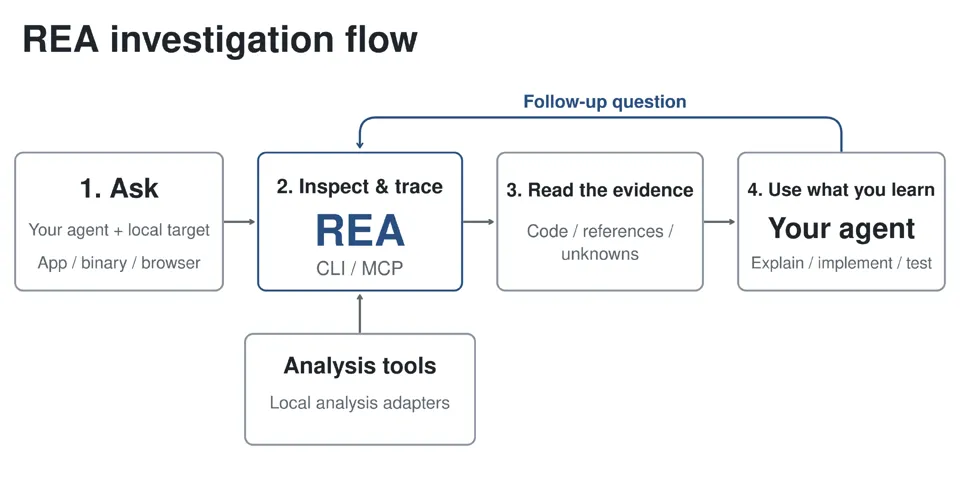
REA uses MCP servers to expose reverse engineering tools to agents. Agents can query disassemblers, inspect functions and cross-references, trace program behavior, and iteratively validate hypotheses against binary files. The tool also supports static analysis of JavaScript and Electron apps, as well as .NET assemblies, using the analysis results to guide subsequent investigations. REA runs locally and does not claim to recover original source code.
The showcases on GitHub demonstrate how REA traces Notion's Electron clipboard implementation, reconstructs sound panning functions from the classic game DX-Ball by matching all 3,205 original x86 test cases and all 63 bytes of the compiled function, and recovers the angle calculation logic for bullet hell rings from the 16-bit code of the DOS game Touhou 4.
On Hacker News, some practitioners questioned what value the project adds compared to simply having AI coding agents install and use Ghidra directly. Ghidra is an open-source tool developed by the U.S. National Security Agency for analyzing compiled programs. Other users noted that REA yields better results than previous attempts to use reverse engineering tools via AI agents. Hacker News user revelationnow wrote:
I think this will accelerate big tech companies moving apps to the cloud. As long as they stop distributing binaries, it cuts off at least one avenue for reverse engineering.
REA is not limited to Ghidra. It also supports Hopper, a native macOS disassembly and reverse engineering tool, and IDA, a disassembler and debugger for analyzing executable code across various processor architectures and platforms. JavaScript and .NET inspection can run without native analysis engines.
On Reddit, some indie developers worry that AI-assisted reverse engineering might make it easier for others to copy their games and applications, bypass paid features, and profit from their work without permission. Other users are discussing which hardware they would like to reverse engineer and what could be built using the analysis results. AMD Director Sreekanth Pannala noted:
How much things have changed in ten years! We've gone from an era where software was king and hardware was just a commodity, to an era where hardware is king and proprietary software is increasingly easy to replace.
REA is released under the permissive MIT License, supporting legitimate reverse engineering, research, analysis, and reconstruction. Users are responsible for obtaining necessary authorizations and complying with applicable laws. Cleverson Santos, creator of the Persistent Intelligence Project, warned on LinkedIn:
This is a blurry boundary! I do not endorse crossing these lines—and this is just the beginning. Everything created to help humanity will eventually be used against it in some way. I hope my view isn't too extreme; this isn't criticism, just an observation about which boundaries should or shouldn't be crossed.
The project author uses the pseudonym morluto, and their real name has not been disclosed. They also published Awesome Reverse Engineering, a collection of tools and learning resources for reverse engineering binaries, applications, firmware, file formats, and protocols.
Original article:
https://www.infoq.com/news/2026/10/reverse-engineer-anything/