SpaceX AI Revenue Surpasses Starlink as Power Becomes Key Bottleneck
SpaceX's Q3 AI revenue hit $7.6 billion, surpassing Starlink for the first time, driven by $16.4 billion in capital expenditures. Elon Musk stated that the primary bottleneck for deploying superintelligence has shifted from chips to power, cooling, and infrastructure, with projected capex doubling to $35-40 billion next quarter.
Full Report
On October 21, SpaceX released its second earnings report of the year, revealing that the company’s AI spending (officially listed as SI in the announcement; referred to as AI below for natural English phrasing) hit a new record high, with capital expenditures potentially doubling in the near future.
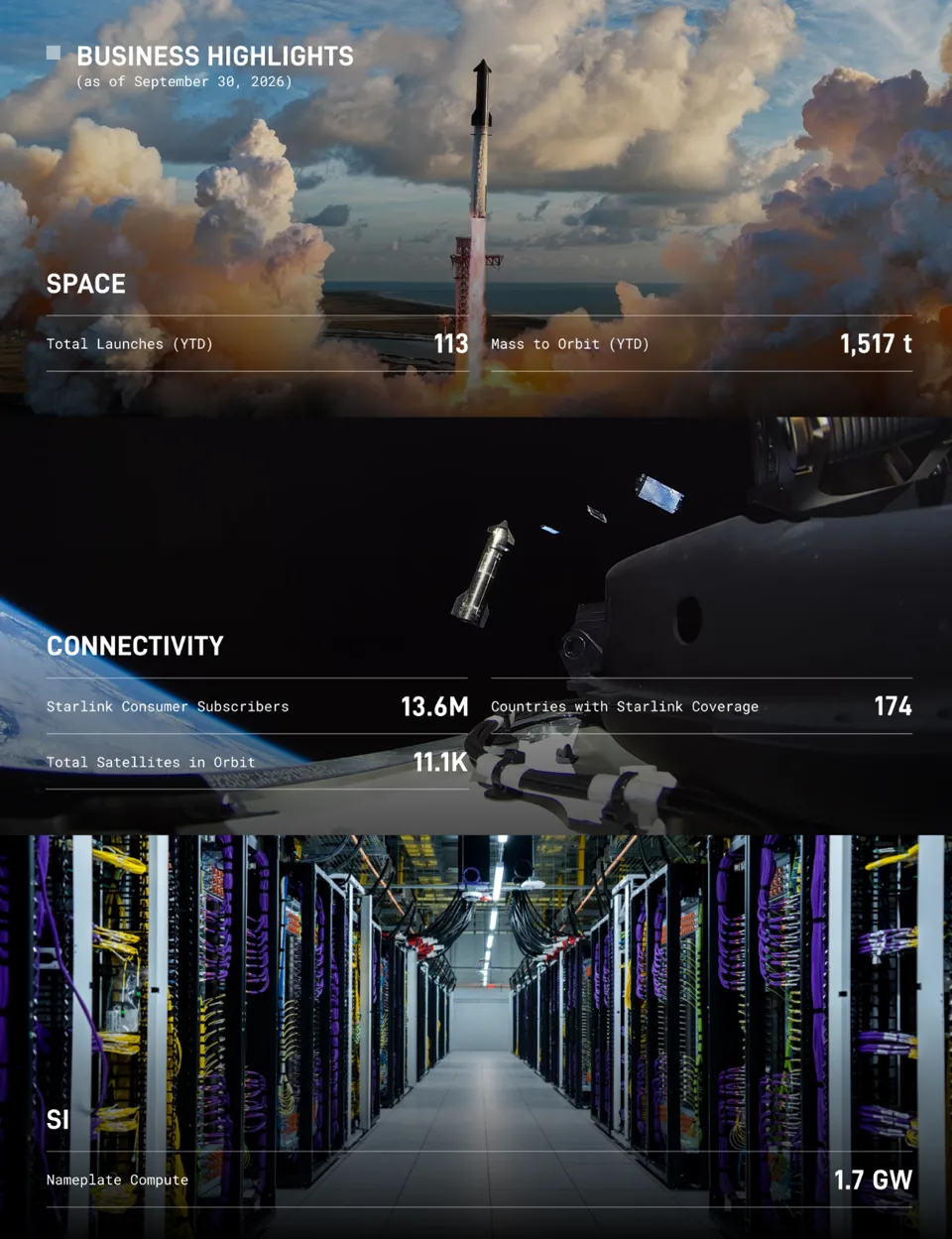
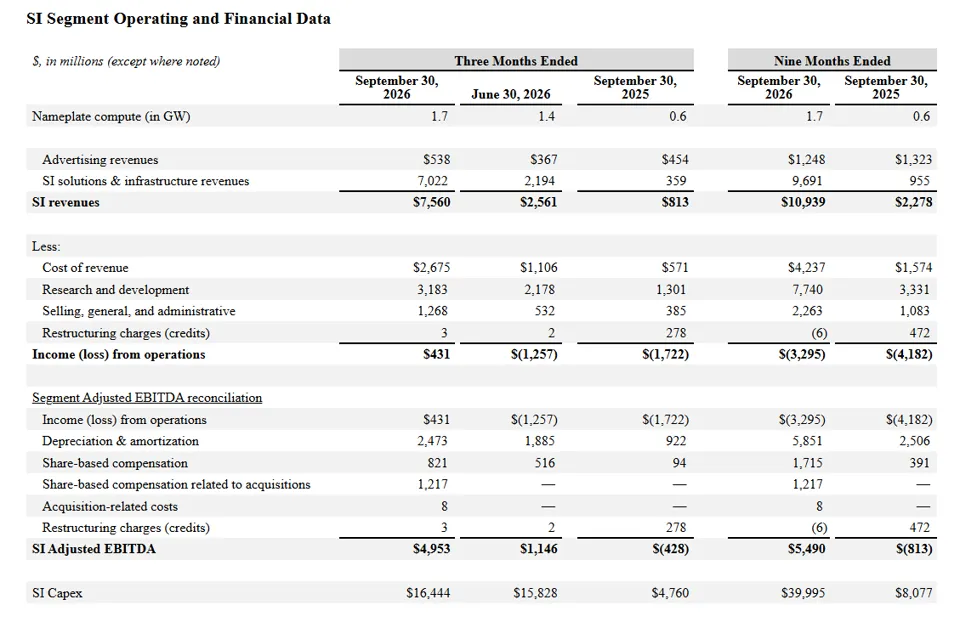
SpaceX’s AI-related capital expenditure reached $16.4 billion in the third quarter of this year (Note: approximately RMB 109.738 billion at current exchange rates), continuing the trend of sustained investment increases seen over recent quarters.
The company continues to expand infrastructure for its AI businesses, including Grok. Total capital expenditure for the third quarter was approximately $19.6 billion (roughly RMB 131.15 billion at current exchange rates), largely aligning with Wall Street analysts’ expectations.
Of this total, $16.4 billion (approx. RMB 109.738 billion) was allocated to AI operations, slightly below the analyst consensus of $16.9 billion (approx. RMB 113.083 billion).
SpaceX anticipates a significant further increase in capital expenditure this quarter. CFO Brett Johnson projected that as more compute facilities come online, capex will rise to between $35 billion and $40 billion (approx. RMB 234.196–267.653 billion). He also expects these new investments to recoup costs quickly: “At current pricing standards, newly deployed compute capacity can break even in less than a year.”
Following the earnings release, SpaceX stock rose 4% in after-hours trading.
During the earnings call, CEO Elon Musk noted that the biggest bottleneck in AI infrastructure is no longer chips: “When it comes to SpaceX’s superintelligence business, SpaceXSI—call it ‘sexy’ or whatever you like—I think people are starting to realize that the primary constraint on deploying superintelligence isn’t chips; it’s power supply, cooling, and infrastructure.”
SpaceX’s AI revenue saw substantial quarter-over-quarter growth, reaching $7.6 billion (approx. RMB 50.854 billion), exceeding analysts’ estimates of $6.3 billion (approx. RMB 42.155 billion).
With $7.6 billion in revenue (approx. RMB 50.854 billion), the AI business officially surpassed SpaceX’s Starlink division. Starlink generated $5.2 billion in revenue during the same quarter (approx. RMB 34.795 billion).
According to Business Insider, SpaceXSI’s compute leasing business has shown traction, with clients including Anthropic, Google, and Reflection AI. In the previous earnings call, CFO Brett Johnson disclosed that compute leasing agreements contributed an additional $1.6 billion (approx. RMB 10.706 billion) in revenue.
Musk stated that SpaceX is receiving an overwhelming number of requests for compute leasing: “Honestly, all the hyperscalers, plus dozens of smaller companies, are constantly pressing us to lease more compute. If we agreed to all their requests, our existing capacity wouldn’t be enough—we could effectively rent out our compute several times over.”
Regarding how SpaceX allocates its compute resources, Musk responded that the ratio adjusts monthly: “Broadly speaking, we aim for a 50/50 split—half for internal use, half leased to other enterprises. But the ratio might shift to 60/40, with either side taking the larger share depending on circumstances.”