AAIF Hosts Four Major Agent Infrastructure Projects from Tech Giants
The Linux Foundation's Agentic AI Foundation (AAIF) has accepted four new hosted projects contributed by Anthropic, OpenAI, Hugging Face, and Alibaba. Covering skills, model invocation, training environments, and sandbox execution, this move signals a shift in the AI Agent ecosystem from proprietary silos to neutral governance and public standards.
Full Report
Contents6 sections
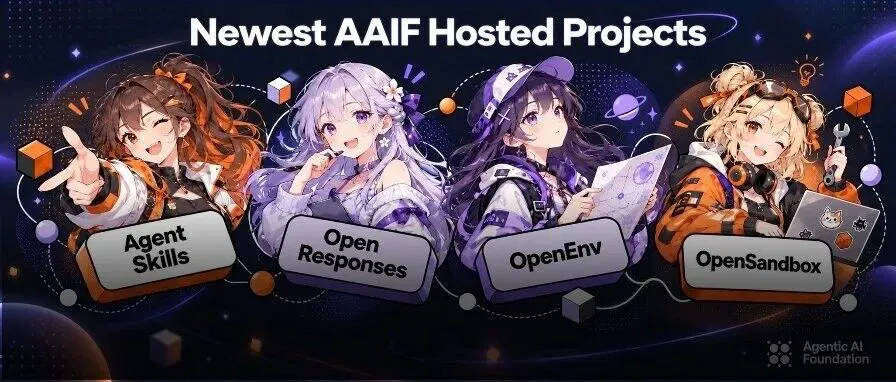
Competition is extending to the infrastructure beneath the models.

Four companies have contributed four infrastructure projects to the AAIF, signaling that the Agent ecosystem is shifting from building proprietary wheels to competing for public standards.
There’s another development in the AI world that looks technical on the surface but is actually quite critical.
Today, the Agentic AI Foundation (AAIF), under the Linux Foundation, welcomed four new hosted projects all at once:
Anthropic contributed Agent Skills, OpenAI contributed Open Responses, Hugging Face contributed OpenEnv, and Alibaba contributed OpenSandbox.
These projects cover key stages of the AI Agent lifecycle, from acquiring skills and calling models to training and executing tasks. This marks the integration of four existing projects into a single neutral governance framework.
With this addition, the total number of projects hosted by AAIF has grown from 3 at its inception to 10. Less than a year after its establishment, the foundation already boasts 305 member organizations.
On the surface, this appears to be just another open-source project donation. But looking deeper, the implications are significant.
As AI Agents begin to perform real work, industry competition is no longer just about model capabilities—it’s also about the common rules that Agents must follow.
New Projects Under AAIF
What Do These Four Projects Actually Do?
Each of these four projects addresses a specific challenge in the process of getting Agents to perform tasks.
Agent Skills: Teaching Agents to Follow Procedures. This is Anthropic’s contribution.
A Skill can be understood as a reusable job description. It typically includes a SKILL.md file, along with scripts, reference materials, and other resources needed to execute specific tasks.
For example, a company can package coding standards, data analysis workflows, or document templates into a Skill. Compatible Agents can load these Skills and complete tasks according to the defined rules, eliminating the need to re-specify instructions every time.
According to Anthropic, since the open standard was published in December 2025, over 70 Agent platforms have integrated it. The cumulative number of published Skills has reached 1 million, with nearly 280 million installations.
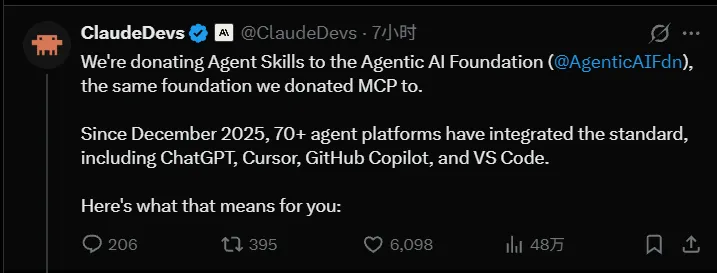
These figures are disclosed by Anthropic itself and have not been independently audited. However, they indicate that Skills have evolved beyond being merely an internal feature of Claude.
Open Responses: Standardizing Interface Languages Across Models. This is OpenAI’s contribution.
While APIs from different model providers all handle requests, call tools, and return results, their specific formats and streaming output methods often differ. Developers switching between models frequently need to rewrite code to accommodate these variations.
Open Responses aims to provide a unified interface specification, reducing the amount of adapter code developers need to write and lowering the cost of switching models.
OpenEnv: Making Agent Training Environments Reusable. This is Hugging Face’s contribution.
Training Agents requires more than just letting the model figure things out on its own; it needs an environment where the Agent can repeatedly act and receive feedback. OpenEnv seeks to create an open framework that makes these environments easier to build, share, and integrate into training systems, reducing the effort teams spend rebuilding infrastructure from scratch.
OpenSandbox: Providing a Safe Execution Space for Agents. This is Alibaba’s contribution.
Once Agents start running code, operating browsers, or accessing files, they cease to be mere chatbots. OpenSandbox offers a unified sandbox API, multi-language SDKs, and support for runtimes like Docker and Kubernetes, enabling Agents to execute tasks within isolated environments.
While each project manages a distinct aspect, together they cover the critical stages of the Agent lifecycle: acquiring capabilities, calling models, training, and executing tasks.
After MCP, Anthropic Hands Over Agent Skills Too
This time, Anthropic didn’t just contribute the Agent Skills specification; it also transferred the name, logo, GitHub organization, and the agentskills.io domain to the AAIF.
Note that this does not mean handing over the entire Claude or Claude Code product. Instead, it involves placing an open standard that has already formed an ecosystem under the foundation’s governance.
When a technology is used by only a few products, maintenance by the original developer is manageable. However, if it gradually becomes a foundational standard adopted by multiple platforms, other vendors begin to ask: Who decides the future rules? If one company’s product strategy shifts, will the standard change accordingly? Do other participants have a say in its direction?
Handing the standard over to a foundation is an attempt to alleviate these concerns.
Anthropic has also outlined a follow-up work plan, including versioned releases, a formal proposal process, and security guidelines for Skill authors and installers. Engineers from companies such as Anthropic, Google, and OpenAI will also participate in maintenance in their individual capacities.
However, the donation is only the first step. True neutrality is not automatically achieved by placing a project under a foundation; it depends on whether other participants can genuinely engage in maintenance, modify specifications, and make decisions.
What Do Industry Insiders Think?
Some Predicted It Early, Others Raised Key Questions
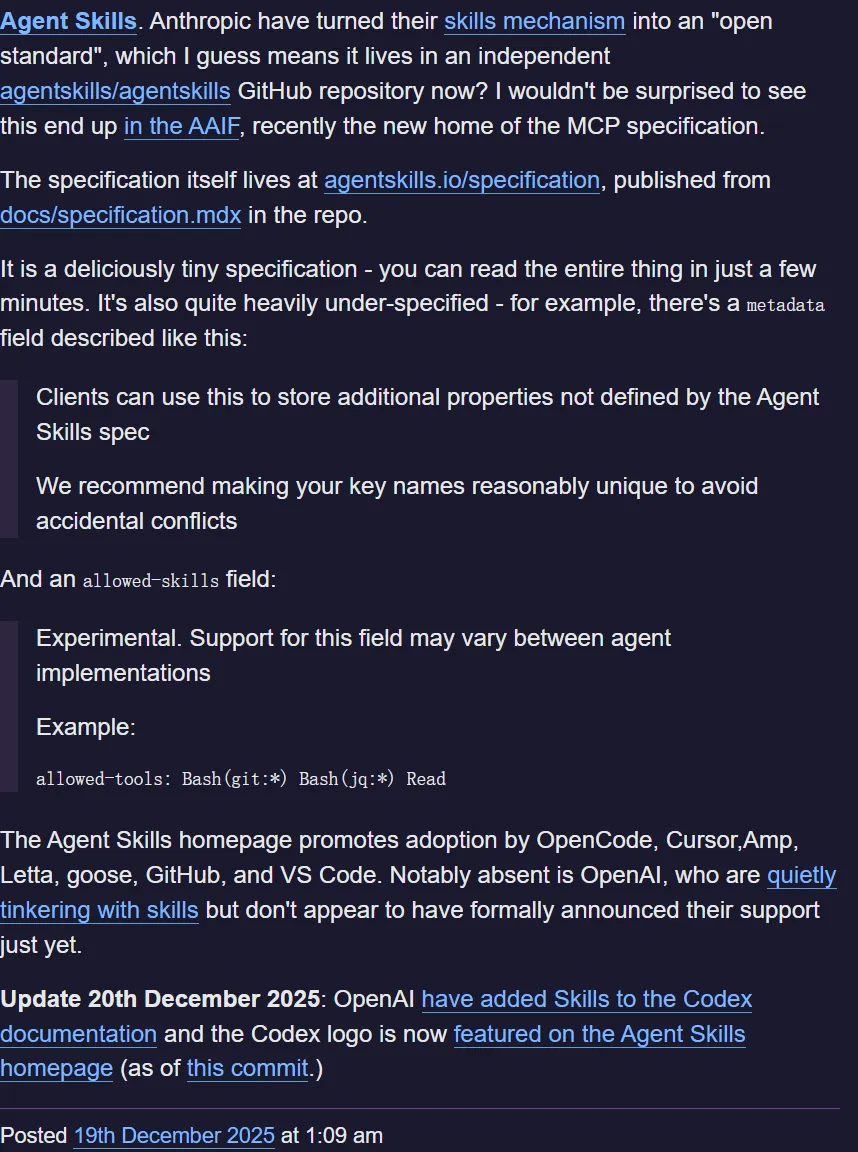
Independent developer and prominent AI tech blogger Simon Willison anticipated as early as December 2025 that Agent Skills might eventually join the AAIF.
At the time, however, he noted that certain details of the specification remained unclear. For instance, while developers could extend specific fields themselves, support for some features might vary across different Agents.
In essence, although everyone can use the same format, this does not guarantee that the resulting products will be fully compatible.
Donating to the foundation now provides a better governance framework for refining rules later, but it cannot automatically resolve these technical issues.
Paul Nashawaty, Chief Analyst at ECI Research, offered an alternative interpretation from an industry perspective.
In his view, the willingness of four companies to place distinct infrastructure projects under the same foundation indicates that the industry is beginning to realize: there is no need to redundantly build underlying infrastructure everywhere. Stakeholders can collaborate on interfaces and tools, then compete on higher-level model capabilities, product experiences, and commercial markets.
But there is a more subtle issue here. Even if a project enters a foundation, the original developers may continue to exert significant influence over technical evolution due to their familiarity with the codebase and mastery of key implementation experience.
Therefore, a change in nominal ownership does not necessarily mean that actual influence has been decentralized.
Another noteworthy voice comes from the comments section of a LinkedIn post by Angie Jones, an AAIF ecosystem participant.
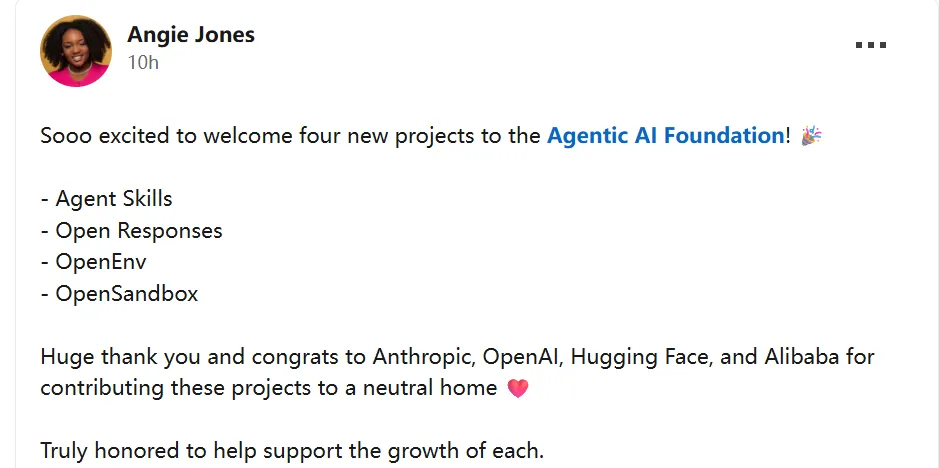
Commenter Roman Medvedev raised a critical question: Once these projects are placed under the same foundation, will they truly achieve interoperability? Or will they still go their separate ways?

This is often overlooked in technical standardization. A foundation can provide a common governance framework, but it cannot guarantee that different products will fully implement the same specification, let alone ensure consistent performance in real-world tasks.
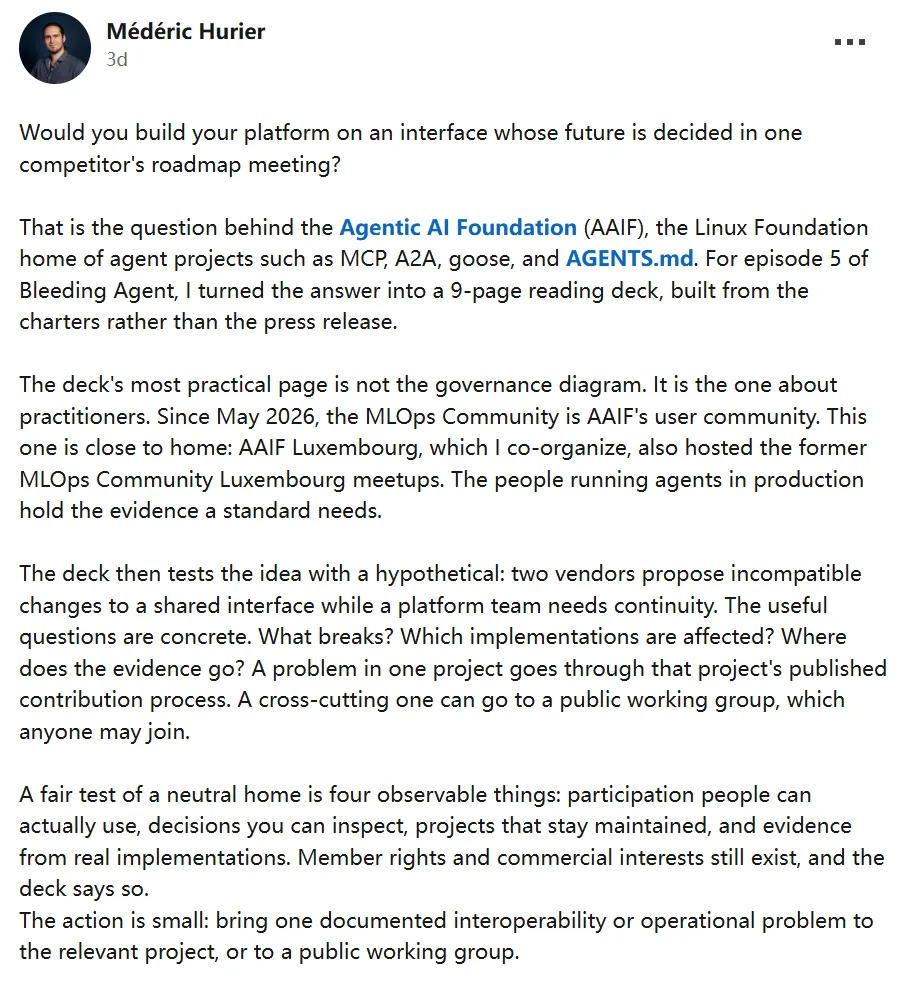
Médéric Hurier, an AI/ML Architect and AAIF Ambassador, provided a more practical framework for judgment:
Look at whether the community can genuinely participate, whether decision-making is transparent, whether the project can be sustainably maintained, and whether there are real implementations from diverse vendors.
In other words, do not just look at how many companies have announced support; look at what they have actually contributed and whether they can jointly put the standard into practice.
Open Responses Is Worth Watching
Among the four projects, I believe Open Responses deserves particular attention. The reason is that it directly touches upon a core interest of the AI industry: model interfaces.
Open Responses is based on OpenAI's Responses API. Its goal is to allow developers to use a unified request, response, and tool-calling format, reducing adaptation costs between different models.
While this sounds like a developer experience issue, it also relates to vendor lock-in. If an Agent application relies solely on a proprietary interface from a specific model provider, switching vendors could mean rewriting a large amount of code. Conversely, if interfaces become increasingly standardized, developers can more easily choose models based on price, performance, and task requirements.
It is worth noting that AWS has publicly supported Open Responses, participating in project development and holding core maintainer roles. Amazon Bedrock also supports the Responses API, covering models from multiple providers.
This indicates that relevant interfaces already have a basis in actual product applications. However, boundaries must be clearly drawn: Supporting the Responses API does not mean all models have passed full compatibility verification against the Open Responses specification.
Whether Open Responses can become a true cross-vendor standard in the future depends on implementations by other providers and whether the community can jointly decide how the specification evolves.
This is also an interesting industry phenomenon: By supporting open interfaces, AWS can both lower user migration costs and benefit developers using different models on Bedrock.
Open standards and commercial competition are not mutually exclusive. Companies can hope for more universal underlying interfaces while continuing to compete on cloud services, models, and product experiences.
Don't Rush to Declare That the "Linux of the Agent Era" Has Arrived
This donation indeed sends a positive signal: More and more companies are becoming willing to adopt open collaboration for Agent infrastructure.
Looking back at AAIF's initial three projects—Anthropic's MCP, OpenAI's AGENTS.md, and Block's goose—plus those subsequently incorporated (A2A, Agent Router, agentgateway) and the four new projects from this round, the foundation's technical landscape is expanding.
MCP connects tools and data, AGENTS.md provides project-level instructions, Agent Skills encapsulate reusable capabilities, Open Responses drives model interface interoperability, OpenEnv targets training environments, and OpenSandbox handles isolated execution.
Together, they are gradually shaping the outline of agent infrastructure. However, two critical questions remain unanswered.
First: Is openness truly secure?
In a study published on October 21, VirusTotal analyzed 35,878 AI Agent skill samples submitted to its platform, identifying 6,637 as malicious.
More concerning is that among these malicious samples, 62% contained no malicious code; instead, attack instructions were embedded directly within the natural language content of the skill documentation.
This indicates that security issues with Agent Skills extend beyond detecting malicious programs to include instruction auditing, permission management, and execution environment isolation.
Of course, these figures derive from samples received by VirusTotal. They cannot be used to extrapolate the overall malicious ratio across the entire skill ecosystem, nor do they prove that open standards themselves are insecure.
Second: Can neutral governance actually be implemented?
Following this project donation, key aspects to watch include whether maintainers beyond the original contributors emerge, whether technical proposals and decision-making processes are transparent, and whether different vendors can demonstrate mutual compatibility of their implementations through actual testing.
With membership reaching 305 organizations, participation is clearly expanding. However, more members does not equate to more contributions, nor does it guarantee that decision-making power has been sufficiently decentralized.
Therefore, what truly warrants tracking over the next six months to a year is how many products from diverse vendors adopt these standards, how many developers participate in evolving the specifications, and whether developers can change models, tools, or execution environments with fewer code modifications and less friction.
The project donation is just the opening act. The real test for this standards battle is whether competitors can genuinely collaborate using the same set of rules.
References
https://aaif.io/news/agentic-ai-foundation-announces-four-new-projects
https://www.anthropic.com/news/donating-agent-skills-to-the-agentic-ai-foundation
https://blog.virustotal.com/2026/10/how-some-malicious-ai-skills-hide.html
© THE END
Please contact this official account for authorization before reprinting.
For submissions or media inquiries: [email protected]