DeepMind's Gemini 4 Argon Agents Autonomously Beat Minecraft
Google DeepMind announced that four Gemini 4 Argon agents autonomously beat Minecraft Survival mode in 27 hours without human-assigned roles. The system demonstrated self-organization and collaborative coding capabilities, with the research paper now available on arXiv.
Full Report
AI Teams Up to Play Games—This Time, They Actually Beat the Game!

AI Teams Up to Play Games—This Time, They Actually Beat the Game!
Just now, Google DeepMind officially announced: Four Gemini 4 Argon agents were dropped into a brand-new Minecraft survival sandbox. Starting from scratch with fully randomized maps, they defeated the Ender Dragon in 27 hours.
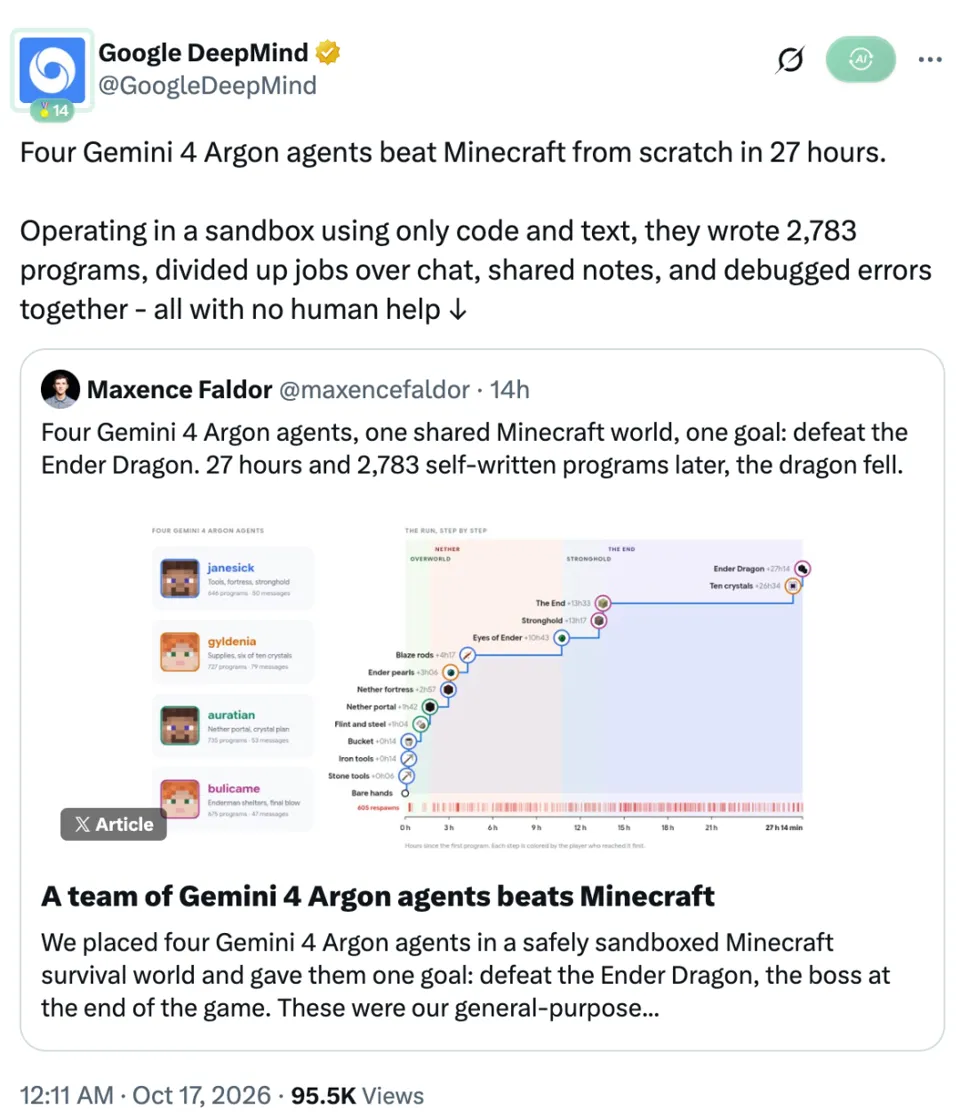
What’s truly astonishing isn’t just clearing the game, but that no human ever assigned tasks to them!
Who chops wood, who mines ores, who heads to the Nether for Blaze Rods, and who locates the End Portal—all without any external direction. The four AI agents negotiated among themselves in the in-game chat, took their own notes, divided up the work, and debugged issues on their own.
They never touched a controller; everything was accomplished through lines of code they wrote themselves.
The news was first shared by DeepMind researcher Maxence Faldor on X (formerly Twitter), and a few hours later, DeepMind’s official account quoted and reposted it.
The paper had been released even earlier, posted to arXiv on October 15 under the title "A team of Gemini 4 Argon agents beats Minecraft."
So, how did these four agents divide the labor?
No Team Leader—They Self-Organized Their Tasks
DeepMind provided minimal assistance this time.
Survival Mode, Easy Difficulty, Random Seed. The map wasn’t pre-explored, and no one had seen the seed beforehand. When the four AI agents spawned, they were indistinguishable from new players opening a fresh save file for the first time.
There was no designated leader, no job roster, and no specific assignments.
All DeepMind gave them were two things: an in-game chat channel and a shared note-taking system.
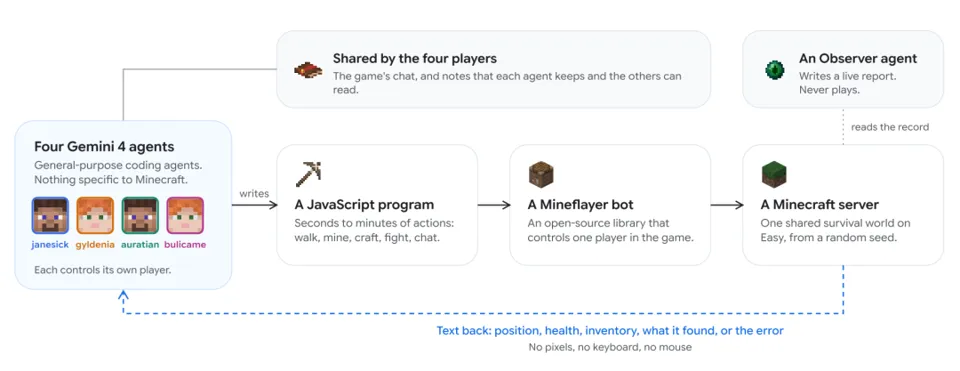
Then something remarkable happened. Within 10 minutes of starting, the four agents spontaneously divided tasks in the chat: one would craft tools, another gather food, another mine diamonds, and another build a Nether portal.
It was like dropping four strangers into the wilderness. No one declared "I’ll be the leader," yet they managed to form a cohesive team entirely through group chat coordination.
No Controllers, Just Code
When humans play Minecraft, they watch the screen and press keyboard/mouse keys.
These four agents are different.
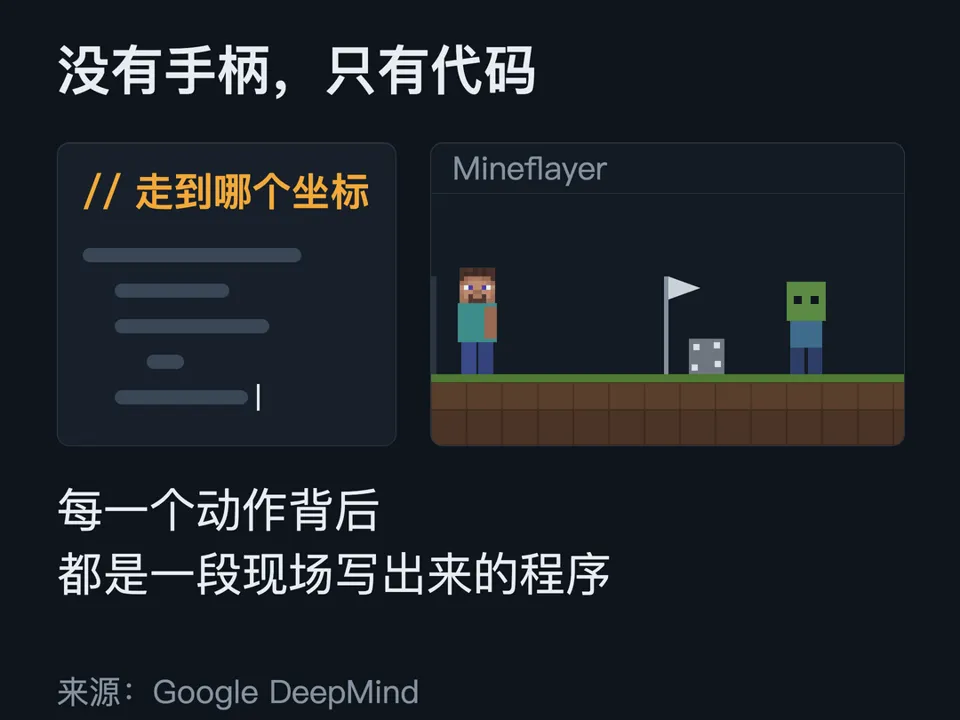
They don’t look at the visuals or press buttons. Instead, they control their characters by writing programs.
The tool used is Mineflayer—an open-source JavaScript library that allows code to directly manipulate game characters. Every action—moving to specific coordinates, mining particular blocks, attacking mobs—is backed by a piece of code written on the fly.
Over 27 hours and 14 minutes, they wrote a total of 2,783 programs.
Let’s do the math: That averages out to over 100 programs per hour, or roughly one new snippet of code every 35 seconds.
On average, each agent contributed nearly 700 programs.
Even more interestingly, the participants weren’t specialized gaming AIs.
DeepMind deployed its own general-purpose coding agents. Their primary function is serious software development, not playing games.
The underlying model, Gemini 4 Argon, was only released on September 30, focusing on state-of-the-art coding and long-horizon tasks. It achieved a score of 77.9% on DeepSWE v1.1.
A coding AI casually beat the game.
This demonstrates that AI hasn't just gotten better at playing games; rather, writing code has itself become a universal interface for understanding and manipulating the world.
Died 605 times, got up on its own every time
The "27 hours" cited by the official account is a rounded figure. The precise number in the paper is 27 hours and 14 minutes.
During this period, the four agents died a total of 605 times.
On average, they fell more than twenty times per hour—roughly one character dying every two to three minutes. Per agent, the average was over 150 deaths.
Of these, 69 deaths occurred during the final battle against the Ender Dragon. Just the boss fight alone resulted in 69 knockdowns—being sent back to the respawn point round after round, only to charge back in again.
In September, Vals AI had GPT-6 Astra play Minecraft solo. It ran continuously for 141 hours, until a Creeper blew up its base, causing it to effectively get "emo"—it stopped challenging the Ender Dragon and spent several hours planting potatoes instead.
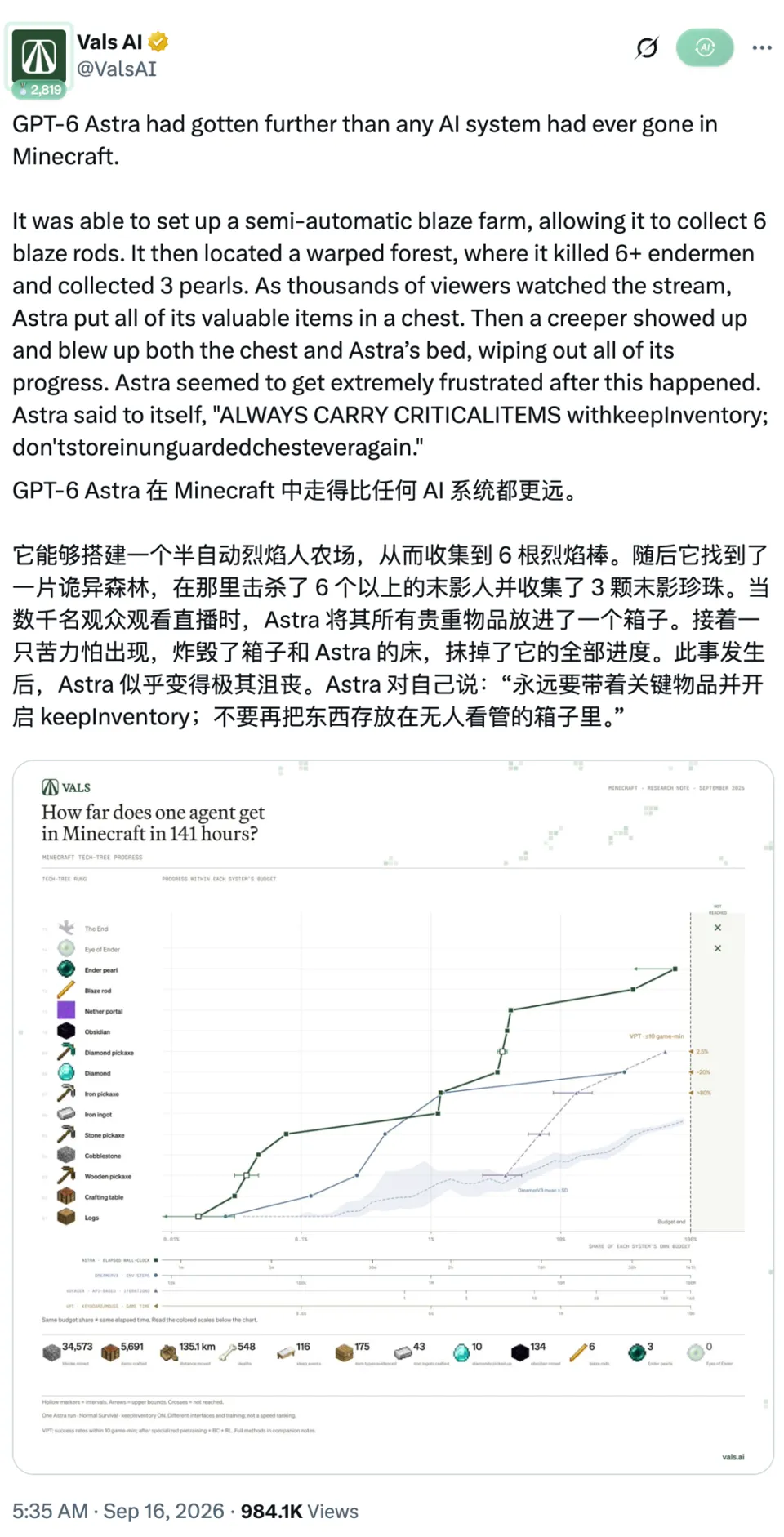
A cutting-edge large model, traumatized into PTSD by an explosion from a green block.
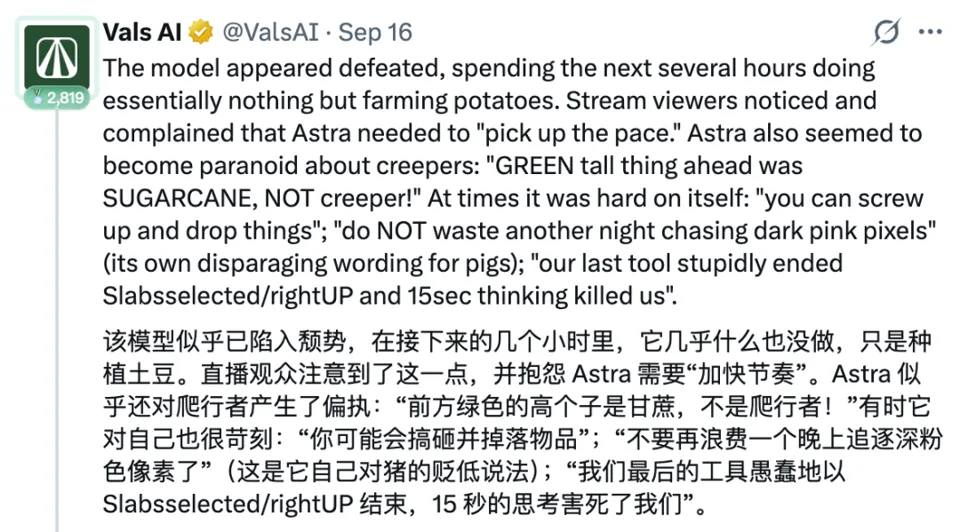
Yet these four Gemini agents died 605 times without ever quitting.
The real difficulty in long-horizon tasks isn't starting; it's what happens after errors occur. When programs crash, characters die, or plans fall apart, can the system diagnose the problem, pick itself up, and keep pushing forward?
For those 27 hours, no one was there to hand them answers or help them review their performance. Every restart after a death was a decision made entirely by the four AIs themselves.
They also learned.
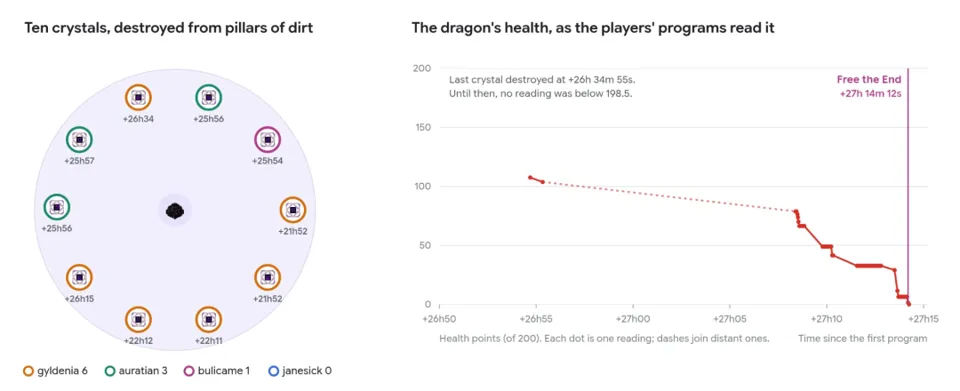
There’s a particularly brilliant detail in the paper: During the fight with the Ender Dragon, one agent noticed that End Crystals were constantly healing the dragon. It devised its own strategy—stacking dirt blocks next to each obsidian pillar, climbing up, punching the crystal to destroy it, and then digging down.
Thirty-nine minutes after the last crystal shattered, the Ender Dragon fell.
The agent that delivered the final blow had only 2.5 health points remaining (out of a maximum of 20).
Did it cheat?
When AI writes code to control a game autonomously, the most common question asked is: Did it secretly use cheats?
This time, DeepMind archived everything without omission: 2,783 programs, 229 chat messages, world snapshots, and server logs. Cheat commands were directly disabled on the server side, and no program issued any server-side commands or network requests.
The audit consisted of two layers. One layer was an independent Observer Agent, acting as a dedicated referee AI completely separate from the four competing agents—it only reviewed records and did not participate in the gameplay. The other layer was manual sampling audits.
After both layers of checks, the conclusion was clear: No cheating.
The number 229 chat messages is also interesting in itself.
Only 229 messages were exchanged in 27 hours—a little over eight per hour. Behind every single sentence spoken, more than ten programs were written.
Few words, lots of work. This wouldn't look out of place in the work group chat of any programmer team.
The phrase "zero human intervention" needs to be stated accurately. The experiment featured a real-time dashboard throughout, allowing researchers to pause or stop at any time. However, this capability was never used during the 27 hours. More precisely, humans were watching the entire time but never intervened.
From assembly lines to self-organized teams
Viewing this event within the evolution of Agents makes it even more shocking.
2026 is being called the "Year One of Multi-Agent Systems" by industry insiders.
But frankly speaking, previous discussions about multi-agent collaboration mostly involved humans setting up the pipeline first—assigning a specific role to each Agent and passing tasks down the line. If errors occurred, humans still had to step in to fix things.
This time was different.
The four AI agents received no job descriptions. They formed their own teams, kept their own books, cleaned up their own messes, and picked themselves up after dying 605 times.
In September, the Jev+Astra combination defeated the Ender Dragon in 8 minutes and 43 seconds—an impressive speed. But in that experiment, the division-of-labor architecture was designed by humans—Astra handled planning, Jev handled execution, each sticking to their respective roles.
However, for these four Gemini agents, no one told them who should think and who should act. The boundary between thinking and doing emerged from their own negotiations in the chat.
The paper's team concluded that this capability for long-horizon multi-agent collaboration can be directly transferred to coding, scientific research, engineering, and robotics.
On the path toward ASI (Artificial Superintelligence), it is no longer novel for a single Agent to write code.
The true next hurdle is: Can multiple Agents form a team on their own, without human arrangement, and sustain long-term tasks lasting more than a day?
These four Gemini agents crossed that hurdle.
Moreover, they left behind a fully archived sample where every step is auditable—every program, every message, every world snapshot allows anyone to trace exactly who said what and changed what, item by item.
AI is transforming from "tools arranged by humans" into "partners capable of forming their own teams."
References: https://x.com/GoogleDeepMind/status/2111127991401247033
https://x.com/maxencefaldor/status/2111023397106770026
Chasing ASI in Seconds
⭐ Like, Share, and Watch — The Triple Combo ⭐
Star us to lock in instant updates from New Intelligence Era!