OpenAI Launches GPT-6.1 Terra: 50% Cheaper, 3x Faster
OpenAI has released GPT-6.1 Terra, a new model optimized for real-world workflows including visual reasoning, computer operation, and coding. The update features a 50% price reduction, over 3x faster API calls, and a nearly 70% drop in factual errors. Terra approaches flagship-level performance on specific tasks while significantly lowering costs, targeting enterprise agent deployment efficiency.
Full Report
Contents3 sections
GPT-6.1 Terra is OpenAI’s latest model designed for real-world workflows, focusing on visual reasoning, computer operation, factual accuracy, and coding capabilities, with significant optimizations in cost and latency.
Pricing has dropped by 50% compared to the previous generation, API call speeds have increased more than threefold, and performance on certain specialized tasks approaches that of the flagship GPT-6 Astra; the factual error rate has decreased by nearly 70%. The model is specifically optimized for high-frequency office scenarios such as drafting business proposals, interpreting technical drawings, and operating software.
This article is suitable for backend engineers, AI application developers, and SaaS product managers.

OpenAI Releases GPT-6.1 Terra: Prices Halved, Task Speeds Increased More Than Threefold
As large language model competition shifts from answering questions to actually completing work, cost and efficiency are becoming just as important as model capability.
Just now, OpenAI officially released GPT-6.1 Terra. As an upgrade to GPT-5.6 Terra, the new model significantly improves visual reasoning, computer operation, factual accuracy, and coding capabilities, while further reducing API call costs.
Unlike previous model updates that primarily emphasized reasoning capabilities and benchmark scores, this release focuses more on daily work scenarios, including writing business proposals, understanding technical drawings, filling out forms, operating software, and assisting with video editing tasks.
OpenAI states that the new model achieves a new balance between speed, capability, and cost. Its standard API pricing is 50% lower than both GPT-5.6 Terra and GPT-6.1 Sol, while in some specialized task tests, Terra’s performance already approaches that of the flagship model GPT-6 Astra.
This means developers may not need to invoke the most expensive models to complete complex tasks that previously required high-performance models.
As usual, let’s first look at how the new model performs across various benchmarks.
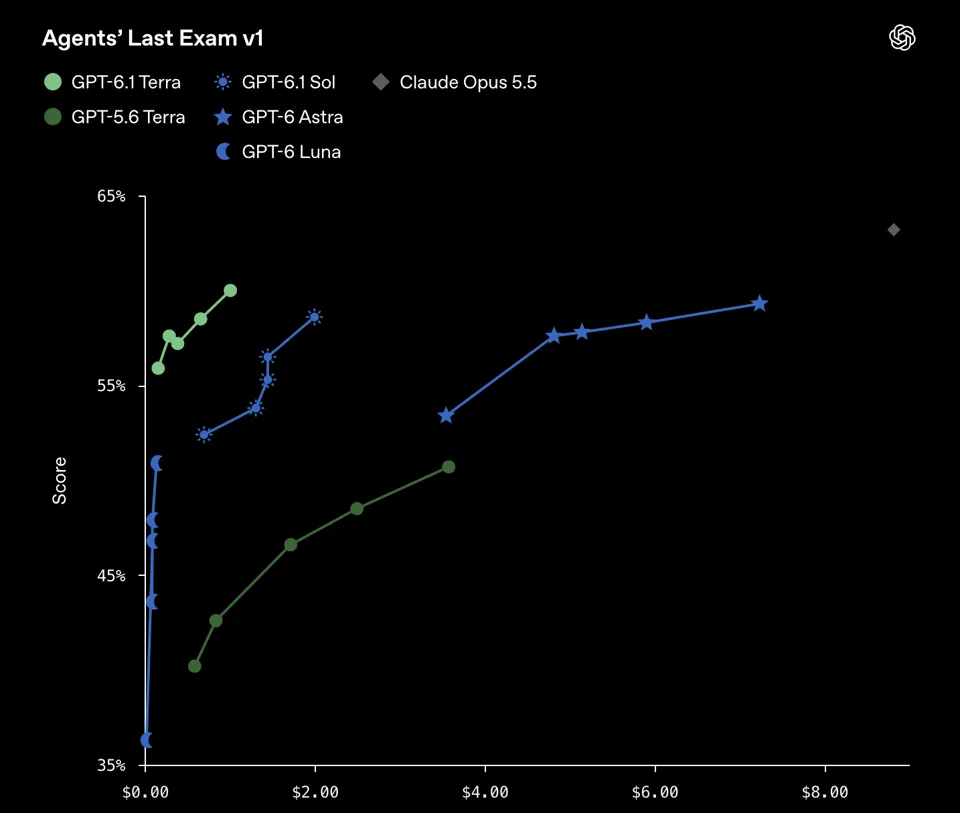
More notably, OpenAI claims that under these test settings, GPT-6.1 Terra’s performance is roughly comparable to GPT-6 Astra, yet its price per token is only one-tenth that of the latter.
Compared to competitors, official data shows that at maximum reasoning intensity, Terra’s token usage efficiency is more than three times that of Claude Opus 5.5, while its price per token is approximately one-quarter of the latter. Calculated comprehensively, its cost per task is reduced by about nine times.
Additionally, Terra completes test tasks more than three times faster than both GPT-6 Astra and GPT-6.1 Sol.
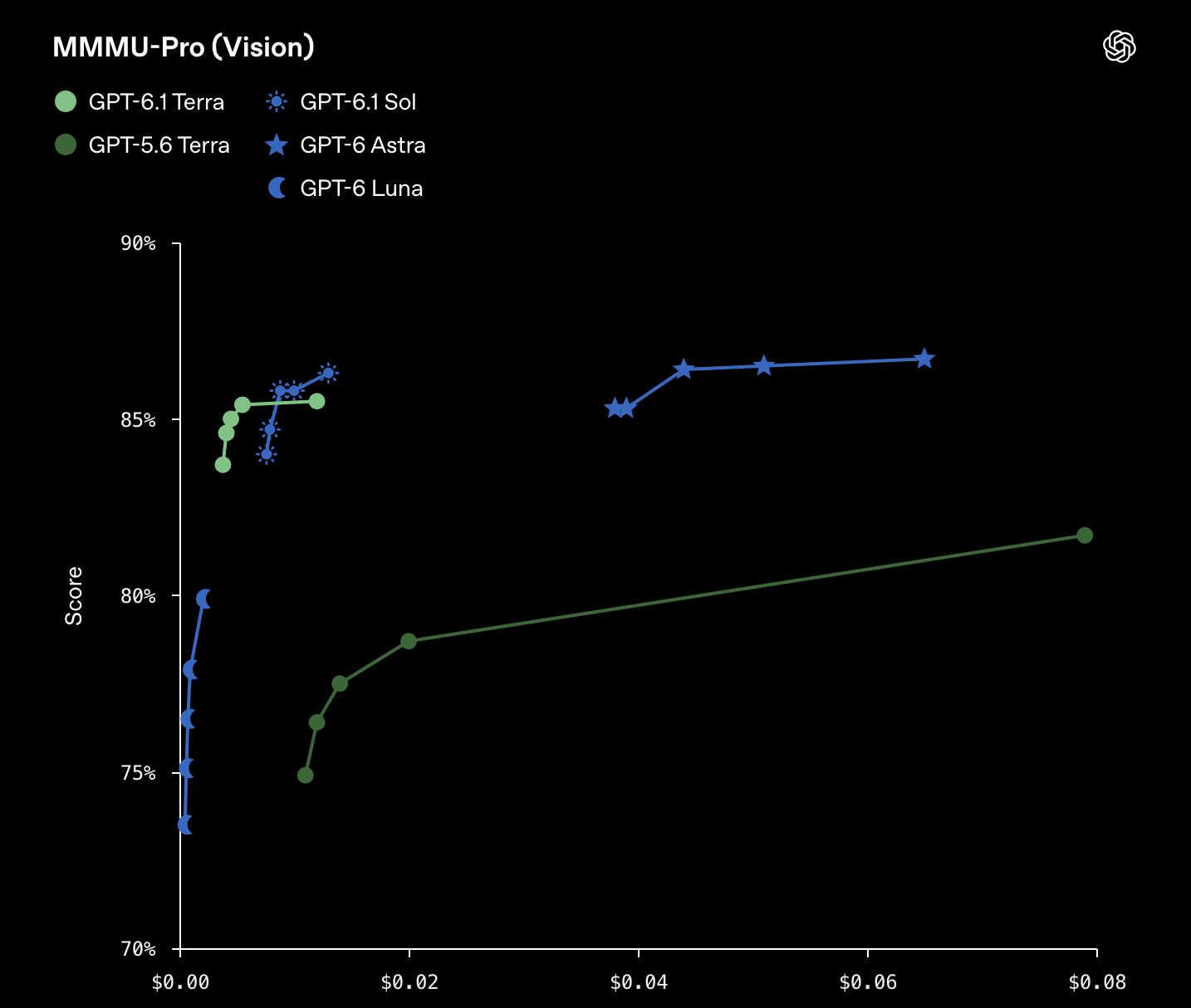
In two other tests, Terra also made progress. The visual understanding benchmark MMMU-Pro shows that the new model outperforms the previous generation across all levels of reasoning intensity.
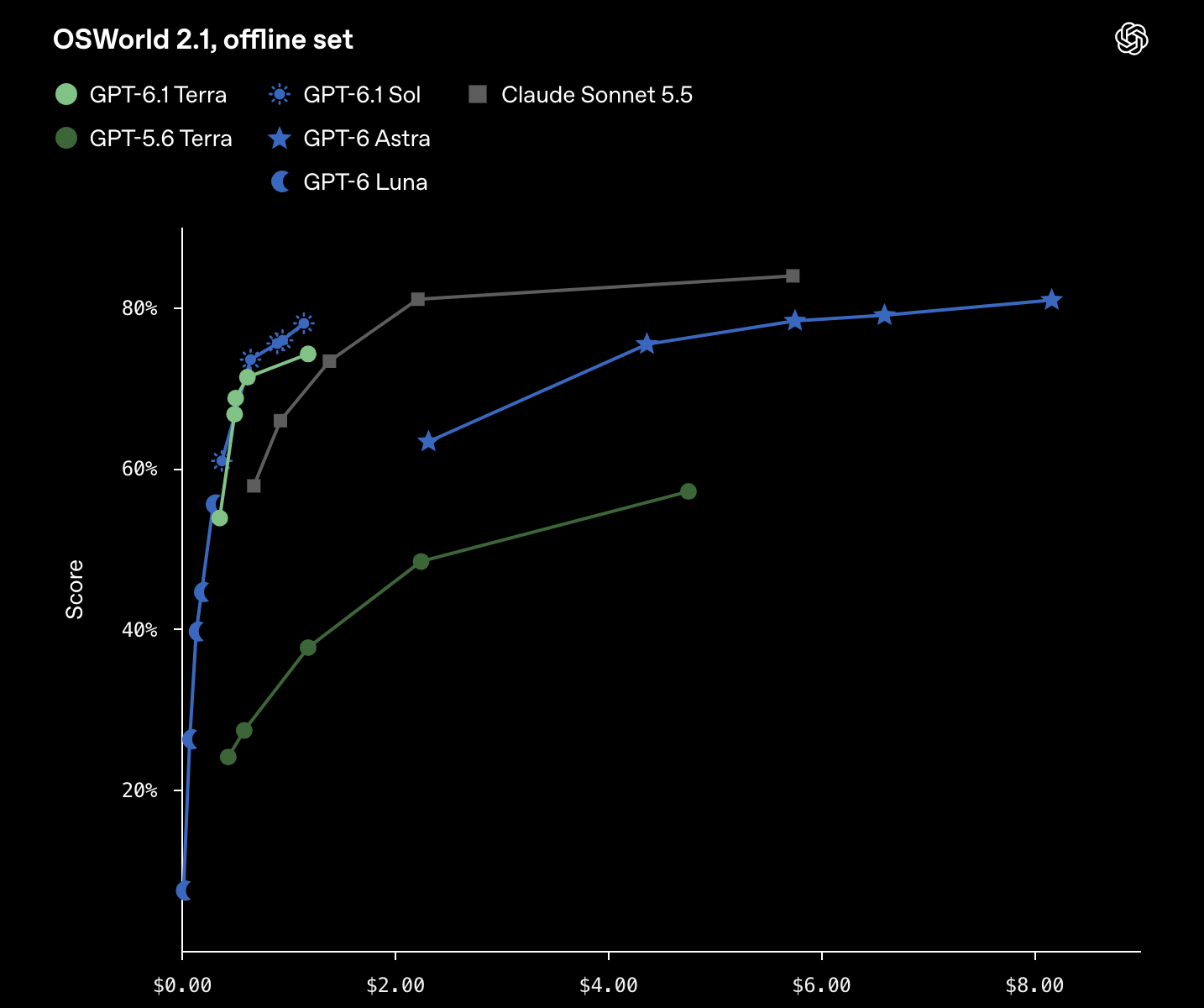
The OSWorld 2.1 benchmark, which tests multi-step operations in desktop applications, shows that Terra at medium reasoning intensity has already surpassed GPT-5.6 Terra’s best performance at maximum settings, while simultaneously reducing task costs.
Beyond computer operation, another clear improvement in GPT-6.1 Terra is factual accuracy.
OpenAI states that over the past year, the company has continuously invested resources to reduce model hallucinations and factual errors. In internal prompt tests designed to induce model errors, GPT-6.1 Terra showed a significant decrease in error rates.
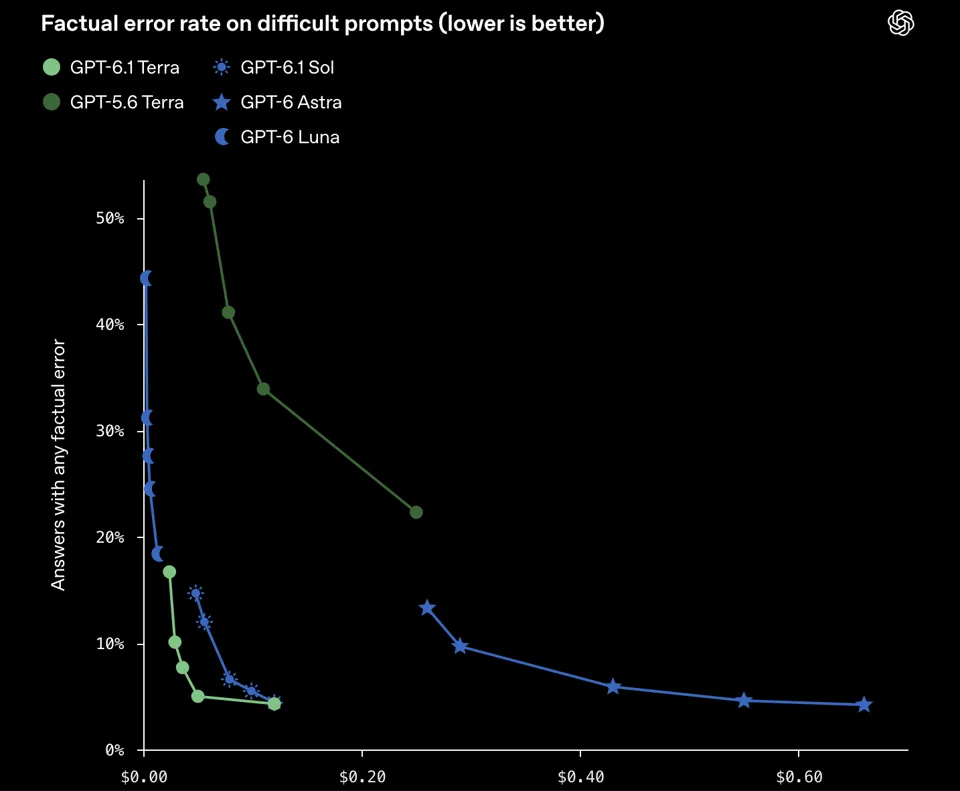
Specifically, at low reasoning intensity, the error rate dropped from 53.6% in the previous generation to 16.7%, a decrease of 36.9 percentage points, representing a relative reduction of approximately 69%.
When reasoning intensity was increased to the highest level, Terra’s error rate further dropped to 4.3%, a decrease of about 18 percentage points from the previous generation, approaching the levels of GPT-6 Astra and GPT-6.1 Sol.
These improvements are significant for actual office scenarios. Whether extracting contract clauses, processing business data, or executing operations based on technical documentation, frequent model errors can increase manual verification and rework costs, regardless of how low the invocation price might be.
Upgrades in coding capabilities are also quite evident.
In the Terminal-Bench 4.0 test, GPT-6.1 Terra completed 50.3% of tasks at maximum reasoning intensity, whereas GPT-5.6 Terra’s previously announced score was 21.5%. Terminal-Bench 4.0 primarily evaluates the ability of coding agents to solve real-world software engineering problems via the command line, such as fixing layout shifts occurring during web page loading.
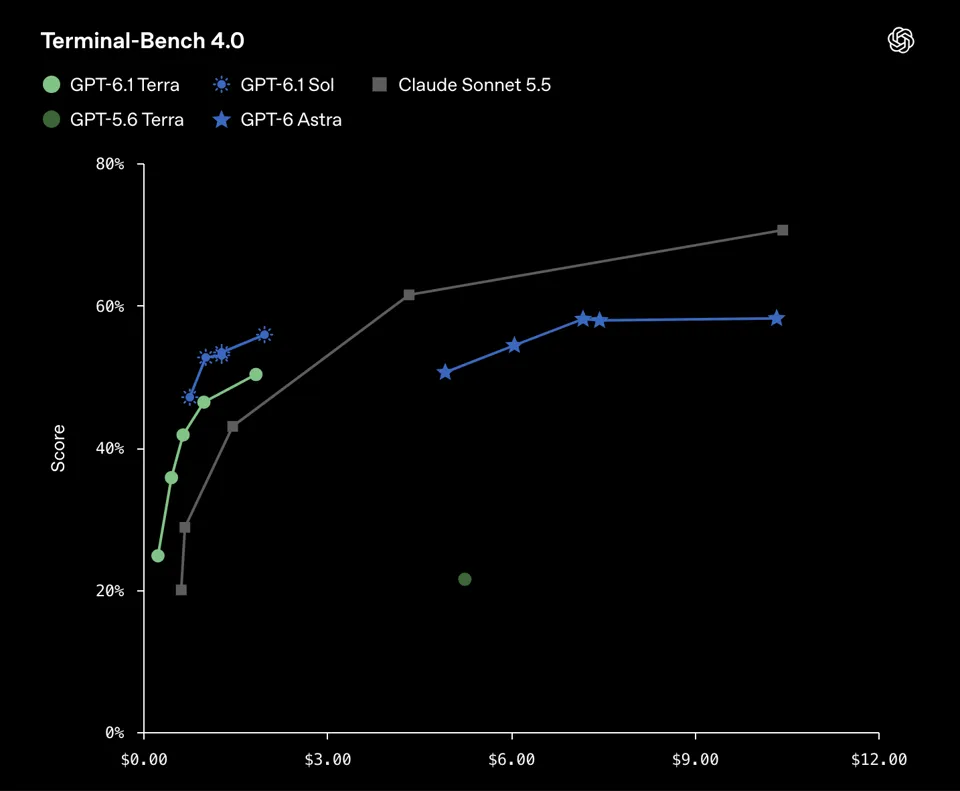
This means the new model’s task resolution rate improved by 28.8 percentage points, reaching approximately 2.34 times that of the previous generation.
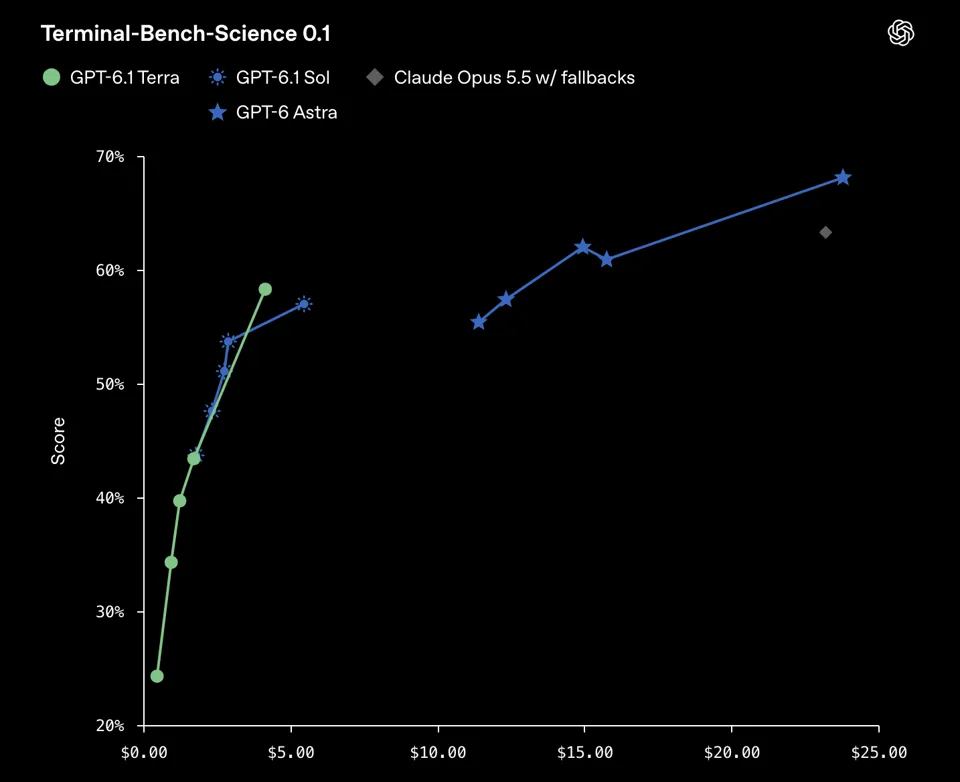
Furthermore, in the scientific programming benchmark Terminal-Bench-Science 0.1, Terra’s performance at maximum reasoning intensity exceeded that of GPT-6.1 Sol, narrowing the gap with Claude Opus 5.5 to within 5 percentage points at significantly lower cost.
However, OpenAI explicitly stated that for the most complex software engineering tasks, GPT-6.1 Sol and GPT-6 Astra remain the more suitable choices.
API Prices Drop 50%, Costing Only $1 Per Million Input Tokens
Pricing is a key highlight of this GPT-6.1 Terra update.
Based on OpenAI’s standard API pricing, the new model costs $1 per million input tokens and $5 per million output tokens. Cached inputs are priced at $0.05 per million tokens.
GPT-6.1 Terra’s pricing alone may not be immediately intuitive, so here is a comparison of the prices for several of OpenAI’s latest models:
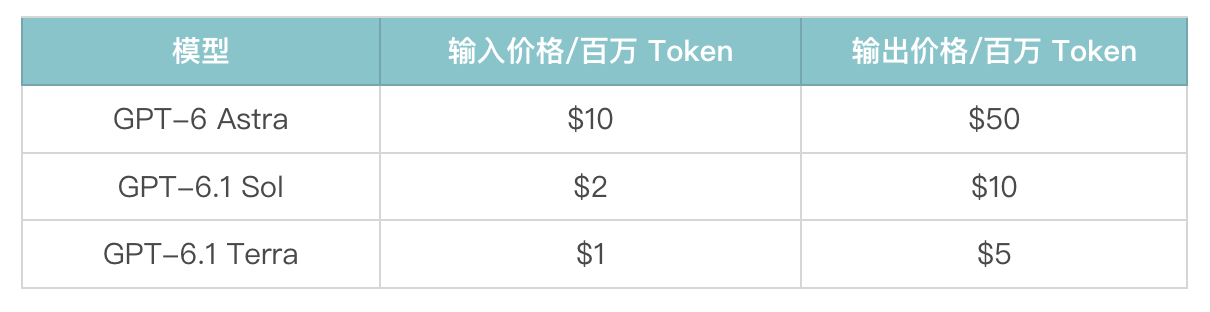
At this price point, GPT-6.1 Terra’s standard input and output token rates are 50% lower than those of GPT-6.1 Sol, and only one-tenth the cost of GPT-6 Astra.
However, token unit price does not equate to final task cost. The actual expense of executing a task depends on the number of inference tokens consumed by the model, the number of steps in the task, the frequency of tool calls, and the cost of retries following failures.
Therefore, beyond simple price reductions, what makes Terra particularly noteworthy is that it simultaneously achieves improved capabilities, better token usage efficiency, and faster task execution speeds in certain benchmarks.
In terms of product availability, OpenAI announced that GPT-6.1 Terra is now accessible to Plus, Pro, Enterprise, and Edu users via ChatGPT Work and Codex. Developers can also access it through the API using gpt-6.1-terra.
OpenAI states that the same usage quota allows GPT-6.1 Terra to cover significantly more tasks than GPT-5.6 Terra, and notably more than either GPT-6.1 Sol or GPT-6 Astra.
According to official technical documentation, GPT-6.1 Terra supports a context window of approximately 1.05 million tokens, with a maximum output length of 128,000 tokens, and accepts text and image inputs. It is worth noting, however, that its API does not natively support video input or output; therefore, video-related workflows primarily rely on integration with external tools and applications.
Too Many Models, Leading to Developer Decision Paralysis
Following the release of GPT-6.1 Terra, discussions have emerged across platforms like X and Reddit.
Unlike previous new model launches, where the focus was largely on whether performance would dominate leaderboards, developers’ attention this time has shifted to three key questions: Is the price genuinely cheaper? Is the speed sufficient? And is the new model worth replacing existing workflows?
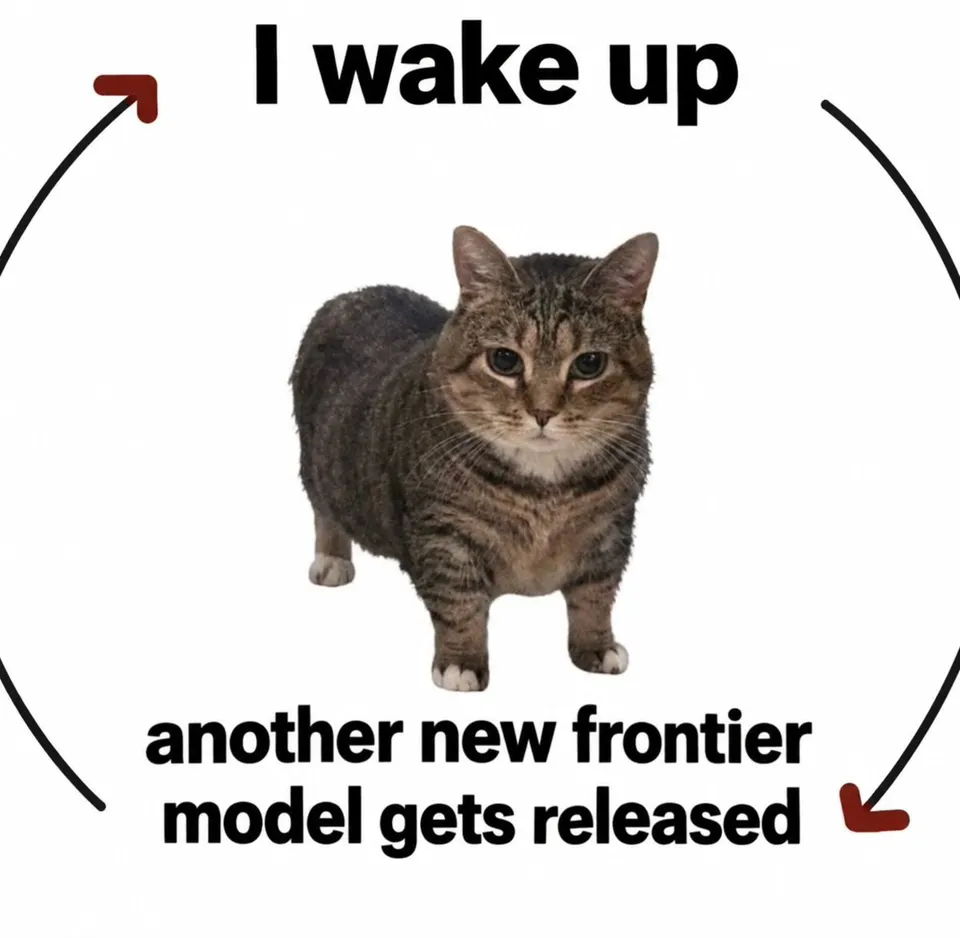
Interestingly, the community exhibits two contrasting sentiments: some users are excited about improvements in performance and cost, while others feel numb due to the increasingly dense pace of new model releases, even joking about OpenAI’s naming conventions.
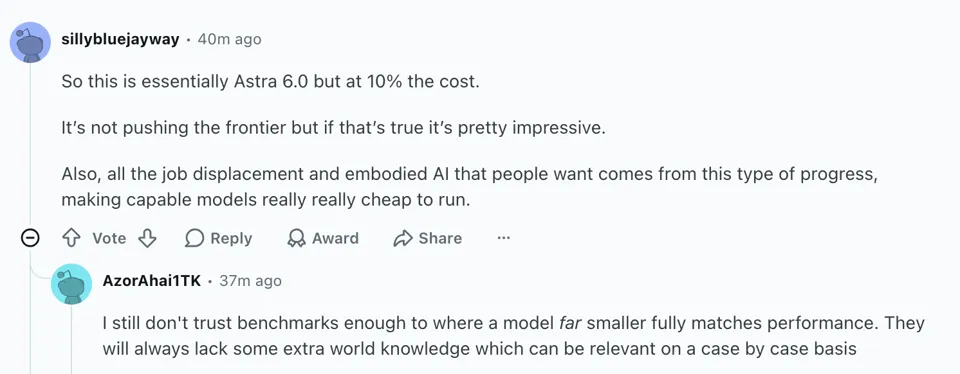
On Reddit, a user named sillybluejayway argued that the new model actually approaches the capability level of GPT-6.0 Astra but operates at only one-tenth of the cost. In their view, while Terra may not push the upper limits of frontier model capabilities further, delivering near-flagship performance from the previous generation at such a low cost represents significant progress.
This user raised an even more compelling point: What truly drives widespread AI adoption may not just be stronger models constantly breaking performance records, but rather making already capable models sufficiently affordable.
They believe that both AI-driven job displacement and advancements in embodied intelligence are closely linked to these cost reductions.
However, some users have questioned this assessment.
User AzorAhai1TK stated that they still do not fully trust benchmarks, particularly the idea that test scores alone can prove a much smaller model has comprehensively caught up with larger ones. They pointed out that smaller models might lack certain additional world knowledge, which could be critical for specific tasks.
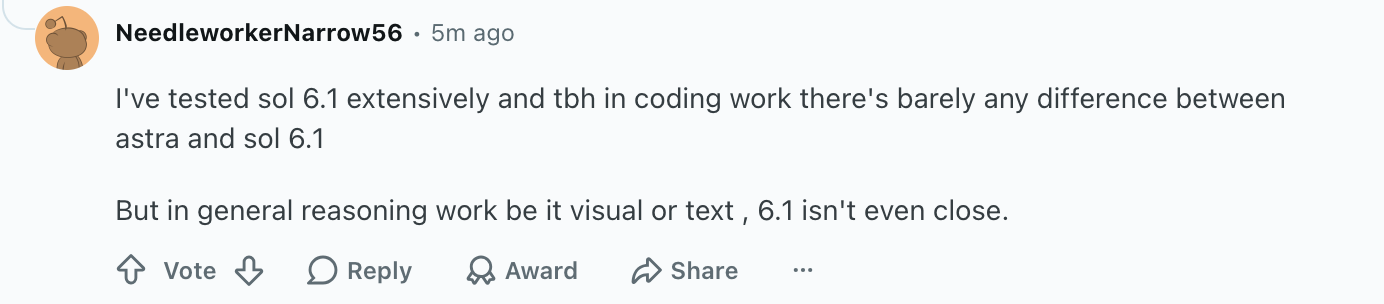
User NeedleworkerNarrow56 mentioned conducting extensive tests on GPT-6.1 Sol and finding that its gap with GPT-6 Astra in programming tasks has narrowed significantly. However, noticeable differences remain in general reasoning tasks involving vision and text.
“Agents operating in the real world don’t always need top-tier frontier capabilities, but they do require a good balance between cost and intelligence,” commented another user, Material-Watercress1.
This highlights Terra’s product positioning: For agent-based applications that invoke models frequently, whether every request requires the strongest model is itself a question worth reconsidering.
But as OpenAI continues to launch different series and versions of models, developers face a new challenge: Which one should they choose?
User NotAFishEnt posed a representative question: With options spanning GPT-5.6, GPT-6.0, and GPT-6.1, along with series like Luna, Sol, and Terra, plus multiple reasoning intensity levels ranging from Light to Ultra, how exactly can one find the optimal combination for their work?
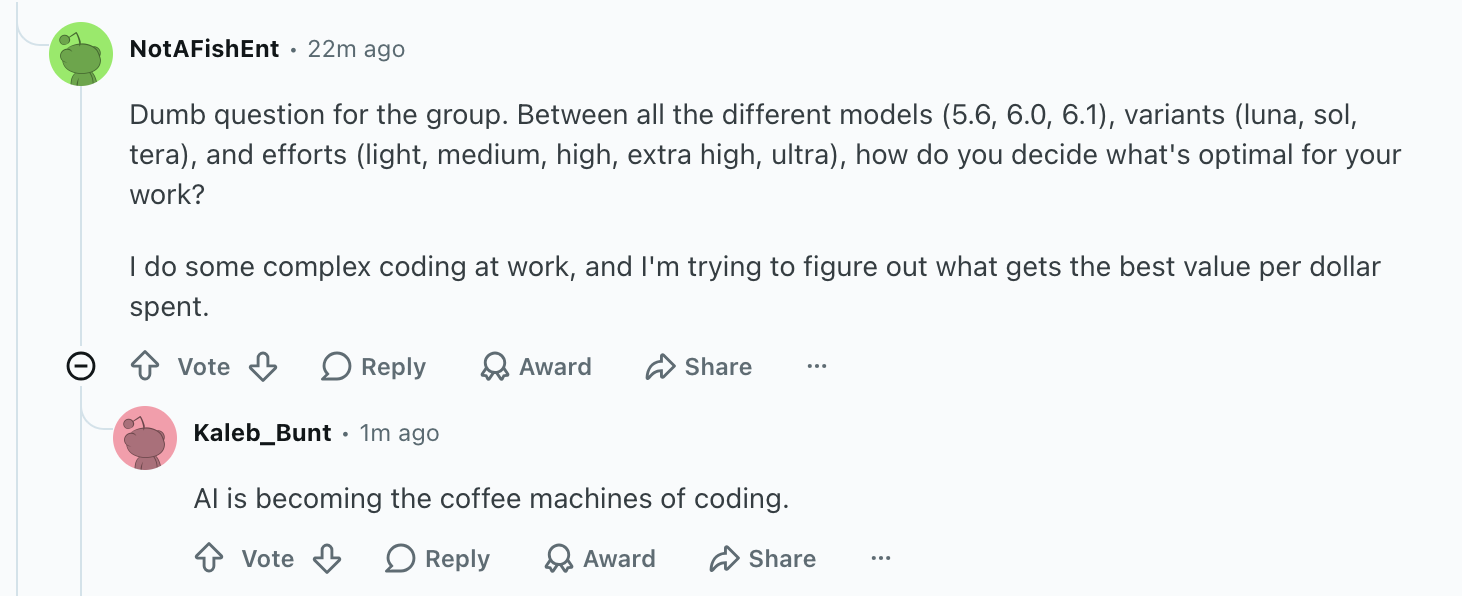
They noted that their daily work involves complex programming tasks, and they really want to figure out how to maximize the return on every dollar spent.
This issue resonated with other developers. Some suggested relying on trial and error based on actual usage experience—for example, starting with Medium reasoning intensity and gradually increasing the tier if the task cannot be completed.
Others recommended referring to Artificial Analysis’s performance-cost Pareto frontier to filter for models that offer competitive value between price and capability.
As the number of model versions grows, developers seem to have taken on yet another task: not only completing development work but also continuously evaluating which AI model offers the best value-for-money—a headache-inducing prospect indeed!
Interestingly, on the very same day GPT-6.1 Terra was released, Anthropic—OpenAI’s long-standing rival—dropped a major announcement.
On October 26 (local time), Anthropic officially filed its S-1 registration statement with the U.S. Securities and Exchange Commission (SEC), initiating the public filing process for an IPO. According to the disclosed information, Anthropic plans to list on Nasdaq under the ticker symbol “ANT,” though the specific offering size and price range have not yet been determined.
Almost simultaneously, OpenAI launched a new model. While Anthropic took a significant step toward public capital markets, OpenAI continued to accelerate its product iteration. Although their actions differed, both companies are addressing the same fundamental question: How can large model capabilities be translated into sustainable commercial value?
In reality, the competition between OpenAI and Anthropic has long extended beyond model leaderboards. Particularly in the realms of AI coding and enterprise-grade agents, both companies must not only compete for developers but also demonstrate that their models can accomplish more real-world work at lower costs.
This explains why OpenAI’s recent models increasingly emphasize cost efficiency. For enterprises deploying agents at scale, while model capability remains important, metrics such as the cost per task, execution duration, and reliability are becoming equally critical selection criteria.
More subtly, as Anthropic begins to showcase its commercialization capabilities and financial health to the public market, OpenAI is demonstrating continuous improvements in model capability and operational efficiency through frequent product updates. It is evident that the competition among large models is evolving from technical leaderboards into a more complex commercial contest.